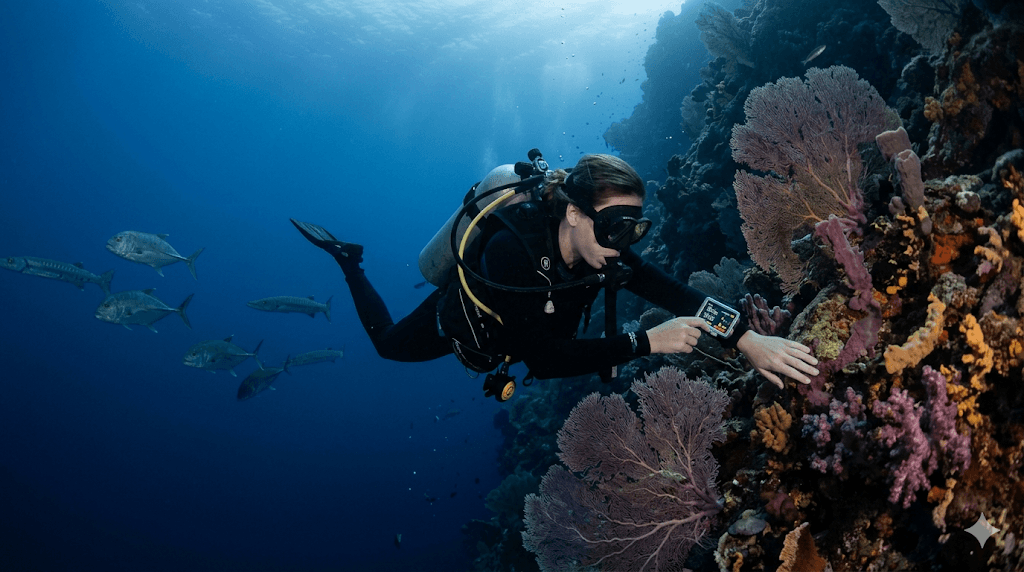
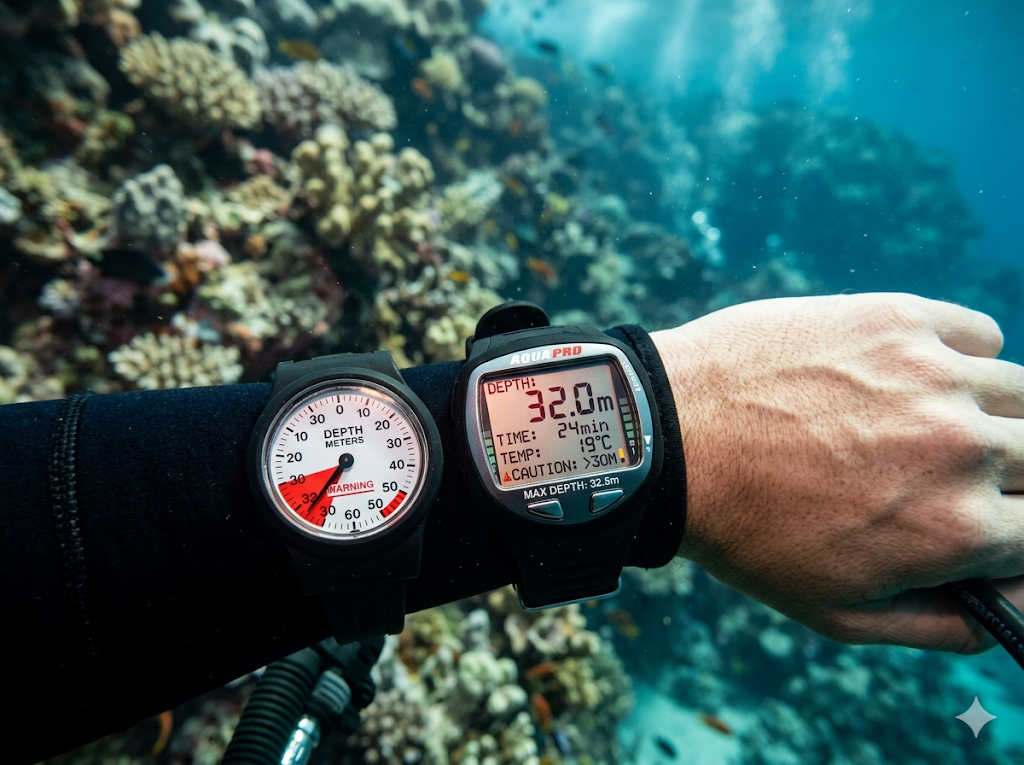
The divemaster pointed at the wall dropping past 35 metres and said "advanced divers follow me." Four of the six divers in the group held Open Water cards capped at 18 metres. None of them checked each other's certifications. At 32 metres one diver's computer alarmed, he panicked, and the group spent the safety stop separated. The shop logged it as a "successful" deep dive. The liability sat with every diver who went deeper than their training — not the guide who led them there.
Your certification card is not a souvenir. It is a trained depth and skill contract with a number attached. This guide maps what Open Water, Advanced Open Water, and Deep Specialty actually allow, how partial pressure of oxygen (PO₂) sets a hard ceiling regardless of your card, where narcosis becomes a factor without repeating the full narcosis guide, and who bears responsibility when limits are ignored.
1. Certification Depth Limits — The Table
Recreational agency standards converge on similar numbers. These are training limits — not physics limits. Exceeding them without proper training, gas planning, and redundancy is how fun dives become chamber cases.
Recreational Certification Depth Limits (typical agency standards)
Always confirm limits with your certifying agency and local regulations. Instructor credentials may impose stricter limits than your card.
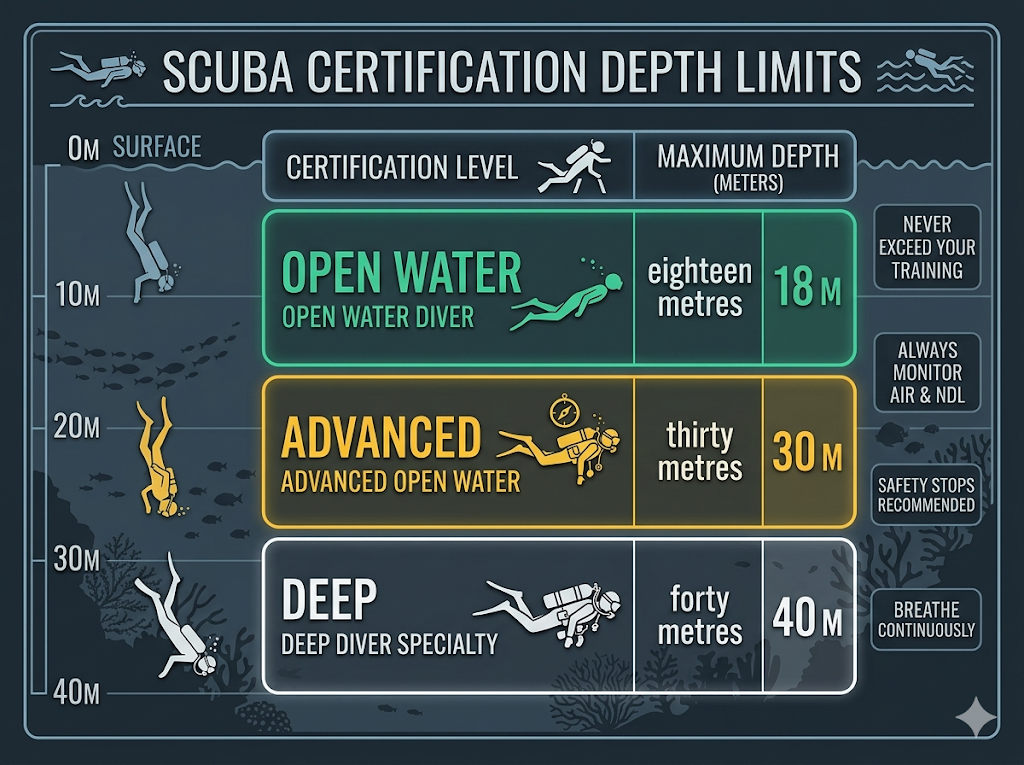
Junior diver restrictions are shallower (typically 12 m OW, 21 m AOW until age 15). Dive computers may also enforce user-set depth alarms independent of your card — set them to your actual certification, not your ambition.
2. PO₂: The Hard Ceiling Your Card Ignores
Depth limits on your card assume air as the breathing gas. A separate hard limit comes from oxygen toxicity: the partial pressure of oxygen (PO₂) in what you breathe. Recreational diving targets a maximum PO₂ of 1.4 bar during the dive (some agencies use 1.6 bar for decompression, but recreational bottom gas stays at 1.4).
On air (21% O₂):
- At 56 m, PO₂ = 1.4 bar — the absolute recreational ceiling on air by oxygen toxicity math
- At 40 m, PO₂ ≈ 1.05 bar — within standard limits but narcosis and NDL compression are the real constraints
This is why nitrox shifts your NDL but not your oxygen toxicity depth on the same mix — and why diving air to 40 m is a different risk profile than diving EAN32 to 40 m. (See the Nitrox guide for MOD calculations.)
3. Narcosis: The Depth Factor (Brief)
Below roughly 30 m on air, nitrogen partial pressure impairs judgement and motor control — nitrogen narcosis. This is not a separate certification limit; it is a physiological one that can disable an Advanced Open Water diver at their maximum authorised depth.
You do not need to master the full narcosis syllabus here. You need three operational facts:
- Onset is insidious — the impaired diver is often the last to know (see Nitrogen Narcosis guide for buddy signs and the ascent cure).
- 30 m is the inflection point — AOW depth and narcosis threshold overlap by design; that is why Deep Specialty training exists.
- Cold, CO₂, fatigue, and alcohol lower the effective threshold — a "routine" 28 m dive after a seasick morning can narc you at 24 m.
Do not stack depth limits with impaired physiology and call it within your certification.
4. Responsibility: Diver, Guide, and Operator
The Diver — Primary Responsibility
You are responsible for knowing your certification limit, monitoring your depth gauge and computer, and aborting the dive if the group goes deeper. "The guide told me to" is not a defence in an incident investigation. Verify buddy certifications before deep dives.
The Guide — Duty of Care
A dive professional who leads uncertified divers beyond their training limit breaches agency standards and local duty-of-care law. You should check certification cards at the surface before deep-site departures. If a shop routinely ignores this, leave.
The Operator — Systemic Risk
Shops that advertise "deep dives for everyone" or run deep sites on OW-heavy boats are externalising liability onto customers. Incident data links deep dives with uncertified divers to DCS, AGE from panic ascents, and separated groups.
5. Practical Depth Discipline
Before Every Deep Dive
✓ Pass
Confirm everyone's cert level; set computer depth alarm to your limit; agree max depth and turn pressure in the briefing; plan gas reserve (rule of thirds for deep dives)
✗ Fail
"We'll see how deep it goes"; no certification check; following a guide past your training because the wall looks exciting; no turn pressure discussed
6. The ScubaProof Filter: Depth Discipline in Reviews
Red Flags — Depth Violations
• Reviews: "took open water divers to 30+ metres" or "deep wall for everyone"
• No certification check mentioned in briefings; OW students on deep specialty sites
• Safety score below 3.5; Trust Score "Under Review"
• Recurring rapid-ascent or DCS mentions linked to deep profiles
Yellow Flags — Ask Before Booking
• Marketing emphasises depth ("40 m daily") without cert requirements stated
• Large groups on deep sites — narcosis management requires small ratios
• No nitrox available for repetitive deep days
• Vague answers about maximum depth policy for OW guests
Safety, Staff Conduct, Gear, Oxygen Readiness, and Trust Score on ScubaProof surface operators who treat depth limits as optional. Your card sets the number — the center you choose determines whether anyone enforces it.