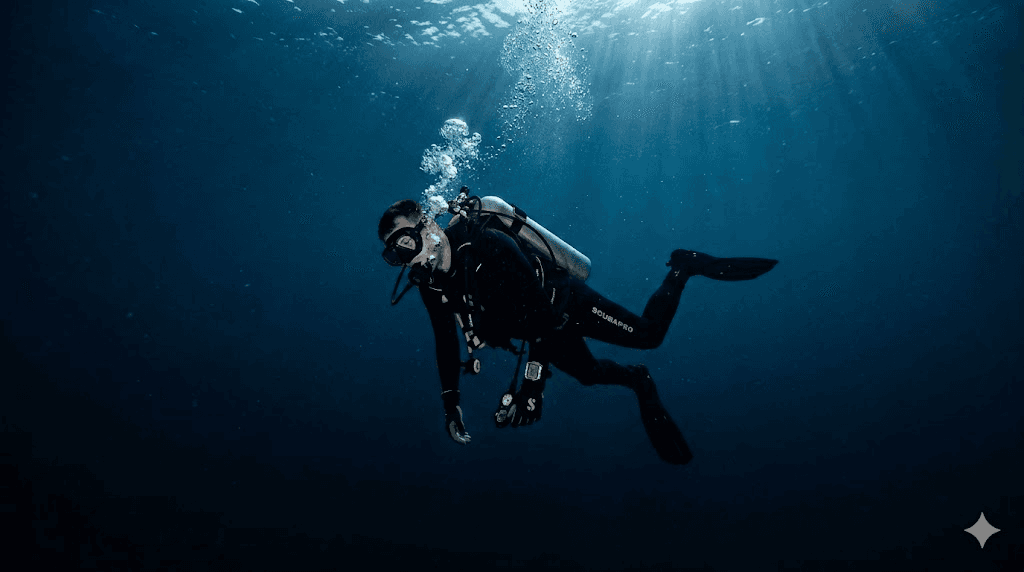
The experienced diver had logged over 200 dives. He knew the site, knew his equipment, and was diving with a trusted buddy. At 35 metres he became very still. His buddy turned to check on him — he was staring at a passing fish, eyes unfocused, a wide grin spreading across his face. When the buddy gave the ascend signal, he shook his head and pointed back at the fish. He had no memory of the next six minutes. His pressure gauge, checked on the surface, read 20 bar.
Nitrogen narcosis does not announce itself. It replaces your judgement before you know it is doing so — and the first faculty it takes is the one you would use to notice.
The Physics: It's Pressure, Not Depth
Narcosis is not caused by depth. It is caused by the partial pressure of the narcotic gases you are breathing, and depth is simply what drives that pressure up. Get the physics right and everything else falls into place.
Two gas laws govern the problem:
- Dalton's Law — in a gas mixture, each component exerts a partial pressure proportional to its fraction. Air is roughly 79% nitrogen, 21% oxygen. At the surface (1 ata) the partial pressure of nitrogen (PN₂) is about 0.79 bar.
- Pressure with depth — every 10 metres of seawater adds 1 bar. So absolute pressure = (depth ÷ 10) + 1, expressed in atmospheres absolute (ata).
Multiply the two and you get the partial pressure you are actually breathing. At 30 m the pressure is 4 ata, so PN₂ = 0.79 × 4 ≈ 3.16 bar — four times the surface dose, delivered to your bloodstream and central nervous system on every breath.
Partial pressure of nitrogen vs depth (air)
This is why the recreational depth limits exist. The PADI and SSI Open Water limit is 18 m; Advanced Open Water and the Deep Diver specialty extend recreational diving to a hard ceiling of 40 m. CMAS and BSAC set comparable boundaries. Below 40 m you are in technical territory, and narcosis is the single biggest reason that line is drawn where it is.
Why this gas in particular
The leading explanation is the Meyer–Overton correlation: a gas's narcotic potency tracks its lipid solubility. Nitrogen, like alcohol and volatile anaesthetics, dissolves readily into the fatty myelin sheaths that insulate your nerve fibres, where it interferes with the electrochemical signalling that keeps your brain firing cleanly. The more soluble the gas, the stronger the effect at a given partial pressure.
Crucially, nitrogen is not the only narcotic gas in your cylinder. Oxygen is narcotic too — roughly as narcotic as nitrogen at equivalent partial pressures — which is why technical divers calculate Equivalent Narcotic Depth (END) using the combined PN₂ + PO₂, not nitrogen alone. And carbon dioxide, which you produce yourself, is far more narcotic than either. That last fact is the one most divers never hear, and it kills the idea that narcosis is something that simply "happens to you" at a fixed depth.
What It Actually Feels Like
The sensation is remarkably close to alcohol intoxication, which is why it earned the name "rapture of the deep" (Jacques Cousteau's term, l'ivresse des grandes profondeurs). Warmth, mild euphoria, a sense that everything is slightly funny — and, critically, impaired insight into how impaired you are.
That is the trap. A narced diver almost never thinks "I should ascend." They think "Everything is fine. This is great." The narcosis edits out the very alarm that would save them. A useful field analogy is "Martini's Law": every 10 m below about 20 m feels roughly like one dry martini on an empty stomach. It is folklore, not physiology — but it captures the progression honestly.
Unlike alcohol, the onset tracks pressure, not time. Drop from 30 to 38 m and symptoms can sharpen within a single breath cycle. Ascend back to 20 m and they clear in under two minutes, leaving no hangover and no residual deficit. That clean disappearance is both the good news and the danger: divers routinely underestimate how badly impaired they were, because the evidence vanishes the moment they come shallow.
Nitrogen narcosis — symptoms by depth (air)
Depth bands are rules of thumb, not guarantees. The actual onset varies between individuals, and — more importantly — within the same individual from one dive to the next. Which brings us to the part that gets people hurt.
Risk Factors: Why Today Is Not Yesterday
Narcosis affects everyone. There is no training, fitness level, or amount of experience that makes you immune — only experience that helps you recognise it and respond correctly. The dangerous myth is that you "build tolerance." You do not. What experienced divers build is the ability to keep functioning while impaired, which is useful but is not the same as not being impaired.
Several factors reliably worsen impairment at any given depth:
- CO₂ retention — the single most underappreciated multiplier. Skip-breathing to stretch your gas, an undersized or poorly maintained regulator that increases work of breathing, heavy finning against current, or simple overexertion all let carbon dioxide build up. CO₂ is strongly narcotic in its own right and potentiates nitrogen. The combination is multiplicative, not additive.
- Fatigue and sleep deprivation — a diver who slept badly may feel at 30 m what a rested diver feels at 40 m.
- Cold water — peripheral vasoconstriction and the cognitive load of being cold both worsen the effect. A 26 °C tropical dive and a 12 °C temperate dive to the same depth are physiologically different events.
- Alcohol and hangover — residual alcohol, and the dehydration that follows it, stack directly onto nitrogen's effect. Two drinks at midnight before a morning dive to 30 m is not a clean slate.
- Anxiety and task loading — a stressed, mentally overloaded, or rushed diver hits effective narcosis earlier. This is why "leading from the front" — the guide dropping fast while a nervous diver scrambles to keep up, breathing hard — is a textbook setup for an incident.
- Rapid descent — going down fast gives no time to acclimatise and tends to spike CO₂. A slow, controlled descent is measurably safer.
- Certain medications — sedatives, antihistamines, and anything that crosses the blood–brain barrier can compound impairment. Clear dive-relevant medications with a dive physician.
The operational takeaway: narcosis is not predictable between dives. A depth that felt crystal clear yesterday can fog you today if any of these has changed. Plan for the bad day, not the good one.
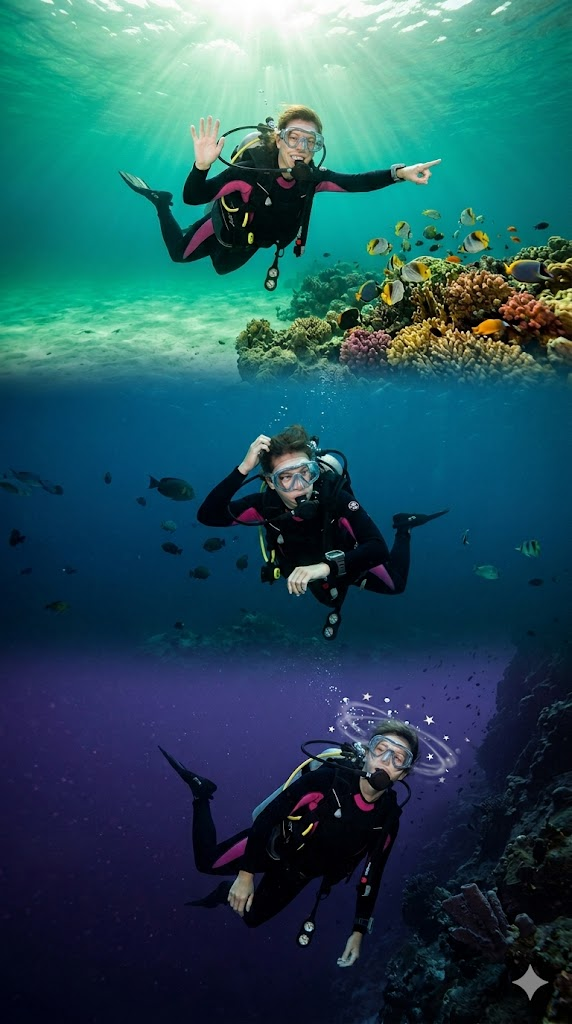
Narcosis vs DCS vs Barotrauma — Don't Confuse Them
These three are routinely muddled by casual divers, and the distinction matters because the responses differ.
Three depth-related problems — not the same thing
Narcosis is a reversible, real-time impairment caused by gas dissolved in your tissues at pressure; ascend and it is gone. Decompression sickness is the opposite phase of the same gas: nitrogen that came out of solution as bubbles when you ascended too fast or stayed too long — it does not improve on ascent and requires emergency oxygen and a recompression chamber. Barotrauma is mechanical pressure damage to an air-filled space (ears, sinuses, lungs) and is an injury, not a gas effect. Confusing narcosis with DCS at depth wastes the one move that fixes narcosis instantly.
How to Recognise It in Your Buddy
This is where lives are saved. The narced diver cannot reliably self-diagnose — the impairment erases the insight that would trigger self-rescue. Your buddy is your only external check, which is the whole point of the buddy system at depth.
Buddy narcosis warning signs
- ⚠Ignores, misreads, or delays response to hand signals
- ⚠Stares blankly, does not maintain eye contact
- ⚠Fixates on one object and stops scanning the environment
- ⚠Stops finning and sinks without reaction
- ⚠Abnormal laughter or playful behaviour underwater
- ⚠Repetitive, clumsy, or purposeless task fixation
- ⚠Attempts to remove regulator or mask
- ⚠Does not respond to a tap on the shoulder
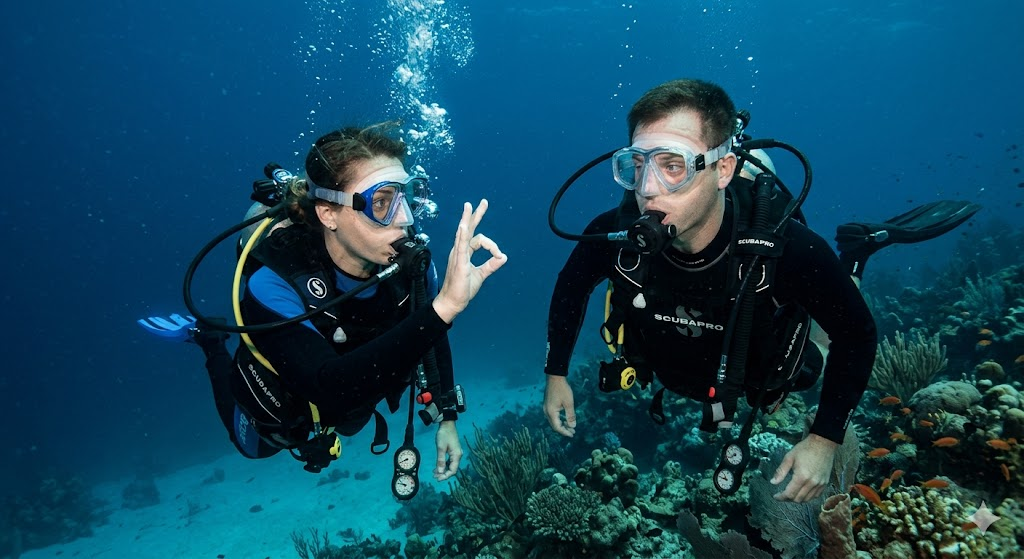
The two-eye check. Agree on a narcosis check signal before every deep dive. A common, fast protocol: give the standard "OK" sign and expect the correct "OK" back, paired with a simple cognitive task — for example, ask your buddy to show their gas remaining on fingers. A lucid diver answers instantly and correctly. A narced diver hesitates, gives a wrong number, or just stares. If the answer is wrong, the dive is over. Don't debate it underwater.
The Cure: Ascend a Little, Now
There is exactly one treatment for nitrogen narcosis, and it has a 100% success rate when applied promptly: go shallower.
You do not need to surface. In most cases, rising 5 to 10 metres drops the partial pressure enough to restore full cognitive function within 60 to 90 seconds. Once both divers are clear and lucid, assess together whether to continue the dive at the shallower depth or call it. Continuing deeper after a narcosis episode is almost never the right call.
What you must never do is bolt for the surface. A narced, panicking diver who ascends too fast risks two serious injuries at once: pulmonary barotrauma (lung overexpansion if they hold their breath) and decompression sickness (if they blow off a required stop). The ascent must be controlled — hold your buddy's arm or BCD if needed, keep the rate at or below 9–10 m per minute (the standard recreational limit), and make the 5 m safety stop if your gas and the situation allow.
Narcosis response — step by step
If the affected diver resists ascent — which happens, because narcosis manufactures confidence — the buddy leads them up firmly. This is not negotiable. A diver who has lost the ability to judge their own impairment has also lost the standing to veto the ascent decision.
Prevention and Depth Planning
Deep-dive narcosis checklist
- ✓Progress depth gradually: 25 m, then 30 m, then 35 m — never jump straight to 40 m
- ✓Descend slowly and feet-first on a reference line; equalise early and often
- ✓Breathe slow and deep — never skip-breathe; manage exertion to control CO₂
- ✓Brief both the narcosis check signal and the abort signal before splashing
- ✓Rested, hydrated, alcohol-free, warm — fix the multipliers before the dive
- ✓Never dive deep solo — there is no self-rescue from severe narcosis
A note on gear and trim. Narcosis degrades fine motor control and task-switching, so a deep dive is the worst place to be fumbling with kit. Stable, horizontal trim and reliable buoyancy mean less work, less CO₂, and less to think about. Run a regulator that breathes easily at depth — work of breathing rises with gas density, and a hard-breathing second stage drives CO₂ retention exactly when you can least afford it. Stow gauges and a backup mask where you can find them by feel.
Nitrox does not help. Enriched air (EANx) reduces nitrogen loading and extends no-decompression time, but it adds oxygen — itself narcotic — so it does not reduce narcosis. It also lowers your maximum operating depth because of oxygen toxicity (the recreational PO₂ ceiling is 1.4 bar), which is a separate hazard. Diving nitrox deep does not buy you a clearer head.
For dives below 40 m, the real fix is helium. Replacing part of the nitrogen (and oxygen) with helium produces trimix, and because helium has very low lipid solubility it is essentially non-narcotic at these depths. Technical divers calculate an Equivalent Narcotic Depth and blend gas to keep their effective narcosis at a manageable level — many target an END at or below 30 m. Trimix requires dedicated training through technical agencies (TDI, GUE, IANTD, PADI TecRec, SSI XR) and the appropriate equipment configuration. It is standard practice in technical diving for exactly this reason.
Choose a dive centre that respects the line. An operator that takes Open Water divers to 35 m+ "to see something special" on the first dive of a holiday is not offering an adventure — it is gambling with your nervous system. On ScubaProof, the Staff Conduct and Safety metrics capture whether briefings cover narcosis and whether guides enforce certified depth limits; Gear reflects regulator condition and work-of-breathing risk; and a centre that cuts corners on these takes a hit to its overall Trust Score.
ScubaProof red flags
- 🚩Takes Open Water divers past their 18 m limit, or anyone past 30 m+ on the first dive of a trip
- 🚩No mention of narcosis in the pre-dive briefing for any dive past 25 m
- 🚩Divemaster leads from the front and never turns to check the group
- 🚩No agreed narcosis check or abort signal discussed before the dive
- 🚩Markets "air dives" to 50 m+ as recreational, with no trimix or tech training mentioned
- 🚩Rushed, high-speed descents with no reference line and no equalisation check