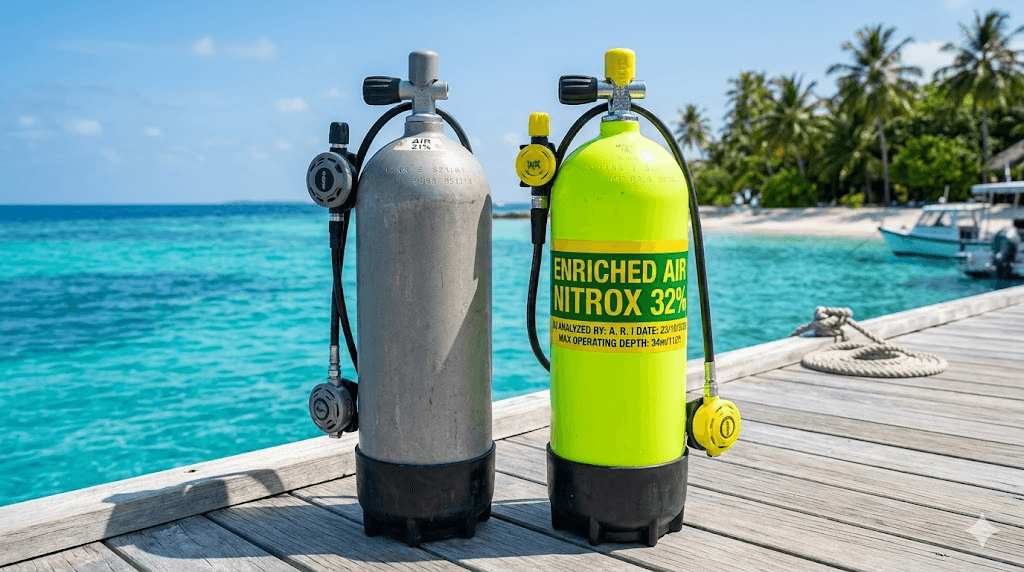
A dive center in Ko Tao handed a diver a yellow-and-green-banded cylinder of enriched air. Nobody asked for his nitrox certification card. Nobody watched him analyse the gas. Nobody confirmed what his dive computer was set to. He descended with the group to 36 metres — three metres past the Maximum Operating Depth for EAN32. At that depth the partial pressure of oxygen in his breathing mix climbed above the convulsion threshold. He lost consciousness, his regulator fell from his mouth, and he did not surface.
This is not a hypothetical. Central-nervous-system oxygen toxicity events occur every year in tropical dive destinations, and the pattern is almost always identical: an enriched-air cylinder issued to a diver who lacks training, or whose computer is configured wrong, or who never analysed the gas. The fix is certification, analysis, and configuration. None of the three takes more than a few minutes. None of them is optional.
This guide covers what nitrox actually does, the gas physics behind both the benefit and the danger, and the exact protocol — analyse, label, configure, plan — that keeps you out of the statistics.
What Is Nitrox?
Atmospheric air — and the compressed air in a standard scuba cylinder — is roughly 21% oxygen and 79% nitrogen (with trace argon and CO₂). Enriched Air Nitrox (EANx) uses the same gas, but raises the oxygen fraction and correspondingly lowers the nitrogen fraction. The two mixes you will meet at almost every recreational dive center are:
- EAN32 — 32% oxygen, 68% nitrogen (the recreational default)
- EAN36 — 36% oxygen, 64% nitrogen
The nitrogen reduction is the entire point. Less nitrogen in the mix means your tissues ongas nitrogen more slowly at any given depth, which directly extends your no-decompression limits (NDL) and reduces decompression stress on repetitive, multi-dive days. The extra oxygen itself is not stored as a stress: oxygen is metabolised, not accumulated the way inert nitrogen is. The oxygen is along for the ride — and, as you'll see, it is the part that can kill you.
One terminology point that separates pros from beginners: this is a cylinder of nitrox, never an "oxygen tank." Pure oxygen at recreational depth would be lethal within seconds. EAN32 is still mostly nitrogen.
Nitrox certification is a short specialty course, separate from Open Water — typically a half-day of online theory plus a knowledge review, and increasingly no mandatory training dives (PADI's Enriched Air Diver can be completed without dives; some agencies still require two). It is offered by PADI (Enriched Air Diver), SSI (Enriched Air Nitrox), SDI, NAUI, RAID, BSAC and CMAS. Most centers in Ko Tao and Bali run it for $80–150.
Air vs. EAN32 vs. EAN36 — key differences
MOD (1.4) is the working limit for the active part of the dive; MOD (1.6) is the absolute contingency ceiling, used only at rest (e.g. a deco stop on a deco mix). NDL figures are illustrative for a single no-stop dive and vary by computer algorithm and conservatism setting.
The Gas Physics: Why It Works and Why It Bites
Three classic gas laws govern everything below the surface. You do not need the maths to dive, but understanding them turns nitrox from a black box into a tool you control.
- Dalton's Law — the total pressure of a gas mixture equals the sum of the partial pressures of its components. Each gas exerts pressure in proportion to its fraction. This is the law behind partial pressure of oxygen (ppO₂) and the toxicity limit.
- Henry's Law — the amount of a gas that dissolves into a liquid (your tissues and blood) is proportional to the partial pressure of that gas. Higher partial pressure of nitrogen drives faster ongassing. Lower the nitrogen fraction, and you ongas slower — that is your extended NDL.
- Boyle's Law — volume is inversely proportional to absolute pressure. It governs equalisation, buoyancy, and lung overexpansion, and applies to nitrox exactly as it does to air. Nitrox changes nothing about your ascent discipline.
Pressure underwater is measured in bar (atmospheres absolute). At the surface you are under 1 bar. Every 10 metres of seawater adds another bar, so absolute pressure is:
P(abs) = 1 + (depth in metres ÷ 10)
At 30 m you are at 4 bar absolute. By Dalton's Law, the partial pressure of any gas in your mix at that depth is its fraction multiplied by absolute pressure. That single multiplication is the key to both nitrox calculations you must be able to do.
The Real Benefits
Longer no-decompression limits. At 18 metres, air gives roughly 56 minutes of no-stop time on a typical recreational algorithm; EAN32 pushes that beyond 90 minutes — often past the point where your gas supply runs out first, which is exactly what you want. At 25 metres, EAN32 delivers around 50% more bottom time than air. For divers doing three or four dives a day — the norm in Ko Tao and Bali — that compounds across the whole day.
Reduced post-dive fatigue. This is the benefit most divers notice first and report most consistently. After four air dives, many feel genuinely wrung out; the same profile on EAN32 leaves them noticeably fresher. The mechanism is debated and not fully proven — controlled studies are mixed — but the leading hypothesis is reduced inert-gas (nitrogen) loading and reduced silent micro-bubble formation. Treat it as a real-world observation, not a guarantee.
A built-in nitrogen safety margin. Dive EAN32 but plan against the air NDL tables (or run your computer in air mode), and you bank a substantial conservatism buffer on every dive — less nitrogen absorbed than your plan assumes. Many cautious divers and instructors use exactly this approach for repetitive diving. (Note: you must still keep the dive shallower than your nitrox MOD — the oxygen limit does not relax.)
What nitrox does NOT do
- ✕It does not let you dive deeper — your MOD gets shallower, not deeper
- ✕It does not reduce narcosis — you are still breathing nitrogen, and oxygen is narcotic too
- ✕It does not make you immune to decompression sickness — it lowers the odds, nothing more
- ✕It does not save gas — you breathe the same volume per minute regardless of mix
The Danger: CNS Oxygen Toxicity
This section is the reason this guide exists. Oxygen under pressure is toxic. The acute hazard for nitrox divers is central-nervous-system (CNS) oxygen toxicity — a neurological cascade that can culminate in a grand mal seizure. Underwater, a seizure means the regulator leaves the mouth, the airway is unprotected, and the diver drowns. There is no treatment at depth; the only response is your buddy bringing you to the surface.
The threshold is defined by partial pressure of oxygen (ppO₂), straight from Dalton's Law:
ppO₂ = (fraction of O₂) × (absolute pressure in bar)
The accepted recreational working limit is 1.4 bar ppO₂ during the active dive, with an absolute contingency ceiling of 1.6 bar reserved for resting situations (such as a decompression stop on a rich mix). Rearrange the formula and you get the Maximum Operating Depth (MOD) — the deepest you may take a given mix:
MOD (m) = ((ppO₂ limit ÷ O₂ fraction) − 1) × 10
For EAN32 at the 1.4 limit: (1.4 ÷ 0.32 − 1) × 10 = 33.75 m, which rounds down to a practical MOD of 33 m. At 36 m the ppO₂ is 0.32 × 4.6 = 1.47 bar — over the working limit. That is precisely how a diver three metres past MOD ends up convulsing.
The frightening reality of CNS toxicity is that a seizure can strike with no prior warning. The classic VENTID-C mnemonic — Visual disturbances, Ears (ringing/tinnitus), Nausea, Twitching (especially lips and face), Irritability, Dizziness, Convulsions — lists symptoms that may precede an event, but frequently none appear before the convulsion itself. You cannot rely on feeling it coming. You stay safe by never reaching the ppO₂ in the first place.
Several factors lower your personal threshold below the textbook number — meaning a "safe" ppO₂ on paper can still be dangerous:
- CO₂ retention from hard work, skip-breathing, or a poorly tuned regulator — the single biggest aggravator
- Heavy exertion (fighting current, finning hard)
- Cold and, conversely, being too warm
- Immersion itself, dehydration, and individual physiology that varies day to day
Oxygen toxicity — critical facts
- ⚡Convulsions can occur with absolutely no warning signs — VENTID-C symptoms are unreliable
- ⚡EAN32 MOD is 33 m at a 1.4 bar ppO₂ limit — exceeding it is immediately life-threatening
- ⚡Warmth, exertion, and CO₂ buildup lower the toxicity threshold below the textbook value
- ⚡Never breathe a nitrox cylinder as if it were air — always set your computer to the analysed O₂%
- ⚡If a buddy seizes underwater, do not pull the regulator; hold it in, control the airway, and ascend with them once the convulsion subsides
The slow burn: CNS clock and pulmonary toxicity
Single-dive ppO₂ is the acute danger, but oxygen exposure also accumulates over time. Computers and tables track this in two ways:
- CNS % ("the oxygen clock") — your cumulative exposure to elevated ppO₂ as a percentage of the NOAA single-dive and 24-hour limits. Recreational nitrox keeps you far below 100%, but aggressive repetitive deep dives on EAN36 can build it up. Stay under 100% per dive and per 24 hours.
- OTUs / pulmonary toxicity — long, sustained oxygen exposure (think technical and rebreather diving) irritates the lungs. The "Lorrain Smith effect" is essentially never a concern on recreational nitrox profiles, but you should know the term exists and that it is the chronic counterpart to the acute CNS hazard.
A note on Equivalent Air Depth (EAD) if you ever plan from air tables: EAD = (((1 − O₂ fraction) ÷ 0.79) × (depth + 10)) − 10. It tells you the depth at which air would give the same nitrogen partial pressure as your nitrox mix at the real depth — letting you read NDL straight off a standard air table. Your computer does this automatically.
Mandatory Protocol: Analyse Every Cylinder
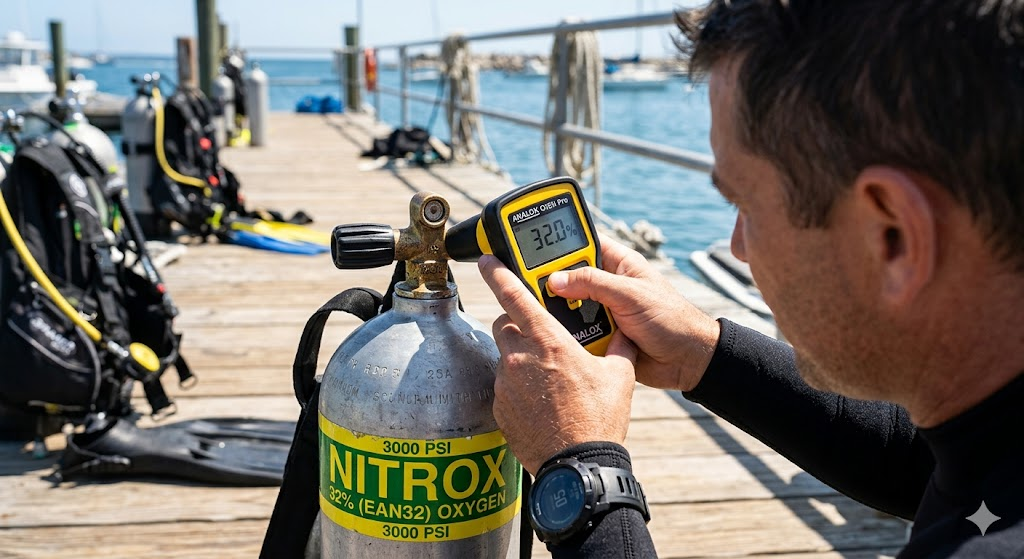
The band and the label on a nitrox cylinder are claims, not guarantees. Misfills, mislabels, and partial-pressure blending errors are well documented. Before every nitrox dive — no matter how reputable the fill station looks — you personally verify the actual oxygen content. The mantra is: if you didn't analyse it, you didn't breathe nitrox — you breathed an unknown gas.
An oxygen analyser is a small electrochemical device (roughly $60–150) that samples gas from the valve and reads the O₂ percentage. Reputable centers keep one on the equipment counter and expect you to use it. If a shop has none, or discourages you from analysing, that is a red flag in its own right.
The whole process takes under a minute:
- Calibrate the analyser to 20.9% on ambient air first (skip this and every reading is suspect)
- Crack the cylinder valve to release a slow, steady flow — too fast a flow gives a false low reading
- Hold the sensor in the stream until the number stabilises (give it 30+ seconds)
- Record the exact O₂ percentage — it may read 31.6% or 32.4%, not a clean 32%
- Round conservatively: for MOD, round the analysed O₂ up (a richer assumption gives a shallower, safer MOD); for NDL, treat the mix as slightly leaner if in doubt
- Mark and sign the cylinder tag with the mix, MOD, your name, and the date
Always plan around your analysed number, then immediately set your computer to it. Analyse-then-forget is one of the most common ways divers end up running an air NDL on a rich mix — or worse.
Setting Your Dive Computer for Nitrox
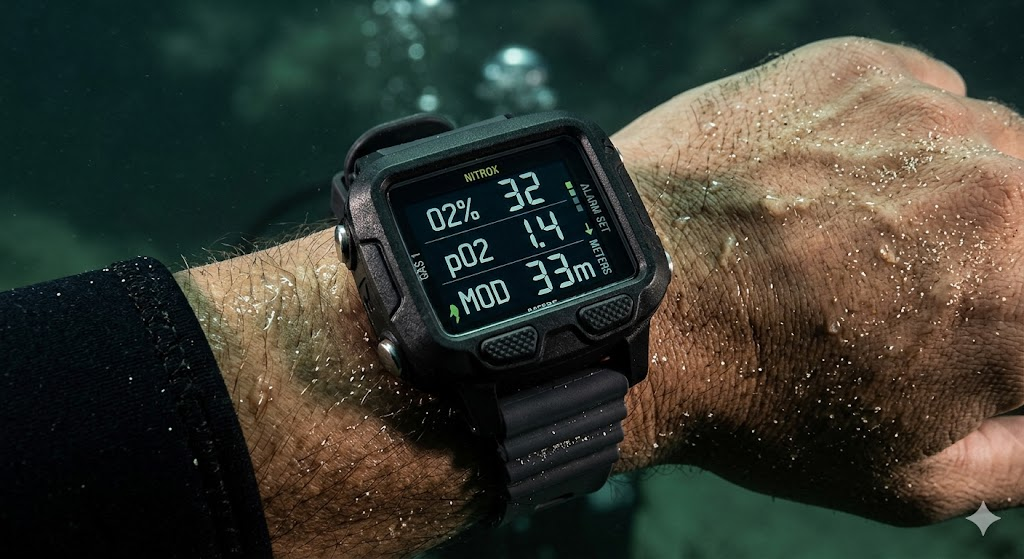
Every computer model buries the nitrox menu somewhere different — check your manual for the exact sequence. The universal requirements never change:
- O₂% / FO₂: enter the exact analysed percentage (e.g. 31.8%), not the label's round number
- ppO₂ alarm: set to 1.4 bar for the recreational working limit (1.6 reserved for deco/rest scenarios)
- Confirm the MOD readout: the computer should now display a MOD consistent with your mix — sanity-check it against your own MOD calculation
- Watch for auto-reset: many computers silently revert to air (21%) after a set number of hours of surface time or at midnight. Re-check the setting before every nitrox dive, not just the first of the trip
Once configured, the computer calculates the extended NDL for your actual mix and tracks your CNS clock, and it will alarm if you approach or exceed your MOD at depth.
The single most dangerous mistake
Analysing the cylinder, then forgetting to update the computer. It keeps running the previous gas (air, or a different nitrox mix), gives you no NDL extension, and — critically — issues no MOD warning for the mix you are actually breathing. This configuration error sits at the root of a large share of recreational oxygen-toxicity incidents. Analyse, set, and verify the MOD on the screen as one unbroken three-step ritual.
Gear and Fill-Station Standards You Should Know
For recreational mixes up to 40% O₂, most agencies and the gear industry accept standard scuba equipment — no special oxygen-cleaning required for cylinders or regulators that stay below the 40% threshold. This is the practical reason EAN32 and EAN36 are everywhere. Cross above 40% and the rules tighten sharply:
- O₂-clean and O₂-compatible cylinders and valves become mandatory for mixes above 40%, because high-fraction oxygen plus a hydrocarbon contaminant plus a heat source can cause a fire or explosion inside the cylinder
- Partial-pressure blending, where pure O₂ is decanted into a cylinder before topping with air, requires O₂-clean kit regardless of the final mix, because the cylinder briefly holds near-100% oxygen
- Continuous (nitrox stick) blending mixes the gas before it ever enters the cylinder, so the cylinder never sees high-fraction O₂ — one reason it is the common method for sub-40% recreational fills
You do not need to operate the blending bench, but you should recognise a properly run nitrox fill station: clean equipment, a working analyser available to divers, fills logged and labelled, and staff who can explain their method without hesitation.
Who Should Get Nitrox Certified?
Worth it if you…
- Dive three or more times a day on a holiday
- Spend most time in the 15–30 m band, where extended NDL pays off most
- Feel wiped out after multi-dive days
- Want a nitrogen safety margin on repetitive profiles
- Are heading to Ko Tao or Bali for a packed dive trip
Less useful if you…
- Mostly dive below 30 m — the shallow MOD becomes a real operational limit
- Dive only occasionally — the fatigue benefit is harder to notice
- Do single short dives where you never approach the air NDL anyway
- Dive cold water hard — exertion and CO₂ raise the toxicity risk
The course is half a day to a day. The certification is permanent and recognised worldwide across agencies. For anyone planning a trip with three or four dives a day, the payback on the card is immediate — usually by the second day of diving.
Pre-Dive Nitrox Checklist
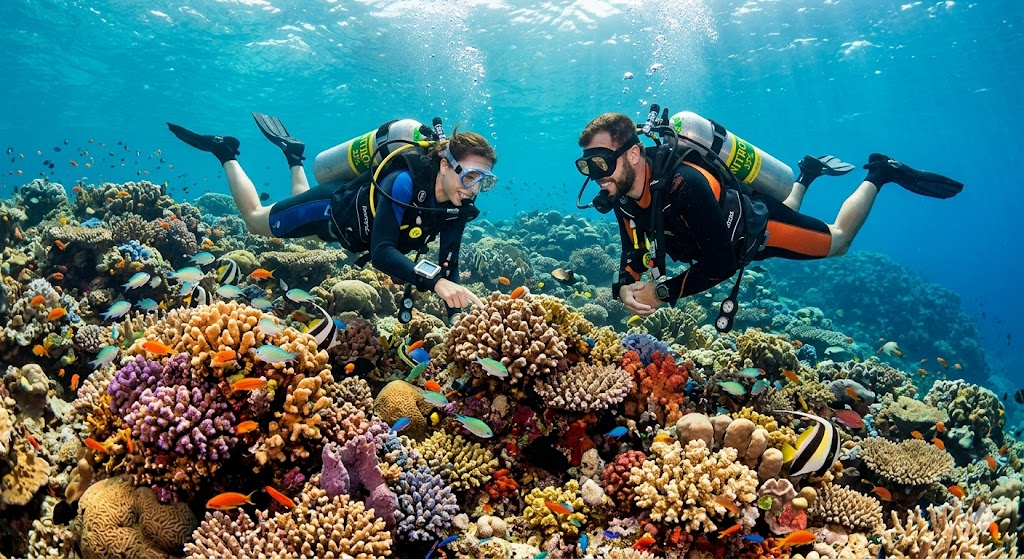
Run this every single dive — not just the first of the trip. It takes ninety seconds and it is the difference between a relaxed long dive and a fatality.
Analyse → Mark → Set → Plan
What NOT to do
- Do not breathe a cylinder you didn't analyse yourself — a label is not analysis.
- Do not trust your buddy's analysis for your own gas; each diver owns their cylinder.
- Do not plan to "just dip" below MOD for a photo — the threshold is not negotiable and the seizure gives no warning.
- Do not leave your computer on the last dive's mix; confirm the setting before every dive.
- Do not assume nitrox lets you go deeper — it is a shallower gas, not a deep one.
How ScubaProof Rates Nitrox Operations
A center's handling of enriched air is one of the clearest windows into its overall safety culture. ScubaProof's Oxygen Readiness and Gear metrics specifically capture whether analysers are available and maintained and whether fill standards are met; Staff Conduct captures whether briefings and certification checks actually happen; and Safety plus the composite Trust Score reflect the pattern across every reported dive. The red flags below feed those scores.
ScubaProof red flags — critical
- 🚩Center hands out nitrox cylinders without checking for a valid nitrox certification card
- 🚩No oxygen analyser available to divers, or the analyser is uncalibrated / non-functional
- 🚩Dives are planned to depths exceeding the MOD for the gas mix provided
- 🚩Staff cannot explain MOD, ppO₂ limits, or how to set a computer for nitrox when asked
ScubaProof yellow flags — caution
- ⚠Cylinders banded as nitrox but with no analysis log, mix, or MOD written on the tag
- ⚠Staff fill in your computer settings for you instead of having you analyse and set your own gas
- ⚠Briefing skips the MOD and ppO₂ discussion entirely for a nitrox dive
- ⚠One analyser shared across a large group with no time to verify each cylinder properly
Nitrox is one of the safest, highest-value upgrades in recreational diving — longer dives, less fatigue, more nitrogen margin. It earns that reputation only when the discipline is intact: analyse the gas, mark the cylinder, set the computer, respect the MOD. Skip a step and the same physics that extends your bottom time becomes the thing that ends it.