
She checked "no" to every box on the medical form because she wanted the course to start on Monday. Three weeks later, after her second open-water dive, she surfaced with blotchy purple skin across her chest and a tingling left arm. The dive doctor at the hyperbaric unit asked one question she had never considered: "Have you ever been screened for a patent foramen ovale?"
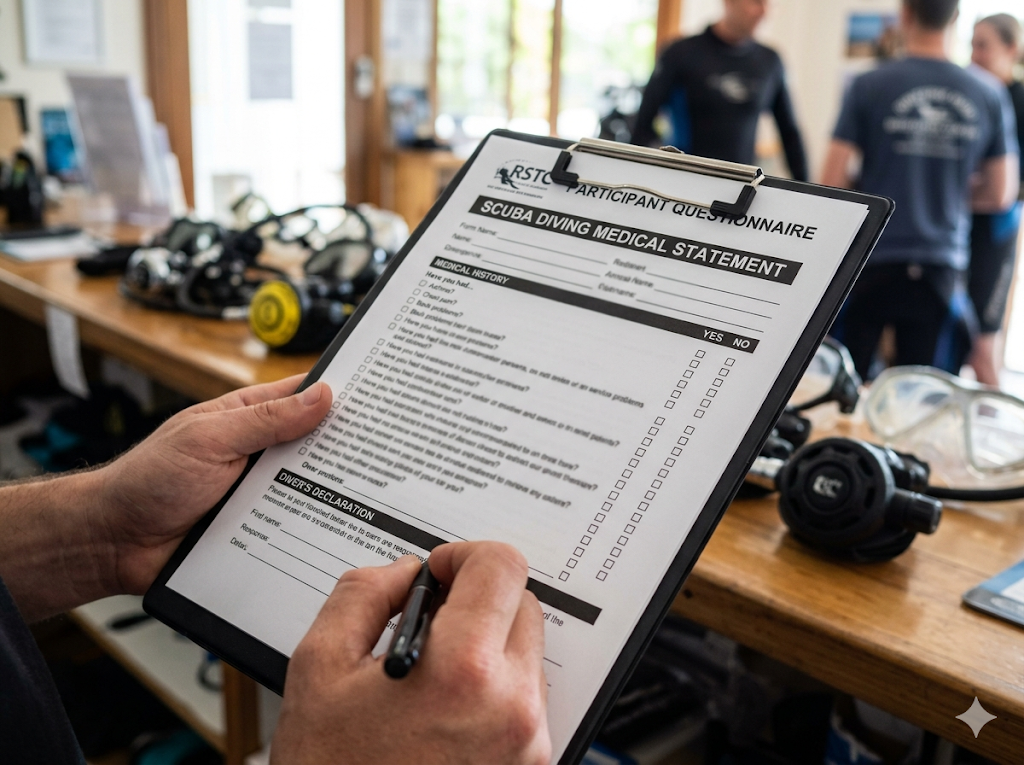
Fitness to dive is not a fitness-test pass or fail. It is a structured medical screening process — built around the RSTC Medical Statement — that identifies conditions where compressed gas, pressure changes, and cold water turn an otherwise healthy body into a high-risk patient. This guide covers the form, the three conditions recreational divers ask about most (PFO, asthma, medications), and when a diving physician must sign off before you enter the water.
1. The RSTC Medical Questionnaire: Your First Gate
The Recreational Scuba Training Council (RSTC) publishes a standard medical screening document used by PADI, SSI, NAUI, SDI, and most major agencies worldwide. You receive it before any in-water training. It is not bureaucratic paperwork — it is a liability-aware filter designed by diving physicians to catch conditions that interact badly with pressure, gas mixtures, and exertion underwater.
The form has two parts:
- Part A (Participant Questionnaire) — yes/no boxes covering cardiovascular, respiratory, neurological, metabolic, and behavioural conditions. Any "yes" does not automatically ban you from diving. It triggers Part B.
- Part B (Physician Evaluation Form) — completed by a physician (ideally one with diving-medicine training) who reviews your history, may order tests, and signs a clearance or restriction.
RSTC Form Outcomes — What Each Answer Means
The critical rule: answering dishonestly does not make you fit to dive — it removes the safety net and exposes you (and your instructor) to preventable injury. DAN incident data consistently shows that undisclosed medical conditions appear in a measurable fraction of serious diving accidents.
2. Patent Foramen Ovale (PFO): The Hidden Shunt
A patent foramen ovale (PFO) is a flap-like opening between the heart's right and left atria. In roughly 25% of adults, this fetal circulation pathway never fully closes. Under normal conditions it is harmless. Under diving conditions it can become a direct route for venous nitrogen bubbles to bypass the pulmonary filter and enter arterial circulation — dramatically raising the risk of neurological and skin (cutis marmorata) decompression sickness.
PFO is strongly associated with:
- Unexplained DCS after conservative profiles
- Type II (neurological) DCS at shallow depths
- Skin mottling DCS with no obvious profile error
- Multiple DCS hits across a diving career with "by the book" dives
Screening — Who Should Be Tested
Any diver with two or more unexplained DCS episodes, neurological DCS after a no-decompression dive, or cutis marmorata without profile violation should discuss transthoracic echocardiography with a "bubble study" (agitated saline contrast) with a diving physician. Routine screening of all divers is not currently recommended — risk-based screening is.
If PFO Is Confirmed — Three Paths
Conservative diving: shallower depths, shorter bottom times, longer surface intervals, nitrox to reduce nitrogen load, strict ascent rates, no flying within extended windows. Many divers with small PFOs manage this way indefinitely.
PFO closure (surgical/device): considered after repeated serious DCS when conservative measures fail. Requires a diving-medicine specialist and cardiologist; return-to-diving timelines are individual.
Stop diving: the only zero-risk option. A legitimate choice after severe neurological DCS.
(For DCS symptom recognition and field protocol, see the Decompression Sickness guide.)
3. Asthma and Respiratory Conditions
Asthma is the most common reason divers are referred to a physician — and the most commonly misunderstood. The risk is not "having asthma." The risk is uncontrolled bronchospasm plus trapped air in the lungs during ascent, which can cause pulmonary barotrauma and arterial gas embolism (AGE).
Asthma — Physician Decision Framework
✓ May clear (with conditions)
Mild, intermittent asthma with no attacks in 12+ months; normal spirometry; uses only a short-acting bronchodilator (SABA) occasionally; no cold-exercise-induced symptoms; can pass a exercise tolerance test
✗ High risk — likely restriction
Daily controller medication (inhaled corticosteroids); recent hospitalisation or oral steroid course; exercise- or cold-induced bronchospasm; any history of status asthmaticus; active wheeze on the day of diving
Cold, dry compressed air is a specific trigger. Tropical warm-water diving is not automatically safe — the air you breathe is still cold and dry from the regulator's pressure drop. A diver whose asthma is "fine at home" can bronchospasm at 15 m.
Other respiratory flags on the RSTC form — COPD, sarcoidosis, pneumothorax history, active respiratory infection — generally require specialist clearance. A chest cold on dive day is an automatic no-dive regardless of what your form says.
4. Medications: What Changes Under Pressure
Not all medications are dive-compatible. The question is whether a drug affects consciousness, cardiovascular response, thermal regulation, or seizure threshold — and whether the underlying condition it treats is itself a contraindication.
Common Medications — Diving Implications
Scopolamine (motion-sickness patches) deserves a separate note: widely used on dive boats but it causes dry mouth, drowsiness, and urinary retention — and interacts with narcosis and heat stress. If you use it, disclose it on your medical form and test it on a non-diving day first. (See the Seasickness on Dive Boats guide.)
5. When You Need a Diving Physician
A general practitioner can complete the RSTC Part B form, but a diving medicine specialist (UHMS/DAN referral network) understands pressure physiology in ways a family doctor may not. Seek one when:
- You have any history of DCS, AGE, or pulmonary barotrauma
- PFO screening or closure is being considered
- Asthma, diabetes, cardiac arrhythmia, or seizure disorder is in your history
- You take medications that affect consciousness or cardiovascular function
- You are returning to diving after a medical event (heart attack, stroke, pneumothorax)

DAN maintains a global directory of physicians with diving-medicine training. A clearance letter should specify any depth, exertion, or gas-mix restrictions — not just "cleared to dive."
6. The ScubaProof Filter: Centers That Take Medical Fitness Seriously
A dive center that treats the RSTC form as a checkbox exercise is a center that will push you into the water when you should not be there. The operational signals matter as much as your personal clearance.
Red Flags — Medical Screening Neglect
• Reviews mentioning "they didn't even look at the medical form" or "signed us all in without reading"
• Pressure to start the course before physician clearance arrives
• No process for divers who answer "yes" on the questionnaire — just "you'll be fine"
• Safety score below 3.5 or Trust Score flagged "Under Review" (3.0)
Yellow Flags — Ask Before You Book
• Cannot name a local diving physician or hyperbaric facility for referrals
• Staff Conduct score notably below Safety score — inconsistent standards
• Aggressive scheduling that leaves no time for medical paperwork on day one
• No mention of DCS history or return-to-diving protocols in course materials
On a ScubaProof profile, Safety, Staff Conduct, Gear, Oxygen Readiness, and the composite Trust Score aggregate these signals from verified reviewer data. Medical fitness starts with your honest form — but the operator you choose determines whether that honesty is respected.