She stepped off the flight at Suvarnabhumi Airport in Bangkok feeling fine. Six hours earlier she had completed two fun dives in Ko Tao — relaxed profiles, no decompression obligations, standard ascents. Reaching for her luggage in the arrival hall, she felt nothing below her waist. The sensation returned, then vanished. By the time she cleared customs, her right leg had stopped responding.
This is not hypothetical. It is a textbook Type II decompression sickness presentation: delayed neurological onset after an apparently uneventful dive, unmasked by a cabin pressure equivalent to roughly 1,800–2,400 m of altitude. The nearest hyperbaric chamber was three hours away. Every minute of that journey changed how much of her leg she would get back.
Decompression sickness (DCS) is the one diving injury where the diver's own actions in the first 30 minutes — not the doctor's hours later — decide how much damage becomes permanent. This guide covers the physics, the disguises, the timeline, and the exact field protocol. Read it before you need it.
1. The Physics: Why Bubbles Form
Three gas laws govern every dive. DCS lives where they intersect.
- Dalton's Law — the pressure of a gas mixture equals the sum of its parts. Air is ~78% nitrogen, ~21% oxygen. At the surface (1 ata) the partial pressure of nitrogen (ppN₂) is ~0.79 ata. At 30 m (4 ata) it is ~3.16 ata. You are now breathing four times the nitrogen molecules per breath.
- Henry's Law — the amount of a gas that dissolves into a liquid is proportional to its partial pressure. As ppN₂ rises with depth, nitrogen drives into your blood and tissues ("ongassing") until those tissues reach equilibrium with the gas you breathe.
- Boyle's Law — at constant temperature, gas volume is inversely proportional to pressure. A bubble that forms at depth doubles in volume as you halve the absolute pressure on ascent. This is why the last 10 m — where pressure changes fastest in relative terms — is the most dangerous part of any ascent.
Nitrogen is metabolically inert: your body cannot consume it, so it can only leave the way it came — dissolved in blood, carried to the lungs, and exhaled ("offgassing"). A slow, controlled ascent keeps nitrogen in solution long enough to be breathed off harmlessly. When you ascend too fast — or surface pressure drops further, as in an aircraft cabin — dissolved nitrogen exceeds what the liquid can hold and comes out of solution as free gas. Bubbles form in venous blood and tissue.
Those bubbles block circulation, mechanically compress nerves, and trigger an inflammatory and clotting cascade at the gas–blood interface. Where they lodge and how large they grow determines whether you get an aching shoulder or a paralysed leg.
Tissue Compartments and M-Values
Your body is not one sponge. Decompression models (Haldane, Bühlmann ZH-L16, the basis of nearly every modern dive computer) divide it into theoretical "tissue compartments" — fast ones like blood and spinal cord, slow ones like fat, joints, and cartilage — each with its own half-time (the minutes it takes to fill or empty halfway, from ~5 to ~635 minutes). Each compartment has an M-value: the maximum nitrogen overpressure it can tolerate at a given depth before bubbling becomes likely. Your computer's no-decompression limit is simply the moment the most loaded compartment is about to reach its M-value. Slow compartments explain why joint-pain DCS can surface up to 24 hours later — those tissues are still quietly offgassing long after you have showered and eaten dinner.
This is also why nitrox (enriched air) reduces DCS risk at a given depth: more oxygen means a lower ppN₂ in the mix, so less nitrogen ongasses. Nitrox does not let you ascend faster — it lowers the load you started with.
(For the flying-after-diving math and the full Henry's Law treatment, see the Flying After Diving guide.)
2. DCS Is Not the Only Bubble Injury — Get the Terms Right
Divers, and even some clinics, conflate three different injuries. The treatment paths diverge, so the distinction matters.
Bubble & Pressure Injuries — Don't Confuse Them
DCS + AGE together are termed Decompression Illness (DCI). Field treatment for both is identical: oxygen, horizontal, evacuate.
Arterial Gas Embolism (AGE) is the fast killer. It comes from pulmonary barotrauma — a diver holding their breath on ascent (or with trapped air from asthma/lung disease) ruptures alveoli, and air enters the arterial circulation directly. Signs appear within seconds to minutes of surfacing and mimic a stroke: confusion, slurred speech, one-sided weakness, seizure, sudden loss of consciousness. Ear or sinus barotrauma, by contrast, is a mechanical pressure injury to a gas-filled space — a burst eardrum, a sinus squeeze — and is distinct from bubble disease, even though inner-ear DCS can mimic it (see §3).
The practical rule: you do not have to diagnose the exact injury in the field. DCS and AGE share one emergency protocol (§5). What you must not do is dismiss stroke-like signs in a fresh diver as "tiredness."
3. The Two Types of DCS
The dive medicine community classifies DCS into two types by which systems are hit. Both are emergencies. Neither can be ruled out by feel alone.
Type I — Musculoskeletal & Lymphatic ("the bends")
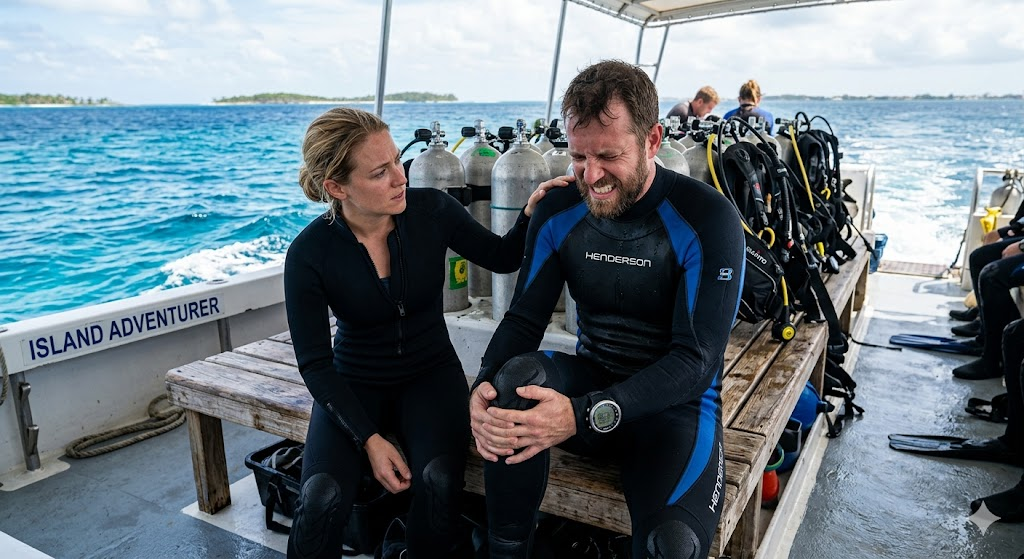
Joint pain — commonly shoulders, elbows, wrists, hips, and knees — that is dull, deep, and unrelated to exertion. It often does not change with movement, which distinguishes it from a muscle strain. Skin marbling (cutis marmorata): a blotchy, lace-like purple discoloration spreading across the trunk. Lymphatic swelling in the armpits or groin. These feel manageable — and that is the trap. A diver who rests and waits can slide into Type II while telling themselves it is post-dive soreness. Type I is still a chamber case.
Type II — Neurological, Pulmonary & Inner Ear
Neurological: Numbness, tingling, or burning — often "pins and needles" that do not resolve. Muscle weakness or partial paralysis (the spinal cord is a frequent target). A "girdle" band of pain or numbness around the trunk is a classic spinal-DCS warning sign. Bladder dysfunction or difficulty urinating. Unusual fatigue. In severe cases, loss of consciousness.
Pulmonary ("the chokes"): Burning chest pain behind the sternum, a dry persistent cough, and breathing difficulty that worsens with deep inhalation — caused by a heavy load of nitrogen bubbles overwhelming the pulmonary filter. This is a high-bubble-load emergency.
Inner ear (vestibular DCS): Sudden vertigo, nausea, vomiting, hearing loss (often one ear), and tinnitus. Easily mistaken for inner-ear barotrauma from a hard equalization. The distinction is real: barotrauma can be worsened by recompression, so an accurate history (did equalizing hurt on the dive?) matters to the treating physician.
4. Symptom Timeline: When They Appear
The most dangerous myth about DCS is that symptoms appear at once. They often do not. A diver who feels fine at the surface can deteriorate hours later — especially after a flight, a drive to altitude, or hard exercise.
DCS Symptom Onset Timeline
Source: DAN Diving Fatalities & Injuries Database. Onset distribution from reported incident data; figures are approximate.
The critical implication: a diver who boards a flight four hours after a dive — feeling fine — is squarely inside the highest-risk onset window. Reduced cabin pressure expands any silent microbubbles already present. This is exactly the mechanism behind the Ko Tao case that opened this guide. The standard surface intervals before flying (per DAN / UHMS consensus) are a minimum of 12 hours after a single no-decompression dive, and 18 hours after multiple dives or multiple days of diving — longer after any decompression diving.
5. The DAN Field Protocol: Oxygen First
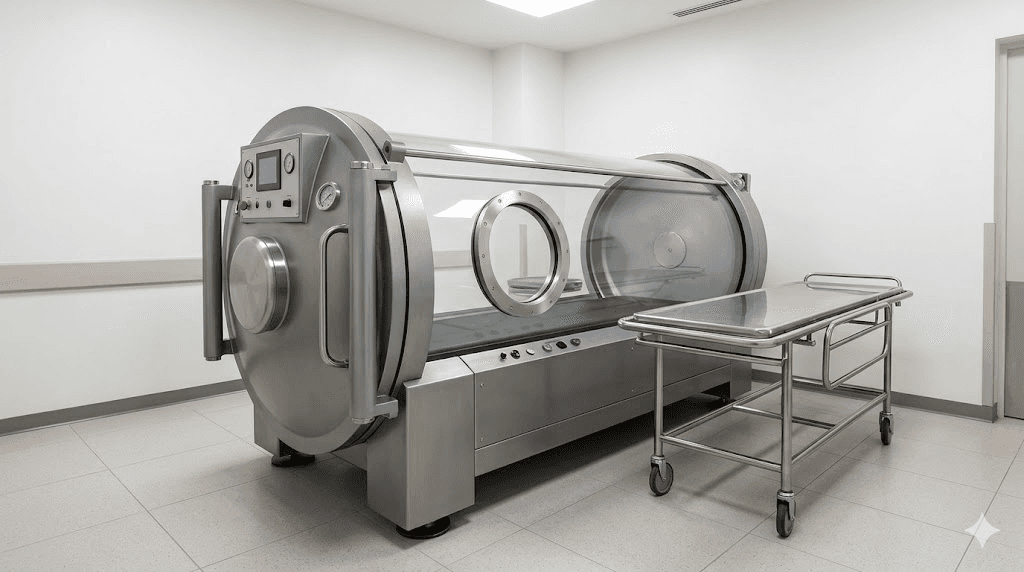
DCS cannot be cured in the field — only definitively treated in a hyperbaric (recompression) chamber. But what you do in the first 30 minutes decides how much neurological damage stays reversible. The sequence below is the global standard endorsed by DAN (Divers Alert Network).
Stop Diving. Check ABCs. Lay the Diver Flat.
Any symptom that could be DCS — joint pain, skin marbling, numbness, vertigo, breathing trouble — ends the diving day for the whole party. Confirm airway, breathing, and circulation; begin CPR if absent. Lay the diver horizontal (supine). A flat position discourages venous bubbles from migrating to the brain under gravity. If the diver is vomiting or unconscious, use the left-lateral recovery position. Do NOT use head-down (Trendelenburg) tilt — that outdated practice raises cerebral bubble and edema risk.
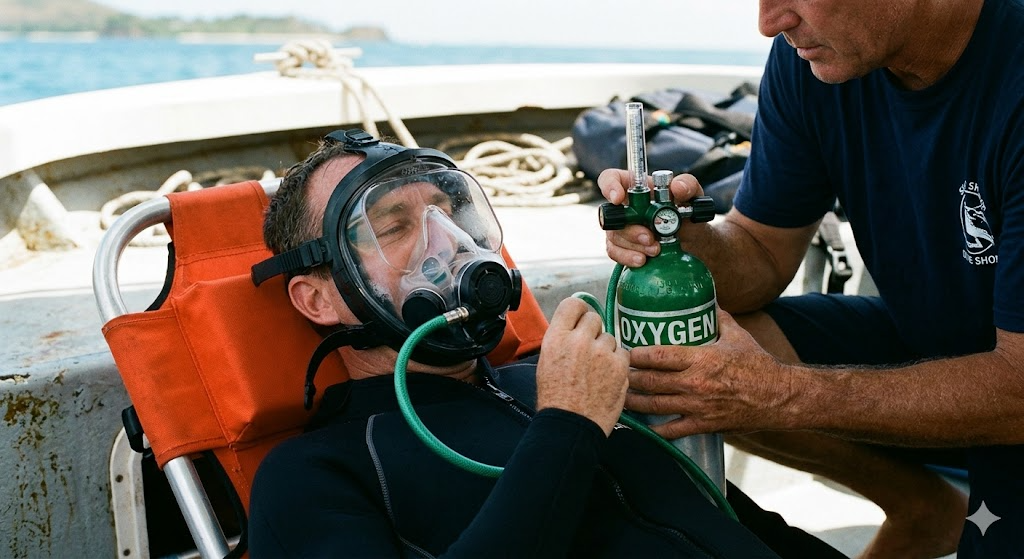
Administer 100% Oxygen — Continuously, at High Flow
This is the single most effective field intervention. Use a non-rebreather mask at ≥10–15 L/min, or a demand valve for a conscious, breathing diver. Pure oxygen drops the ppN₂ in the lungs to near zero, creating the steepest possible gradient to wash dissolved nitrogen out of blood and tissue — and it oxygenates tissue starved by bubble-blocked circulation. Keep it flowing without interruption, all the way to the chamber if supply allows. Surface oxygen alone can fully resolve mild symptoms in some cases — but the diver still needs a physician's assessment.
Hydrate Orally — Not by IV
If the diver is conscious, alert, and not vomiting, give 500–1000 mL of water or an electrolyte drink over ~30 minutes. Restoring blood volume thins the blood and improves the peripheral circulation that carries nitrogen back to the lungs. IV fluids are a trained-medic/hospital intervention — do not attempt field IV access unless qualified and equipped. Never give alcohol or caffeine (see §6).
Document the Dive Profile and Symptom Times
Download or photograph the dive computer. Record max depth, bottom time, ascent rate, safety stops, surface intervals, gas used, and — critically — the exact clock time each symptom began and whether it is improving or worsening. The chamber physician chooses the treatment table (e.g. US Navy Table 6) based on this history. A clear timeline can be the difference between the right table and a guess.
Call DAN Now — Then Evacuate to a Chamber
DAN emergency hotline: +1-919-684-9111 (24/7, worldwide; accepts collect/reverse-charge calls). The on-call physician triages the case, advises on evacuation priority, and routes you to the nearest functioning chamber. In Southeast Asia the closest chambers serving Ko Tao are on Ko Samui, with others in Pattaya and Kuala Lumpur; in Bali, BIMC Hospital Nusa Dua. Call while the diver is still symptomatic — it directly changes the treatment plan. Do not "wait and see."
The Pocket Checklist
Suspected DCS — Do This, In Order
[1] End all diving. Check airway/breathing/circulation.
[2] Lay flat (recovery position if vomiting/unconscious).
[3] 100% O₂, high flow, continuous.
[4] Oral fluids if conscious & not nauseous.
[5] Log profile + symptom onset times.
[6] Call DAN +1-919-684-9111 → evacuate to chamber.
[X] No painkillers. No alcohol. No flying. No going back down.
6. What NOT to Do
Each of these is a well-meant reflex that makes outcomes worse.
7. Risk Factors That Multiply Your Odds
DCS is not random. Specific physiological and behavioural factors raise the odds that nitrogen comes out of solution and causes harm. Spot them before a dive for prevention; recognise them after for faster diagnosis.
8. Your Dive Center Changes the Odds
DCS does not strike at random, and it is not purely the diver's responsibility. Incident data consistently links operational practice to risk: overloaded groups that rush ascents, guides who skip the safety stop to make the next boat, beginners sent into currents they cannot manage and who then bolt to the surface.
A skipped 3-minute safety stop at 5 m removes the slow, final-margin offgassing window most likely to prevent borderline bubbling. An ascent at double the recommended rate (the standard is no faster than 9–10 m/min, or ~18 m/min as an absolute ceiling on older tables) sharply raises bubble load in the fast and intermediate compartments. These are operator decisions — not diver decisions.
When you search a dive center on ScubaProof, the safety-relevant signals are aggregated from verified reviewer data:
Red Flags — Elevated DCS Exposure
• Recurring review phrases like "rushed ascent," "no safety stop," or "guide was in a hurry"
• No emergency oxygen kit on the boat — directly degrades the Oxygen Readiness metric
• Group ratios far beyond agency standards (PADI caps fun-dive guiding and certification ratios; oversized groups force shortcuts)
• A Safety score below 3.5, or an overall Trust Score flagged "Under Review" ( 3.0)
Yellow Flags — Ask Before You Book
• Gear or Staff Conduct scores notably below the Safety score — inconsistent standards
• No mention of dive-computer or profile discipline in reviews
• Aggressive multi-dive day scheduling with short surface intervals and no nitrox option
• Vague answers about the nearest chamber and their DCS evacuation plan
On a ScubaProof profile these map to explicit metrics: Safety, Gear, Staff Conduct, Oxygen Readiness, and the composite Trust Score (safety-weighted: safety × 0.5 + staff × 0.3 + gear × 0.2, with penalties for active red flags). A high Safety score is not a luxury feature — it is the most direct action you can take to lower your personal DCS risk before you ever touch the water.