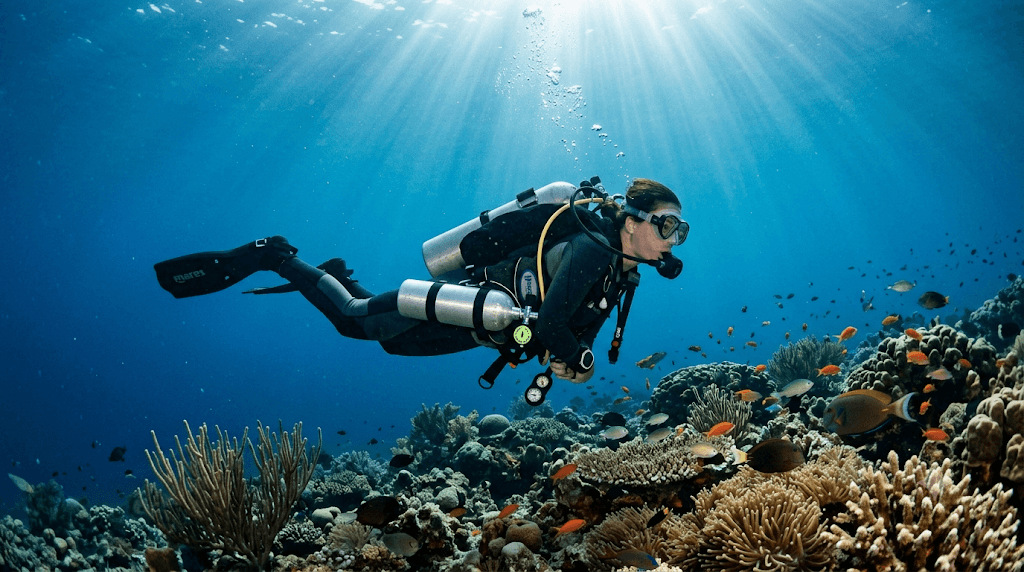
The dive center cancelled your buddy's trip. Yours is still running. The shop offers to "pair you with someone from another group" — a stranger you have never met, whose air consumption, navigation, and panic response you know nothing about. Or they suggest you dive alone because "the reef is shallow and the guide will be nearby." One of those options has a training standard, redundancy requirements, and regional legal framework behind it. The other is a liability waiver disguised as flexibility.
Solo diving is a deliberate risk-management choice — not a convenience when a center runs sloppy ratios. This guide covers SDI Solo Diver certification, redundancy rigs, where solo diving is legal, and how to tell justified self-reliance from an operator cutting corners.
What "Solo Diver" Actually Means
SDI Solo Diver is the most widely recognised recreational solo certification. Prerequisites typically include 100 logged dives and Advanced Open Water (or equivalent). The course teaches:
- Self-sufficient gas planning with true redundant air supply
- Solo dive planning and surface communication protocols
- Managing emergencies without a buddy present
- When solo diving is and is not appropriate
PADI does not offer a recreational solo certification — PADI standards require the buddy system for all training and guided dives. SSI has independent diver programmes with similar redundancy requirements in some regions.
Solo certification does not override local law. It gives you a training framework; the country and the dive center still set the rules.
Redundancy: The Non-Negotiable Requirement
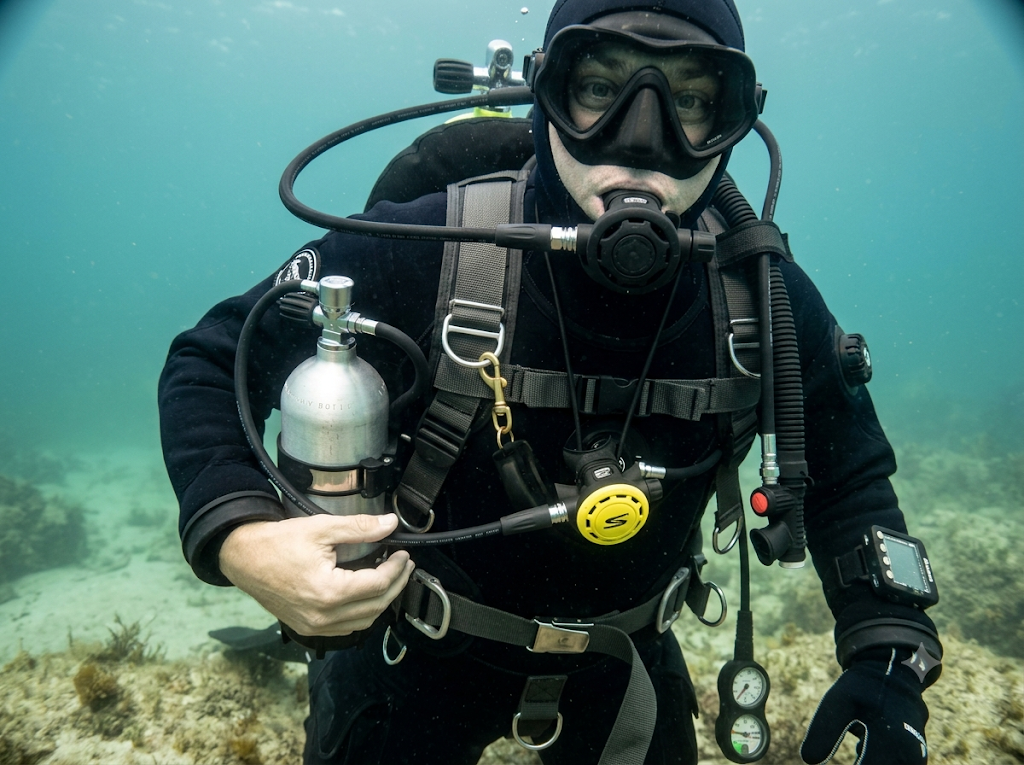
The buddy system exists because a single-cylinder, single-regulator diver who loses gas or consciousness has no backup. Solo diving replaces the human buddy with equipment redundancy:
Solo Redundancy — Minimum Standard
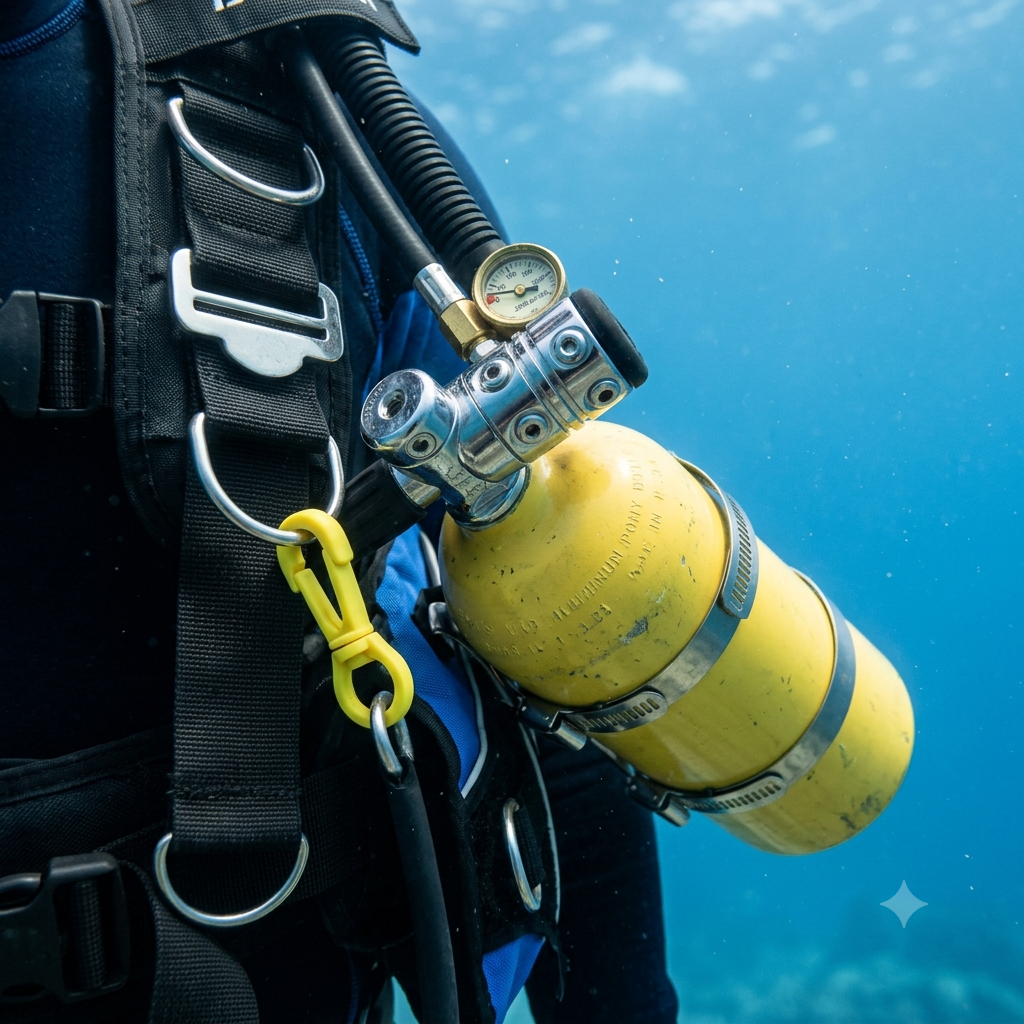
A pony bottle is a small cylinder (typically 3–6 litres) mounted on the main rig with its own regulator. It provides enough gas for a controlled ascent from recreational depths — not a second full dive. Plan pony volume using your actual SAC rate at depth, not a generic table.
Additional solo kit:
- SMB + reel — mandatory; no buddy to deploy a marker for you
- Dive computer — with audible depth and ascent alarms
- Surface signalling — whistle, mirror, or PLB for shore or boat recovery
- Cutting tool — entanglement has no buddy to assist
Regional Legality: Where Solo Diving Stands
Laws and operator policies vary. General patterns:
- United States: solo diving is legal in most states for certified divers; many boats and parks require buddy pairs — check operator policy.
- Maldives, Thailand (most operators), Philippines: operators typically prohibit solo diving on guided boats regardless of certification.
- Mexico (Cozumel, Baja): mixed; some operators allow experienced solo divers with redundancy; many do not.
- Europe (UK, Malta, Croatia): varies by dive centre and insurance; BSAC culture includes more self-reliance; always confirm insurance coverage for solo dives.
- Egypt (Red Sea): most boat operators require buddy pairs; shore diving in Dahab has more solo culture — still confirm with the center.
Insurance: many dive insurance policies exclude solo diving unless you hold a recognised solo certification. Read your policy before you rely on it.
When Solo Is Justified vs When It Is an Excuse
Solo Justified vs Bad Center Excuse
✓ Justified solo
• You hold SDI Solo (or equivalent) with logged redundancy practice
• Shore dive on a site you know, shallow, no current
• Photography or survey work where a buddy would obstruct the task
• Operator explicitly allows solo with redundancy check at check-in
✗ Center excuse
• "Just go alone, the guide will watch everyone" — 1:8 ratios are not solo supervision
• Paired with a stranger as default — you inherit their unknown risk profile
• Solo offered without redundancy requirement or gear check
• Deep or current site with "you'll be fine alone" — depth and current multiply solo risk
A center that routinely sends uncertified divers alone on boat dives to fill seats is not offering freedom — it is avoiding the cost of adequate guide staffing. That pattern appears in ScubaProof reviews as Staff Conduct and Safety red flags.
The Physics Solo Divers Cannot Delegate
Without a buddy, every failure mode is yours alone:
- Out-of-gas — no octopus handoff; pony or doubles only
- Entanglement — no knife handoff or line cutting assistance
- Narcosis impairment — no buddy to catch impaired judgment (see Nitrogen Narcosis guide)
- Rapid ascent — no buddy to physically slow an unconscious diver
Solo diving compresses the margin for error to zero. Gas planning must include reserve for a slow ascent with a failed primary regulator, not just "enough to surface."
Red Flags
• Center encourages solo without checking solo certification or redundancy rig
• "Octopus is your backup" accepted as solo redundancy
• Boat dive alone with 1:10 guide ratio and no surface lookout for solo divers
• Current, overhead, or depth site offered as solo to fill a roster gap
• No SMB requirement stated for solo shore dives
• Insurance exclusion for solo not disclosed when you ask
How ScubaProof Flags Solo-Related Risk
ScubaProof's Trust Score weights Safety (50%), Staff Conduct (30%), and Gear Quality (20%). Review patterns like "sent me alone without a buddy check," "paired with random diver," and "guide lost the group" trigger Staff Conduct deductions — they indicate systemic ratio and briefing failures, not solo diving culture done right.
Use Trust Score to avoid centers that use solo as a staffing shortcut. If you are a certified solo diver with proper redundancy, choose operators that verify your rig at check-in rather than those that waive all standards to fill the boat.