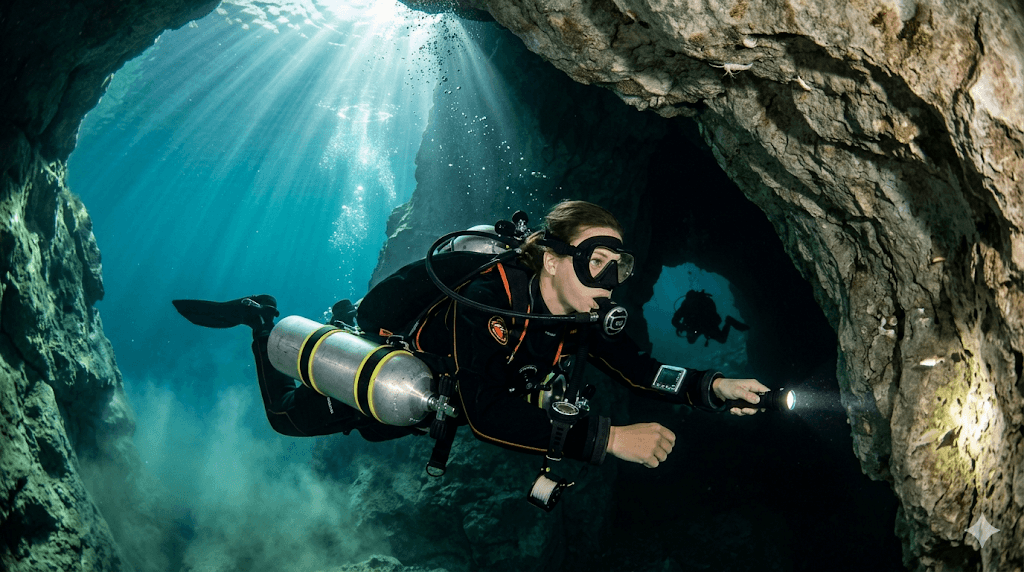
He switched to sidemount for "better trim" after watching a cave video. On his third ocean dive the left cylinder snagged a fishing line at 22 metres, rotated forward, and pulled him head-down. He had never practised the shutdown drill in surge. The redundancy he bought with a second reg became a entanglement hazard he did not know how to manage.
Sidemount and backmount are not fashion choices. They are cylinder configurations with different centre-of-gravity, failure modes, and training requirements. This guide places both in the GUE/TDI/SSI XR context, compares streamlining and trim, explains redundancy honestly, and outlines when a switch is worth the investment.
1. Backmount: The Default Recreational Platform
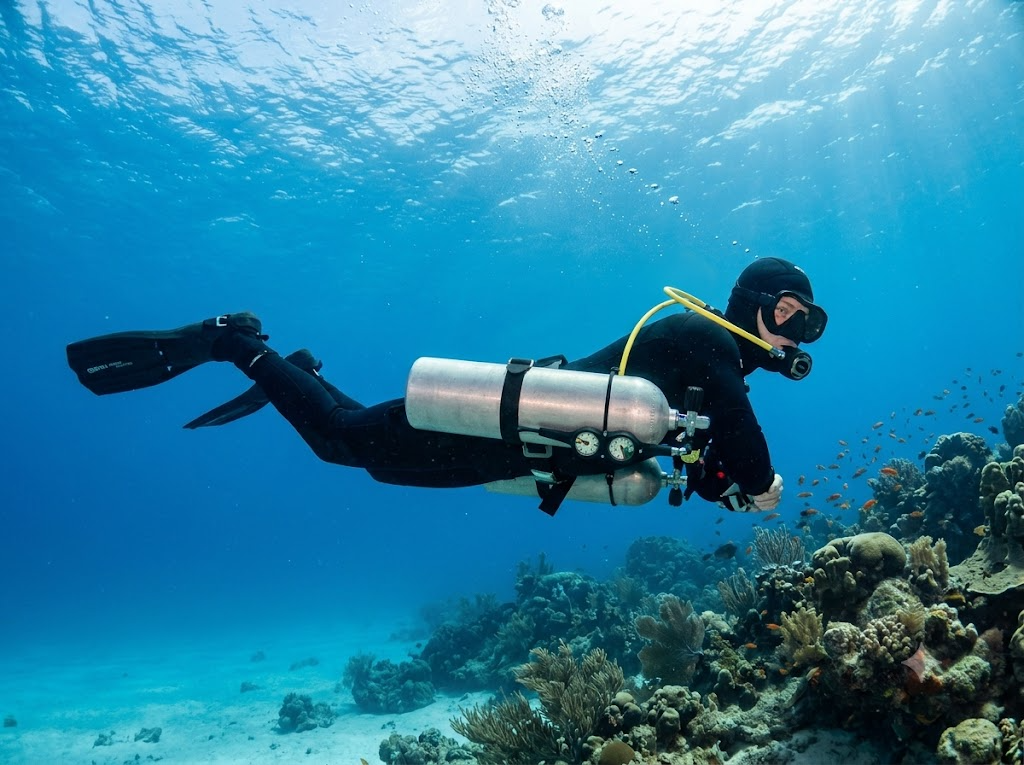
Backmount — twin or single cylinder on the back via a BCD or wing/harness — is what most Open Water courses teach. The cylinder mass sits behind your shoulders, which is intuitive on boats and in pool training.
Strengths:
- Fast setup on crowded dive boats
- Universal instructor familiarity
- Single-cylinder simplicity for OW and AOW divers
- Twinset backmount (doubles) is the technical/rec standard in GUE and TDI cave/wreck pipelines
Weaknesses:
- Single backmount = single regulator failure point without a pony bottle
- Heavy valving behind the head in tight environments
- Poor access to valves for shutdown drills without training
Backmount Configurations
2. Sidemount: Cylinders at the Sides
Sidemount places one or two cylinders along the diver's flanks, clipped at the hips and secured at the shoulders. Originating in cave diving, it is now taught recreationally through TDI Sidemount, SSI XR Sidemount, and agency-specific programmes.
Strengths:
- Valves and regulators accessible in front — fast shutdown drills
- True gas redundancy with two independent cylinders (when trained for two)
- Easier transport of cylinders to/from water separately
- Low profile through tight restrictions (when configured correctly)
Weaknesses:
- Snag risk from dangling cylinders in mid-water and fishing line
- Complex hose routing; poor setup = terrible trim
- Requires dedicated training — not "figure it out" configuration
- Boat logistics slower than backmount on busy charters
3. Trim and Streamlining: Myth vs Reality
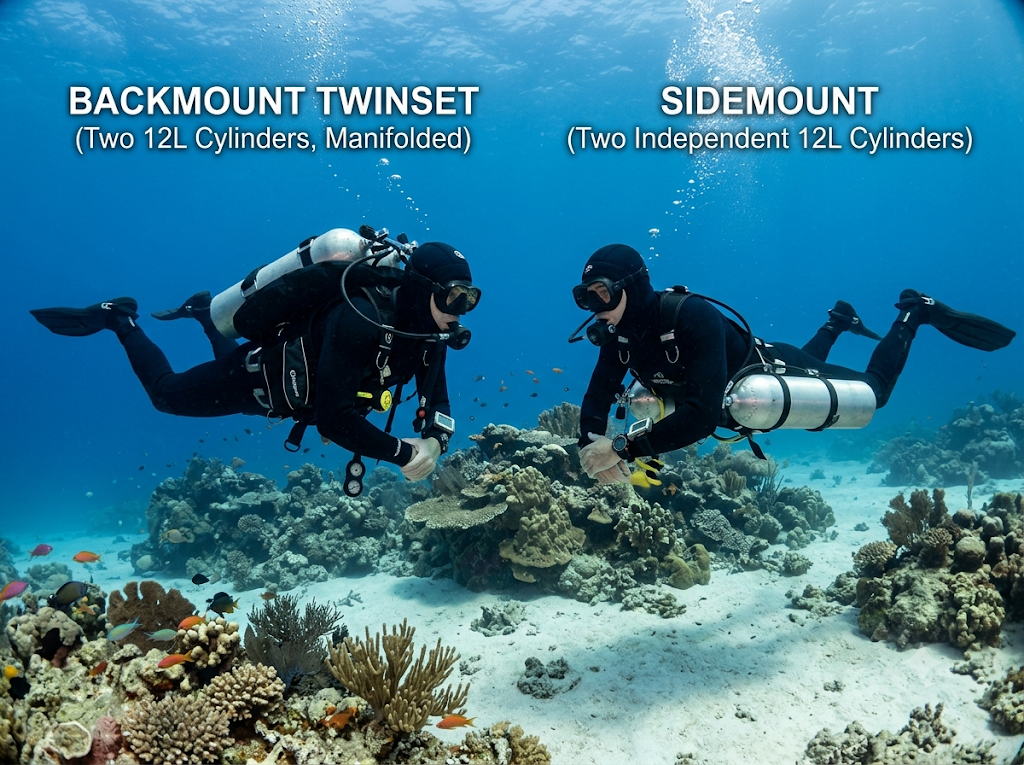
The internet claims sidemount automatically improves trim. It does not. Trim is a function of weight distribution, lung volume, and propulsion — not cylinder position alone.
Backmount Trim
✓ Good
Backplate/wing, weight distributed on belt or integrated, cylinder band height correct, head-up pitch minimal
✗ Poor
Jacket BCD over-weighted at shoulders, cylinder rides low, feet drop, frog-kick into silt
Sidemount Trim
✓ Good
Cylinders parallel to body, clipped high on hip, bungee snug, minimal hose dangling, balanced left/right gas
✗ Poor
Cylinders swinging forward, one side heavier, hoses catching knees, head-down from unbalanced rig
(For buoyancy fundamentals independent of config, see the Buoyancy Control guide.)
4. Redundancy: What You Actually Gain
Redundancy means a backup for a critical failure — not simply carrying more metal.
| Failure | Single backmount | Sidemount (2 cylinders, trained) | |---|---|---| | Regulator free-flow | Shut down valve or breathe off buddy — no own backup | Switch to second reg; shutdown failed side | | Cylinder valve issue | No backup unless pony/stage | Isolate failed cylinder, continue on second | | Entanglement | Cylinder behind head — harder to see | Cylinders at sides — visible but snag-prone |
GUE philosophy favours twinset backmount with a long hose donate for team redundancy. TDI sidemount favours independent cylinders with gas-sharing protocols. SSI XR teaches sidemount as an extension path from recreational diving. None of these replace buddy gas sharing as the primary emergency gas source in recreational diving.
5. When to Switch — and When Not To
• You have back/neck issues carrying heavy backmount on shore entries
• You are progressing into TDI/SSI XR cave or wreck penetration (with proper training)
• You want valve-access redundancy and will complete a full sidemount course plus practice
• You think it fixes bad buoyancy without training (it will not)
• Your primary diving is crowded boat charters with no sidemount support
• You are avoiding a pony bottle instead of learning proper backup gas planning on backmount
6. The ScubaProof Filter: Config Competence in Reviews
Red Flags — Sidemount/Config Neglect
• "Sidemount available" with no certified sidemount instructor on staff
• Rental sidemount rigs with mismatched bungee, old bands, no hose routing check
• Reviews mentioning entanglement, dangling cylinders, or failed shutdown drills
• Gear score below 3.5; Safety "Under Review"
Yellow Flags — Ask Before Booking
• No dedicated sidemount course listed — only "try it on fun dives"
• Cannot explain gas-sharing protocol for sidemount vs backmount mixed groups
• Staff unfamiliar with twinset valve drills if offering technical dives
Safety, Gear, Staff Conduct, Oxygen Readiness, and Trust Score on ScubaProof help you find operators who teach configuration properly — not shops that rent hardware without the training pipeline behind it.