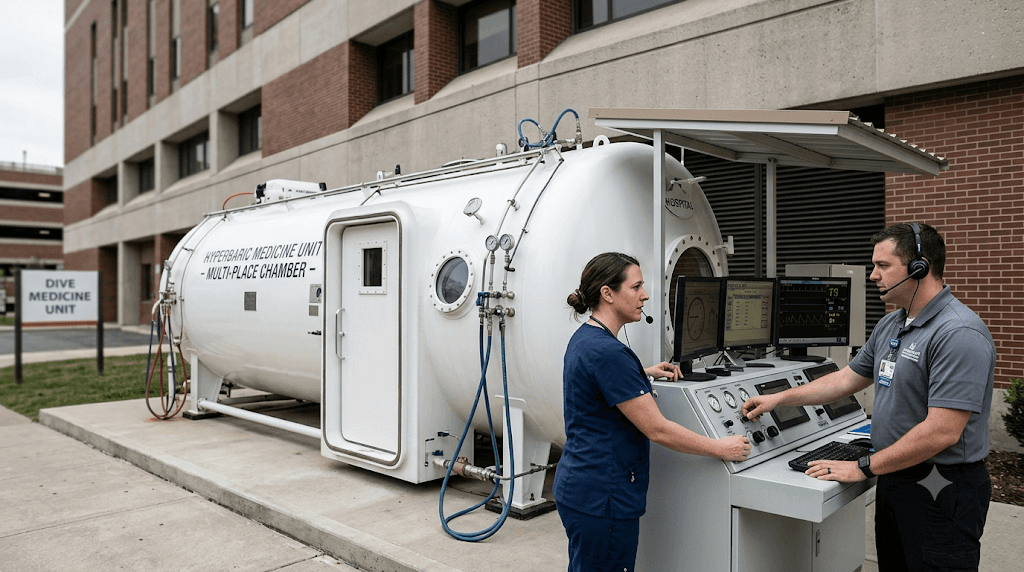
Your buddy surfaced complaining of tingling in both legs. You administered oxygen on the boat for 40 minutes. The dive center called the chamber. Now you are standing in a hospital corridor while a technician wheels your buddy toward a steel cylinder the size of a small room. The door seals. Pressure rises. You have no idea what happens next — and whether the treatment your buddy receives in the next six hours will determine if they walk normally again.
This guide covers the treatment side of decompression illness — not symptom recognition (see the DCS Symptoms guide). It explains what recompression does physically, what US Navy Table 6 involves, how long treatment takes, and exactly what you should have done on the boat before the ambulance arrived.
What Recompression Actually Does
Decompression sickness (DCS) occurs when dissolved inert gas — primarily nitrogen — comes out of solution faster than the body can eliminate it, forming bubbles in blood and tissue. Recompression reverses the physics:
- Increasing ambient pressure shrinks bubble volume (Boyle's Law). A bubble at the surface is largest; at 18 m (2.8 ata) it is roughly one-third the size.
- Breathing oxygen at pressure creates a steep partial-pressure gradient that drives nitrogen out of tissues faster (Henry's Law in reverse). Oxygen replaces nitrogen in the alveoli, accelerating offgassing.
- Gradual decompression during treatment ascent allows remaining dissolved gas to leave solution slowly, preventing bubble reformation.
Recompression does not "squeeze the bubbles back in." It reduces bubble size and mechanical tissue damage while accelerating gas elimination. Early treatment — ideally within the first hour of symptom onset — correlates strongly with better neurological outcomes.
US Navy Treatment Table 6: The Standard Protocol
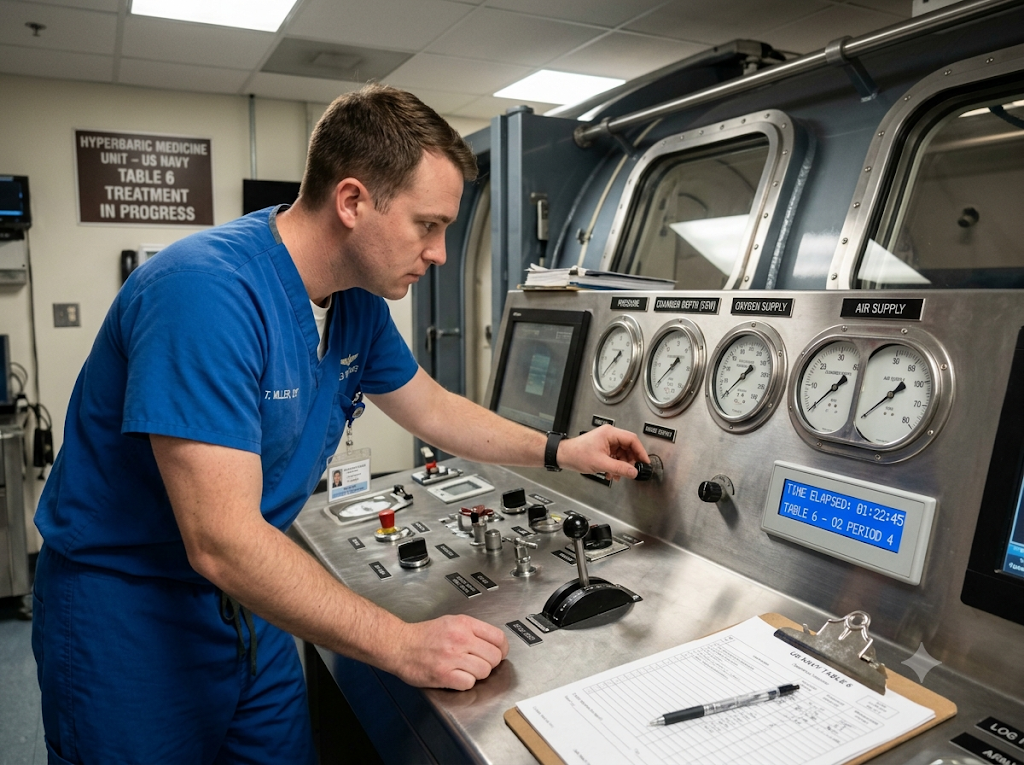
Most dive medicine facilities worldwide use variants of the US Navy Diving Manual treatment tables. Table 6 is the workhorse for serious Type II DCS and arterial gas embolism (AGE):
US Navy Table 6 — Simplified Profile
Lighter Type I DCS (joint pain, skin rash) may be treated on Table 5 (shorter profile, 2.8 ata). The chamber physician selects the table based on symptom severity, onset time, and response to initial oxygen.
Total chamber time including compression, treatment, and decompression: typically 5–8 hours for a full Table 6 run. Patients may receive multiple treatments over consecutive days if neurological symptoms persist.
Inside the Chamber: What the Patient Experiences
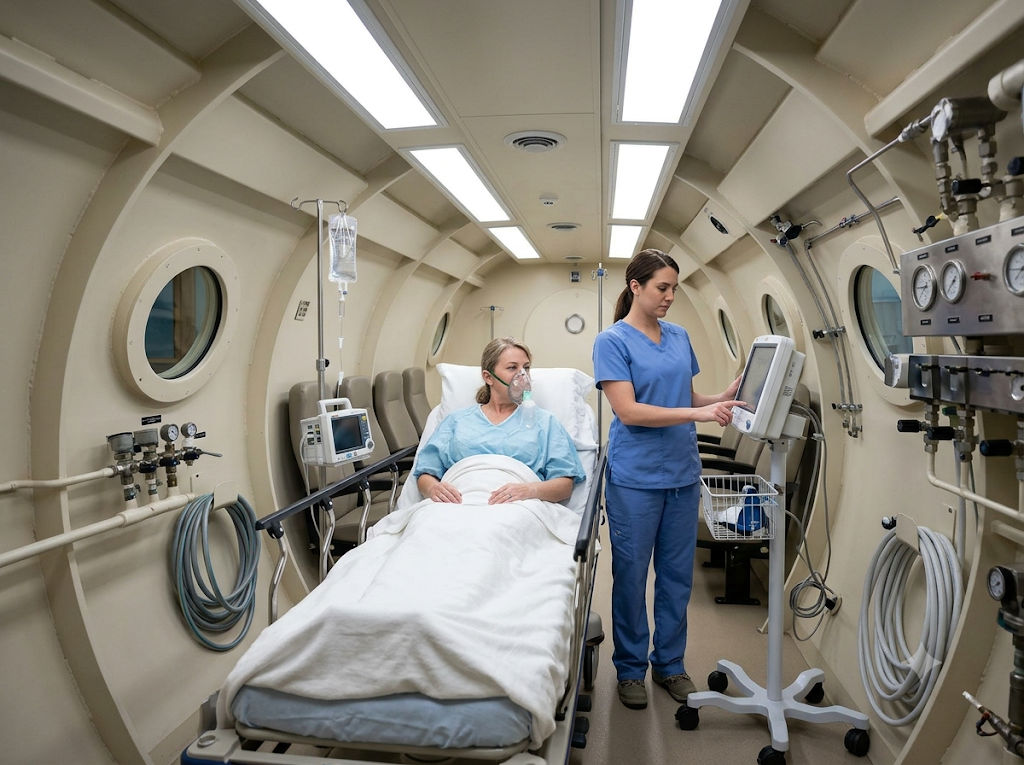
Multi-place chambers accommodate a patient, an inside attendant (chamber operator), and sometimes equipment. Single-place chambers fit one person — claustrophobia is a real concern, but treatment proceeds regardless.
During compression (descent to treatment depth):
- Ear equalization is required — the same Valsalva or Frenzel techniques used in diving. Patients who cannot equalize may need slower compression rates.
- Temperature rises slightly as gas is compressed (adiabatic heating). The chamber may feel warm.
- Voice pitch changes — helium or air under pressure alters sound transmission in the chamber environment.
During treatment:
- Patient breathes oxygen through a mask or demand valve on a schedule (20 on / 5 off for Table 6).
- Inside attendant monitors consciousness, equalization, and mask seal.
- Symptoms often improve within the first O₂ period — tingling may resolve, joint pain may ease. Incomplete resolution does not mean treatment failed; extensions are common.
During decompression (ascent from treatment depth):
- Pressure drops gradually over 1–2 hours with continued O₂/air cycles.
- Do not fly for 12–24 hours after treatment — residual nitrogen and tissue changes require a surface interval (DAN guidance).
What Your Buddy Should Have Done on the Boat
The chamber treats DCS. The boat determines how much damage accumulates before treatment starts. Field protocol — identical for DCS and AGE:
Boat-Side DCI Protocol — Pass/Fail
✓ Pass
• 100% oxygen via demand valve or NRB mask — not room air
• Diver horizontal, left side if possible (reduces bubble transit to brain)
• Hydration if conscious and not vomiting
• DAN called (+1-919-684-9111); chamber notified before transport
• No re-descent, no painkillers that mask symptoms, no alcohol
✗ Fail
• "Rest and see if it goes away" — neurological DCS worsens with time
• Putting diver back in water ("in-water recompression") — not standard care
• Driving to hospital without oxygen en route
• No chamber phone number in the dive center emergency plan
Oxygen on the boat is not optional equipment — it is the bridge between symptom onset and chamber door. Operators without emergency oxygen fail ScubaProof's Oxygen Readiness check regardless of their Trust Score.
When Treatment May Not Fully Resolve Symptoms
Honest expectations matter:
- Neurological Type II DCS treated within 6 hours often shows significant improvement. Delay beyond 24 hours increases permanent deficit risk.
- Spinal cord DCS may leave residual weakness even after multiple treatments.
- Inner ear DCS (vestibular symptoms) can persist for weeks.
- PFO (patent foramen ovale) increases recurrence risk — cardiology evaluation is recommended after any DCS event.
Repeat chamber treatments (Table 6A, Table 4 extensions) are normal, not a sign of failure.
Red Flags in Dive Center Chamber Preparedness
• No emergency oxygen kit on the boat — or kit with expired cylinders
• Staff cannot recite the nearest chamber name and phone number
• No written DCS action plan posted or briefed
• Discourages calling DAN or chamber directly ("we handle it")
• Transport to hospital without notifying chamber first — delays treatment start
How ScubaProof Tracks Chamber Readiness
ScubaProof's Trust Score weights Safety (50%), Staff Conduct (30%), and Gear Quality (20%). Oxygen Readiness is a standalone binary signal — because the quality of your buddy's chamber outcome begins with the oxygen your operator carried on the boat.
Centers with verified emergency oxygen, published chamber contacts, and staff trained in DCI field protocol score higher on Safety. Use Trust Score to filter operators before you dive — then confirm the O₂ kit location yourself on day one.