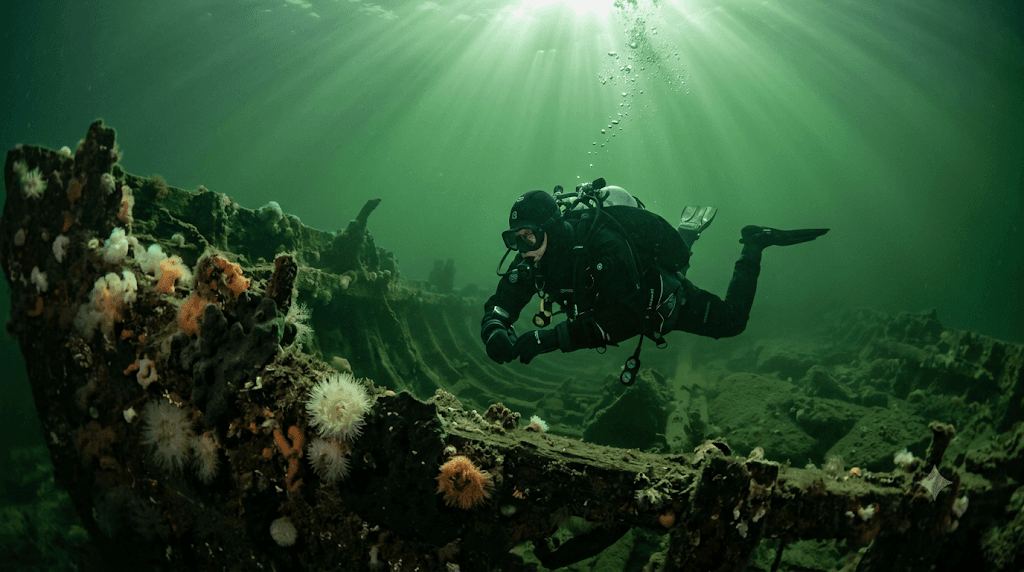
At 18 metres his feet lifted and his head dropped. He had been adding air to the dry suit on descent — the same reflex that works in a wetsuit BCD — and now a bubble the size of a football sat at his shoulders while his legs pointed at the surface. He finned hard, lost his reg, and shot upward from 14 metres. The squeeze on his dry gloves during the rapid ascent left his fingers purple for an hour.
Dry suit diving is not "wetsuit diving with more warmth." The suit is a second buoyancy device wrapped around your body, with inflation and dump systems that behave differently from a BCD. This guide covers suit inflation discipline, dump valve sequencing, feet-first ascent risk, squeeze prevention, and emergency procedures — without repeating wetsuit compression physics from the buoyancy article.
1. Dry Suit vs Wetsuit: Different Buoyancy Physics
A wetsuit compresses with depth, reducing buoyancy — you add air to your BCD to compensate. A dry suit traps a gas space around your entire body. That gas compresses on descent and must be replaced via the suit inflator, or you get a squeeze. On ascent it expands and must be vented via dump valves, or you get an uncontrolled feet-first rise.
Buoyancy Control Split — Dry Suit Discipline
(For general Archimedes/BCD/wetsuit compression principles, see the Buoyancy Control guide — this article covers dry-suit-specific control only.)
2. Inflation: The Suit Inflator and Gas Choice
The dry suit inflator connects to your regulator (usually a low-pressure port) or a dedicated pony bottle. Short bursts — not continuous flow — maintain suit volume without over-inflation.
On Descent — Prevent Squeeze
✓ Pass
Add small suit puffs as compression tightens; feel gentle pressure on body, not pinching at wrists/neck; stay horizontal or slight head-up
✗ Fail
No suit gas until painful squeeze; continuous inflator hold; head-down descent with air pooling at feet
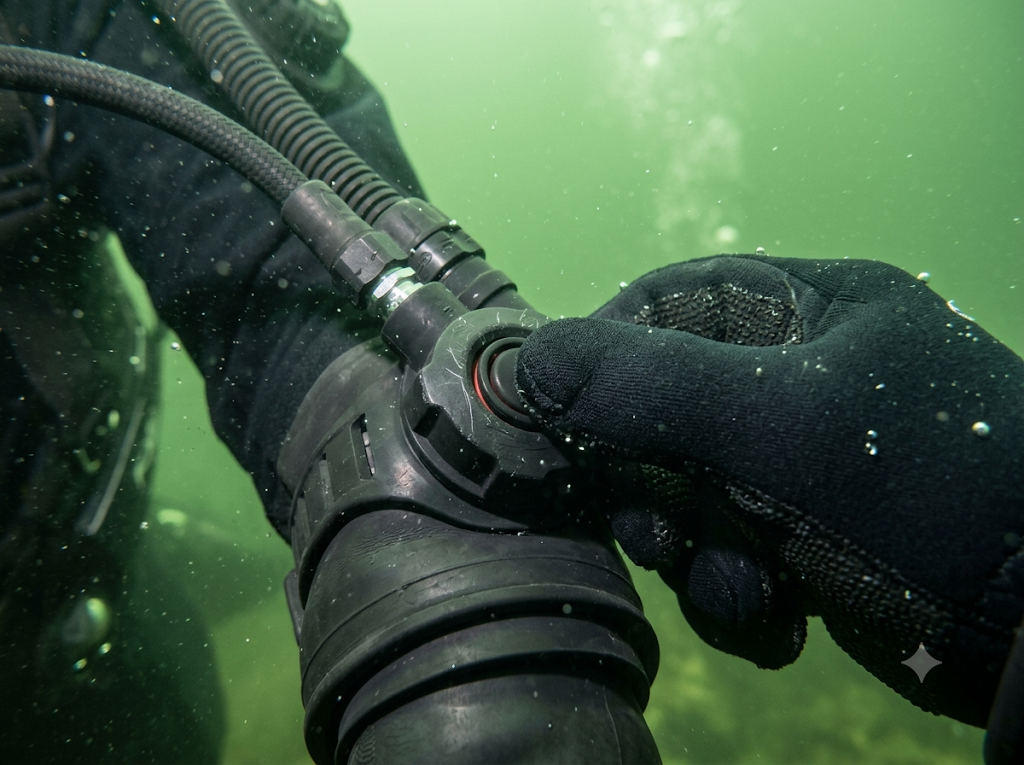
Undergarment thickness changes the gas volume needed. A thick undersuit in cold water requires more suit gas — plan weighting accordingly in a pool or shallow check dive, not on a 30 m wreck.
3. Dump Valves: Shoulder and Cuff
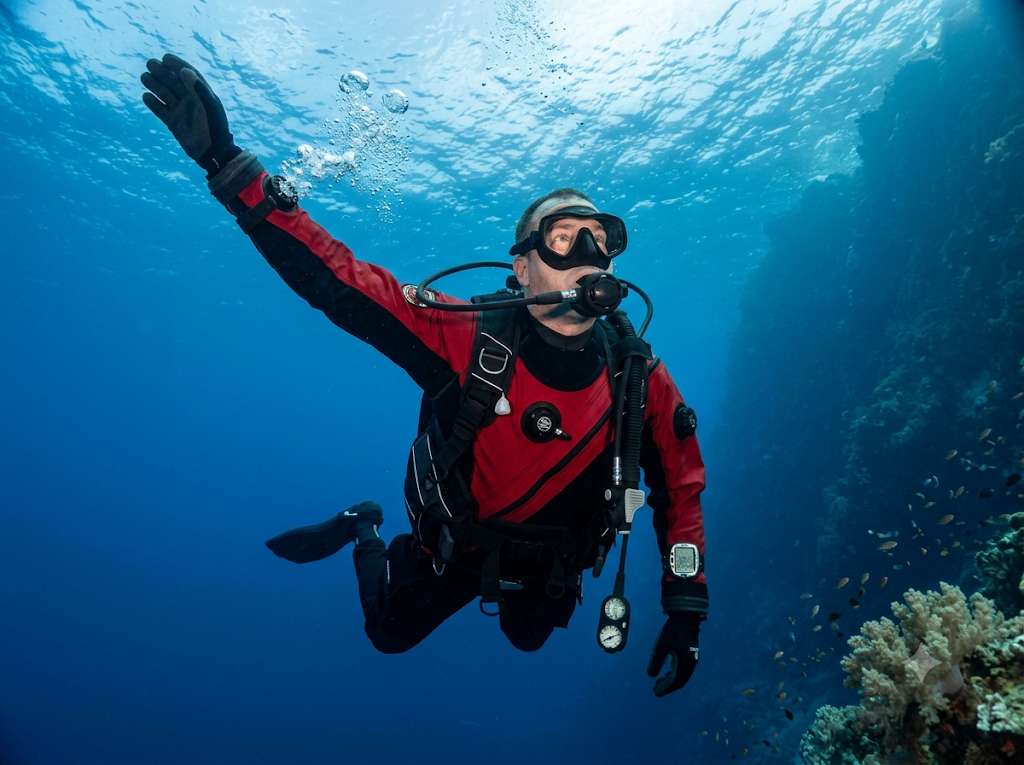
Most dry suits have an automatic shoulder dump (set to vent at a given suit pressure) and a cuff dump operated by raising the arm. On ascent, vent before the expanding suit lifts you.
Ascent sequence:
- Begin venting at 5–6 m or when you feel positive suit buoyancy
- Raise left arm (cuff dump) while holding depth briefly
- Fine-tune with shoulder dump setting — pre-dive adjust for expected depth
- BCD vent handles remaining lift at the surface
4. Feet-First Ascent: The Primary Dry Suit Emergency
When excess suit gas migrates to the feet in a head-down attitude, Boyle's Law takes over: expanding gas accelerates a feet-first surface shot. This is the signature dry suit accident — distinct from BCD runaway because the lift is distributed along the legs.
• Rotate to horizontal or head-up immediately — do not fight feet-first lift with more finning
• Dump suit gas aggressively: cuff up, shoulder dump open
• Vent BCD if combined lift; flare body to increase drag
• Do not hold breath — exhale continuously during any uncontrolled ascent
• At surface: check for barotrauma, DCS signs; breathe O₂ if available
5. Squeeze: Wrists, Neck, and Valves
Suit squeeze occurs when external water pressure exceeds internal suit pressure. It is painful, can cause bruising, and signals you failed to add gas on descent.
| Site | Cause | Prevention | |---|---|---| | Wrist seals | No suit gas; tight seals | Puff suit gas before deep descent; check seal size | | Neck seal | Head-down + no gas | Maintain volume; avoid extreme head-down trim | | Dry gloves | Insufficient gas in gloves | Equalise gloves with small bursts; avoid cotton liners |
A torn neck seal at depth is a flooding emergency — abort the dive, ascend controlled, signal buddy immediately.
6. Training and When to Get Certified
Dry suit diving requires a specialty course (PADI Dry Suit, SSI Dry Suit Diving, etc.) covering:
- Pool/confined water inflation and dump drills
- Weighting with undergarments
- Emergency procedures including feet-first ascent recovery
- Repair and seal maintenance
Do not rent a dry suit for a cold-water holiday without training and at least one supervised checkout dive.
7. The ScubaProof Filter: Dry Suit Operations
Red Flags — Dry Suit Rental Neglect
• Dry suit rented without checkout dive or proof of certification
• Perished neck/wrist seals, non-functioning dumps, incorrect inflator hose routing
• Reviews citing squeeze injuries, runaway ascents, or flooded suits
• Gear score below 3.5
Yellow Flags — Ask Before Booking
• Limited dry suit sizes; no on-site repair kit or spare seals
• Cold-water dives scheduled without dry suit specialty requirement stated
• Staff cannot explain BCD vs suit buoyancy split in briefing
Safety, Gear, Staff Conduct, Oxygen Readiness, and Trust Score on ScubaProof surface operators who maintain dry suit kit and enforce training prerequisites.