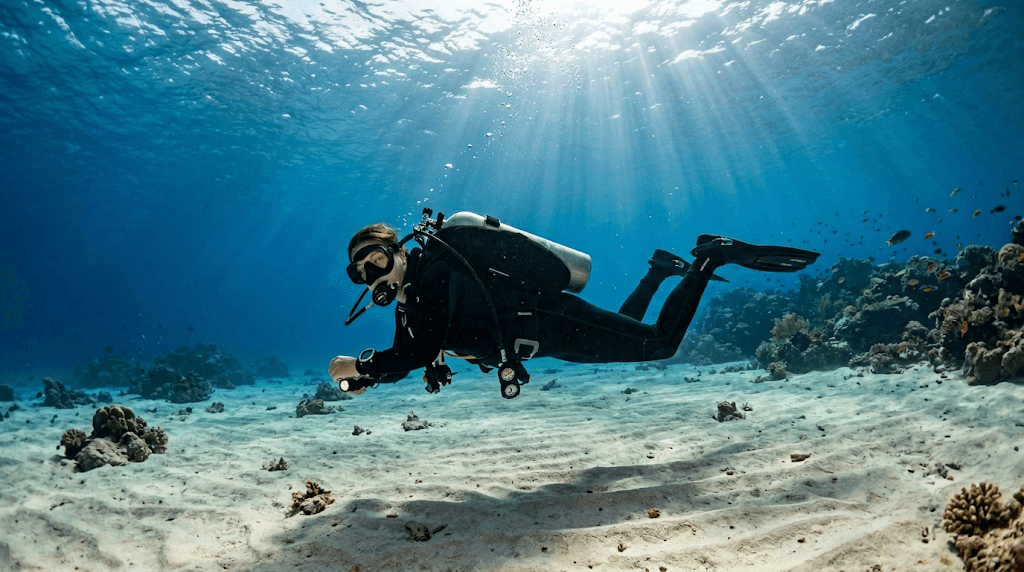
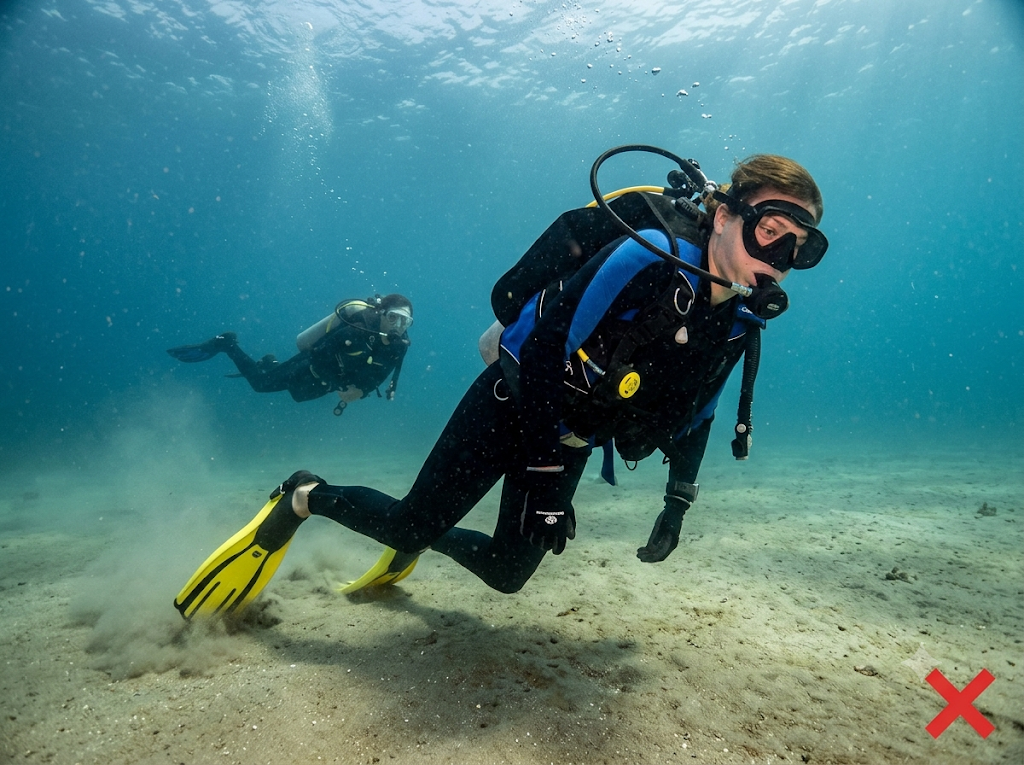
You kneel on the bottom during your Open Water course, fins dragging, cylinder rolling to one side, instructor nodding that "everyone starts like this." The rental jacket BCD is size Large. You are 175 cm and 70 kg. The shoulder straps hang past your elbows and the waistband rides on your hips, not your torso. Every breath sends air to the wrong bladder zone. You think you lack buoyancy skill. You may just lack the right BCD geometry.
Jacket-style BCDs and back-inflate wings solve the same problem — holding your cylinder and controlling ascent — with different inflation physics and trim consequences. The wrong choice, or the wrong fit, turns a manageable dive into a fight against your own gear. This guide explains the mechanism, the travel trade-offs, and what to inspect on rental kit before you giant-stride.
Two Designs, Two Buoyancy Vectors
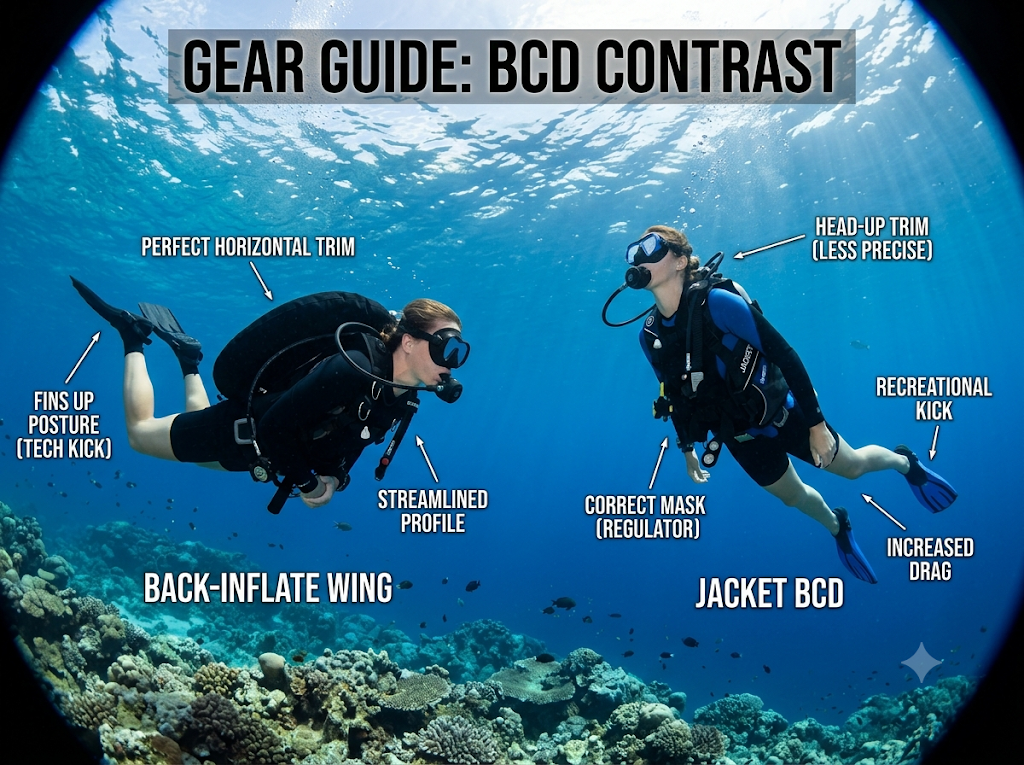
Jacket BCD (stab jacket): inflatable bladders wrap the torso — front, sides, and often behind the diver. Air distributes around the chest and waist. Most Open Water courses teach in jackets because they keep novices upright and face-up on the surface.
Back-inflate wing: a single bladder (or paired bladders) sits behind the diver, between the cylinder and the back plate or soft pack. No front inflation. The diver's chest stays relatively flat underwater.
The trim difference is physics, not preference:
BCD Type — Trim Impact
Poor trim is not cosmetic. A legs-down posture increases drag, raises gas consumption, puts fins near the reef, and makes buoyancy control harder because Boyle's Law acts on a larger vertical profile — small depth changes at the feet translate to bigger buoyancy swings at the head.
Jacket BCD: When It Makes Sense
Jacket BCDs excel for:
- Open Water training — surface flotation is intuitive; students float face-up reliably.
- Boat diving in warm water — integrated weight pockets, pockets for SMB, simple donning.
- Divers who dive infrequently — less configuration to remember.
Problems appear when:
- The jacket is oversized — the most common rental failure. Excess strap length lets the BCD slide on the torso; air migrates unpredictably.
- The diver is overweighted — compensating with BCD gas creates a yo-yo profile (see Buoyancy Control guide).
- Front inflation at depth — a full front bladder pushes the diver's chest up and feet down precisely when horizontal trim matters most.
Jacket BCD Fit — Pass/Fail
✓ Pass
Shoulder straps snug with no more than 5 cm excess; waist band on natural waist (not hips); cylinder band at shoulder-blade height; inflator hose reaches left chest without pulling.
✗ Fail
Straps hang loose, BCD rotates on torso when you twist, cylinder rolls independently, or you need two sizes of weight to compensate for a BCD that will not stay put.
Back-Inflate Wing: Trim and the Learning Curve
Wings are standard in technical diving, sidemount, and increasingly in recreational travel diving. Benefits:
- Horizontal trim — air behind the centre of mass encourages the streamlined posture that reduces gas consumption and reef contact.
- Streamlining — no front bulk; easier to pass through restrictions and swim in current.
- Modular travel — plate and wing pack flatter than a jacket in a bag.
The learning curve is real:
- Surface flotation — wings can float the diver face-down if overinflated on the surface. Practice surface skills in a pool before open water.
- Weighting change — wings typically require 1–2 kg less weight than an equivalent jacket because front bladder buoyancy is absent.
- Dump valve location — rear dump is harder to reach for novices; oral inflation backup matters.
Travel BCD Considerations
Frequent travellers face a packing equation:
- Jacket travel BCDs (e.g. lightweight versions) sacrifice durability and lift capacity for weight. Check lift rating — a 10 kg wing may be insufficient with a steel cylinder in cold water.
- Wing + travel plate systems pack flatter but require assembly at destination.
- Rental at destination — run the full rental gear inspection: inflator adds and dumps cleanly, all dump valves respond, no slow leak at corrugated hose.
Ask the dive center: "What BCD sizes do you stock, and can I try one in the pool before the open-water dive?" A center that refuses a fit check is a center that treats BCDs as interchangeable furniture.
Red Flags in Rental BCD Fleets
• Stuck inflator button or slow-leak at shoulder dump — runaway ascent risk (Boyle's Law expansion near surface)
• Corrugated hose cracked or taped — structural failure under pressure
• One-size-fits-all policy with no size range below Medium
• Weight pockets with broken zippers or missing quick-release handles
• Bladder that takes more than 3 seconds to deflate on shoulder dump test
• Older jacket with faded fabric but functional valves — inspect function, not cosmetics
• Wing offered to OW student without surface practice — ask for jacket alternative or pool session
• Center stocks only wings but guides kneel on every dive — trim culture matters as much as gear
How ScubaProof Scores Gear Quality
ScubaProof's Trust Score weights Gear Quality (20%) alongside Safety (50%) and Staff Conduct (30%). BCD fleets are evaluated indirectly through review signals: stuck inflators, poor fit, missing sizes, and uncorrected gear failures mentioned repeatedly trigger Gear deductions.
Centers that offer fit checks, maintain service logs, and stock multiple sizes per model score higher. Pair Trust Score with your own inflator-and-dump test at the rack — the algorithm catches patterns; your hands catch the specific BCD you are wearing today.