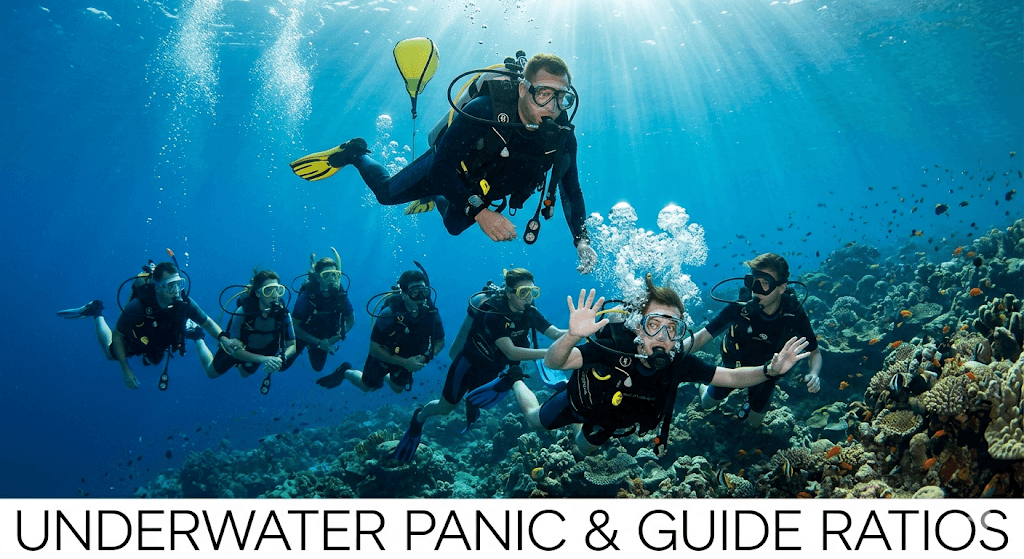
The regulator suddenly feels stiff, like it isn't delivering enough air. The mask has fogged and half-flooded after a fin-kick to the face. The current is stronger than the briefing suggested. And in the time it takes to read this sentence — roughly four seconds — a recreational diver can slide from mild disorientation into a full panic response that ends in an uncontrolled ascent, a ruptured lung, and a hyperbaric evacuation.
Almost none of this is inevitable. The single most powerful variable separating a non-event from a fatality is not your certification card, the water temperature, or the dive site's reputation. It is how many divers your guide is watching at the moment things start to go wrong — and whether they are close enough to physically intervene inside a window measured in seconds.
This guide is written for two readers: the diver who wants to never become the panicking diver, and the diver choosing an operator who refuses to be the one running an unsafe group. Both questions resolve to the same number: the ratio.
1. The Anatomy of Underwater Panic
Panic is not a decision and it is not a character flaw. It is a neurobiological cascade, and underwater it accelerates faster than in almost any other environment because the body interprets submersion plus air-supply doubt as an immediate threat to its most fundamental need: breathing. Once that threat signal fires, higher reasoning is progressively switched off — the diver does not "decide" to bolt, the brainstem decides for them.
The sequence typically unfolds in five stages:
Trigger Event — 0 seconds
Mask flood, unexpected current, regulator free-flow, entanglement, or buddy separation. The perceived threat activates the amygdala before the prefrontal cortex can form a rational response. The diver feels fear before they can name a cause.
Skip-Breathing & CO₂ Loading — 4 to 12 seconds
The diver holds their breath or takes rapid, shallow breaths that move air only in and out of the airway dead space, not the gas-exchanging alveoli. Carbon dioxide builds in the bloodstream. Crucially, it is rising CO₂ — not falling oxygen — that drives the conscious urge to breathe. That air-hunger feels exactly like running out of gas, so the diver "confirms" their own false emergency and the loop tightens.
Buoyancy Loss & Narcosis — 10 to 25 seconds
The diver stops finning, may spit out the regulator, or frantically dumps weights and over-inflates the BCD. Below roughly 30 metres, nitrogen narcosis (an inert-gas effect described by Dalton's law of partial pressures) is already blunting judgement and fine motor control. The narcotised, panicking diver cannot reason their way out — they must be physically managed by someone within arm's reach.
Uncontrolled Ascent — 20 to 40 seconds
The diver kicks for the surface. Gas in an inflated BCD expands as ambient pressure drops, creating a self-accelerating rocket effect: the faster they rise, the more lift they generate. Ascent rates above 18 m/min are routinely recorded in panic scenarios. Modern training agencies cap controlled ascent at 9–10 m/min, with most dive computers alarming at 18 m/min.
Pulmonary Barotrauma & AGE — at the surface
If the diver holds their breath while ascending, the air in their lungs expands (Boyle's law) faster than it can escape, over-pressurising and rupturing lung tissue. Gas forced into the arterial circulation becomes an Arterial Gas Embolism (AGE) that can reach the brain within a minute of surfacing. Note the distinction: this is barotrauma — a mechanical pressure injury — not decompression sickness, which is dissolved nitrogen coming out of solution. AGE is among the leading causes of immediate diving death, and definitive treatment is recompression in a hyperbaric chamber, started as early as possible.
Diving Alert Network (DAN) analyses of recreational fatalities repeatedly converge on the same pattern: in most lethal cases, a diver showing early warning signs was not intercepted in time. This is rarely a failure of the diver's training. It is a failure of supervision capacity — there was no one positioned and free to act in the 10–15 seconds that mattered.
2. The Physics: Why an Uncontrolled Ascent Kills
To understand why a guide has so little time, you have to understand what is happening to the gas in a panicking diver's body. Two gas laws do most of the killing.
Boyle's Law — at constant temperature, gas volume is inversely proportional to absolute pressure. Pressure underwater is measured in atmospheres absolute (ata): 1 ata at the surface, plus 1 ata for every 10 metres of seawater.
Boyle's Law: A Held Breath Expanding on Ascent
The greatest proportional volume change — and the greatest barotrauma risk — happens in the final 10 metres, closest to the surface, where divers feel safest.
The cruel detail is in that last row. The biggest pressure swing per metre is in the shallows. A diver who has held their breath from 5 metres and ascends to the surface still subjects their lungs to a ~1.5× expansion — enough to rupture alveoli. This is why the cardinal rule of scuba is absolute: never hold your breath, breathe continuously, and if your airway is shut on ascent, exhale steadily. A pool training accident at 3 metres can produce the same AGE as one at 30.
Henry's Law governs the slower danger. The amount of a gas dissolving into a liquid is proportional to its partial pressure. At depth, nitrogen dissolves into the diver's tissues (ongassing). On a controlled ascent and safety stop, it comes back out gently as the surrounding pressure drops (offgassing). Rush the ascent and dissolved nitrogen leaves solution faster than the lungs can clear it, forming bubbles — that is decompression sickness (DCS). A panic ascent therefore stacks two separate injuries: barotrauma/AGE from expanding lung gas, and DCS from skipped offgassing. The 9–10 m/min limit and the 3-minute safety stop at 5 metres exist to keep both in check.
3. The Time Factor: Seconds the Guide Doesn't Have
Here is the arithmetic dive operators rarely advertise.
A diver at 18 metres begins a panic ascent. The maximum safe ascent rate is 9–10 metres per minute, so a controlled diver takes about two minutes to surface from this depth. A panicking diver ascending at 30 m/min reaches the surface in roughly 36 seconds. The window for physical interception — the guide closes distance, grips the diver, establishes eye contact, and arrests buoyancy — is approximately 10 to 15 seconds from the moment the ascent begins. Miss it and the only remaining option is surface rescue and oxygen.
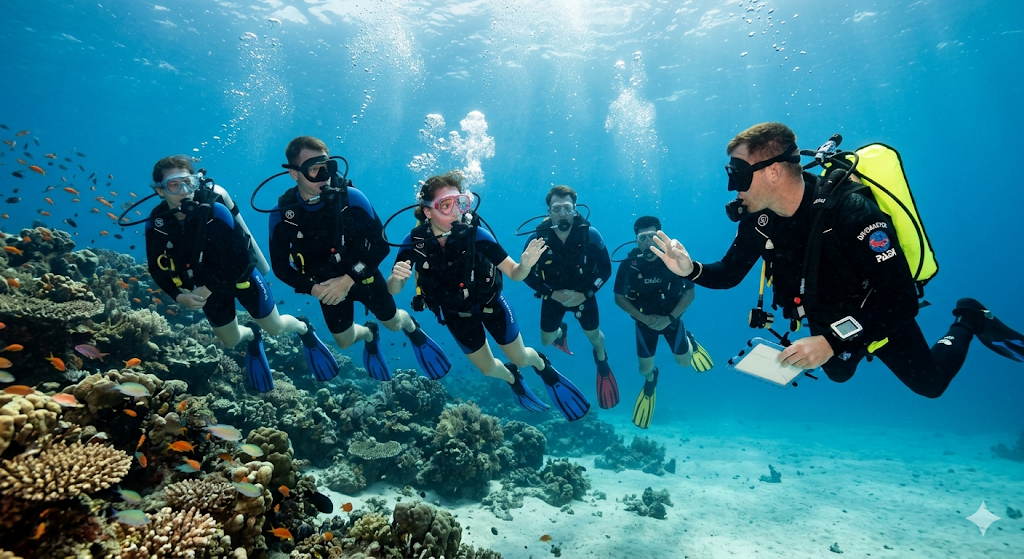
Now overlay attention. A guide cannot stare at one diver; they cycle their gaze across the group, navigate, monitor their own depth and gas, and watch the time. Assume a generous 12-second scan cycle — the time to complete one full sweep of the group and return to any given diver.
Attention Capacity vs. Ratio: Time-Per-Diver in a 12-Second Scan Cycle
Illustrative model assuming continuous scanning; in reality attention is further divided by navigation, depth monitoring, gas checks, and the guide's own buoyancy management.
This is the structural problem with a 1:8 ratio in anything other than a calm, shallow, flat-bottom dive: the guide physically cannot achieve the scan frequency needed to catch panic inside its first 15 seconds. By the time the group's drift brings the struggling diver back into view, the diver is already ascending — and the guide is on the far side of the group with current between them.
4. What Agency Standards Actually Mean
Training agencies publish maximum supervision ratios. These are upper limits beyond which the agency considers the dive non-compliant — they are not "ideal" numbers, and the published maximums always assume the easiest conditions and competent, comfortable divers. They are the line at which an operator can claim they followed the rules, not the line at which divers are safe.
The numbers also differ by what kind of dive it is — a certified guided fun dive, a training course with students, or a discover/intro program for uncertified participants — and the strictest of those usually governs.
| Agency | Certified guided dive | Training / students in water | Intro / uncertified |
|---|---|---|---|
| PADI | No fixed cap; guide discretion | Up to 1:8 open water (+2 with certified assistant) | 1:4 confined / discover scuba in water |
| SSI | Guide discretion by conditions | Up to 1:8 open water training | 1:4 try-scuba / basic diver |
| CMAS / BSAC | Club ethos: small teams, buddy pairs | Typically 1:4 or tighter for students | 1:2–1:4 closely supervised |
| GUE / TDI (tech) | Self-sufficient teams of 2–3 | Commonly 1:3 or 1:4 max for tech students | N/A — prerequisites required |
Maximums vary by standard revision and local regulation; always treat them as ceilings, not targets. Many DAN-aligned safety practitioners recommend 1:4 as a working maximum for any recreational guided dive regardless of depth.
The 1:8 figure was conceived for sheltered, shallow training and resort diving with comfortable participants on dives they have done before. When operators apply it to first-time open water divers, to drift dives in current, or to low-visibility night dives, they are stretching a standard designed for the easiest possible conditions over the hardest possible ones.
Condition Multipliers: When Standard Ratios Must Drop
Conditions compound. A guide's effective capacity is not fixed — every adverse factor shrinks it, and two factors together shrink it more than either alone.
The most dangerous operations in the world are not the ones diving the deepest water or the strongest current. They are the ones running 1:8 groups of mixed-experience divers into exactly those conditions while marketing it as "advanced fun diving."
5. Briefing Quality: The Guide's Most Powerful Safety Tool
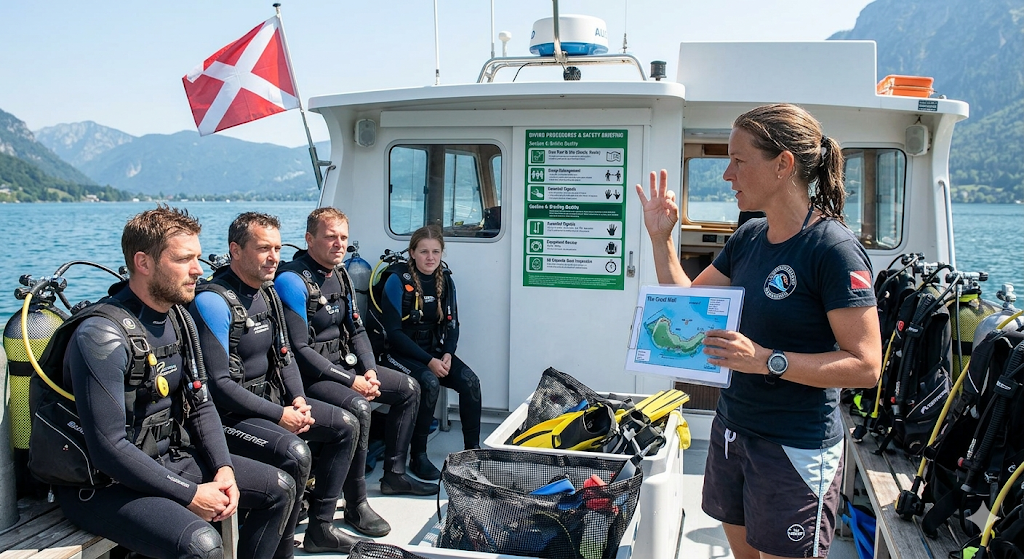
A pre-dive briefing is not procedural housekeeping. It is the primary mechanism by which a guide calibrates each diver's comfort level, spots anxiety before anyone enters the water, assigns buddy pairs deliberately, and establishes the communication contract that makes in-water intervention possible. A good briefing prevents the Stage 1 trigger from ever firing.
DAN incident data consistently shows that divers who received an inadequate briefing had a higher rate of in-water emergency responses, independent of certification level. On a guided dive, the quality of the briefing predicts the day better than the C-card in the diver's pocket.
What a Quality Briefing Contains
Site conditions delivered personally, not by recording
A pre-recorded audio briefing cannot see your face when it says "moderate current." A live guide can. Eye contact, vocal tone, and the chance to ask "have you dived in current before?" are what separate a briefing from a disclaimer.
Explicit panic protocol and signal review, not just "any questions?"
"If you feel uncomfortable at any point, make eye contact with me, put your fist on top of your head, and I will come to you." A clear self-summon signal plus a quick review of the core hand signals — OK, problem, out-of-air, up, down, low-on-air — gives the diver an exit path before they need it, which by itself lowers the probability of a solitary bolt.
A planned lost-buddy and lost-group procedure
The standard rule: search for no more than one minute, then ascend slowly, complete a safety stop if your computer and gas allow, and reunite on the surface. A briefing that never states this leaves a separated diver improvising at the exact moment they are most likely to panic.
Under 3 minutes / no signal review / no buddy assignment
A briefing that ends before covering what to do when something goes wrong is a legal formality, not a safety briefing. Ask yourself two questions before you giant-stride: does the guide know who your buddy is, and do you know who your buddy is?
6. The Diver's Job: Stop a Panic Before It Starts
Supervision is half the equation. The other half is what you bring to the water. No ratio rescues a diver who never built the reflexes that interrupt the panic loop. The single most protective habit is also the simplest.
S — Stop. Freeze motion. Stop finning, stop reaching, stop ascending. Grip a fixed reference if one is near.
T — Think (and Breathe). Take one slow, deep, complete breath, then a long exhale. This single act flushes CO₂, kills the false air-hunger, and reactivates rational thought.
O — Observe. Check your gauge, your depth, your buddy, your guide. Almost always the real situation is less dire than the felt one.
A — Act. Now, calmly, solve the actual problem: clear the mask, signal the guide, switch to your alternate air source.
Pro habits that prevent the cascade
Breathe slow and deep — never skip-breathe
Long, full exhalations are what keep CO₂ down. Holding breath "to save air" does the opposite: it loads CO₂ and manufactures the very air-hunger that feels like an emergency. Continuous breathing is also your barotrauma insurance on any ascent.
Master neutral buoyancy and a horizontal trim
A diver who is correctly weighted (not over-weighted), neutrally buoyant, and trimmed flat is not fighting the water. Over-weighting forces a head-up, feet-down posture, more BCD air, and an unstable platform that turns any wobble into a buoyancy emergency. Get weighting checked at the surface; you should hover at eye level on an empty BCD with a near-empty cylinder.
Rehearse the "annoying" skills until they are boring
Mask flood-and-clear and alternate-air-source use are exactly the triggers that start a panic. Practise them at the start of a dive, in shallow water, every few trips. A skill you can perform without thinking cannot become a Stage 1 trigger.
Never dive task-loaded, hung-over, dehydrated, or to impress
Fatigue, dehydration, and a hangover all raise DCS risk and lower your panic threshold. So does peer pressure. The most experienced divers are the ones most willing to thumb a dive — calling it before or during is a skill, not a failure.
If your buddy panics — what NOT to do
• Do not approach head-on into their reach — a panicking diver grabs, climbs, and can submerge a rescuer. Approach from behind or below.
• Do not try to out-muscle a surface ascent that has already started; control buoyancy, signal, and protect their airway instead.
• Do not remove your own regulator to "share calm." Keep your air. Offer your alternate, establish contact, and ascend at a controlled rate.
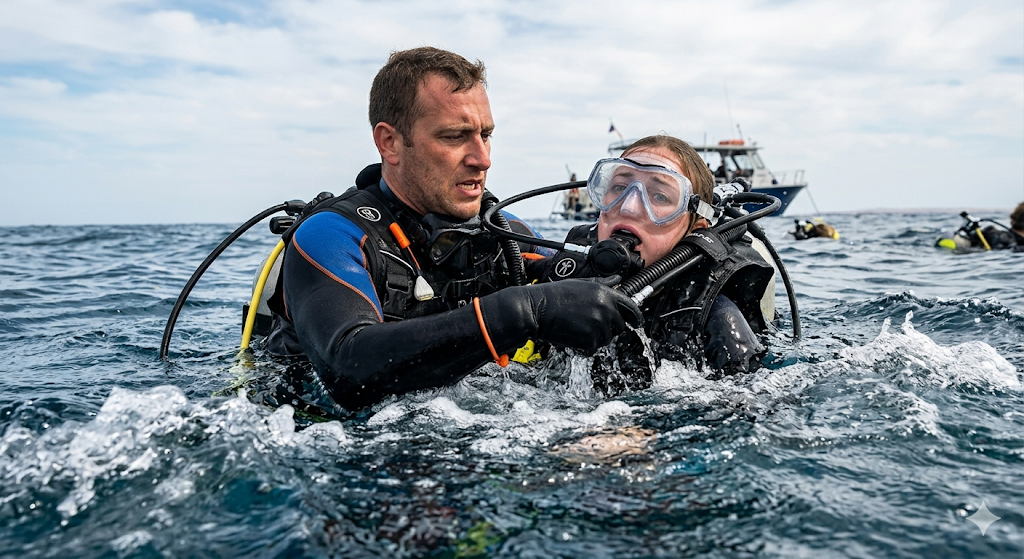
• On the surface, inflate their BCD, drop weights if needed to keep them afloat, and call for the boat and oxygen. This is rescue-diver territory — your job until help arrives is buoyancy and airway.
7. Oxygen Readiness: The Last Link in the Chain
When interception fails and a diver surfaces from an uncontrolled ascent, the treatment for suspected AGE and DCS is the same first step: 100% oxygen, administered immediately and continuously, while arranging evacuation to a hyperbaric chamber. Breathing high-concentration oxygen at the surface increases the pressure gradient that drives inert gas out of bubbles and improves oxygenation of injured tissue — it can meaningfully change the outcome before the chamber is even reached.
This is why an operator's oxygen provision is not paperwork. ScubaProof tracks it as a distinct Oxygen Readiness signal, because three things must all be true at once:
A full O₂ kit is physically aboard the boat — every dive
A demand valve and/or non-rebreather mask, an adequately sized cylinder, and enough gas to last until evacuation. A kit "back at the shop" does not exist for the diver bleeding minutes on the boat.
Staff are current in emergency O₂ administration and CPR
Equipment without a trained, in-date provider is a prop. Ask when staff last refreshed their emergency oxygen and CPR/first-aid certifications.
A written emergency action plan with chamber contacts
The nearest functioning hyperbaric chamber, the evacuation route, and the DAN emergency hotline should be posted, not improvised. In remote dive regions the nearest chamber may be hours away — the plan is what closes that gap.
8. How ScubaProof Detects Supervision Failures
Ratios, briefings, and oxygen readiness all reduce to one human variable: was someone watching, and were they ready? ScubaProof separates this into distinct metrics — Safety, Gear, Staff Conduct, Oxygen Readiness, and the composite Trust Score — because they are genuinely independent. A center can keep immaculate gear and a clean compressor log and still fail the human side entirely.
The Staff Conduct metric specifically captures supervision behaviour. Our extractive language engine scans verified reviews for a pattern cluster we call supervision signal vocabulary — it reports what divers actually described, it does not invent accusations:
• "guide disappeared" / "left us alone at depth" / "never saw our guide underwater"
• "my OK signal was ignored" / "couldn't get the guide's attention"
• "briefing was two minutes" / "no briefing, just got in the water"
• Any mention of an uncontrolled ascent, near-miss DCS, or AGE event
• "group was too large" / "guide couldn't keep track of everyone"
• "rushed briefing" / "briefing was very generic, not site-specific"
• "guide was on the phone during the briefing" / "seemed distracted"
A center can have pristine gear, a clean compressor log, and still carry a degraded Staff Conduct score — because equipment maintenance and human attention are separate disciplines. Both must be present; neither substitutes for the other.
Questions to ask the operator before you book
1. What is your maximum guide-to-diver ratio on this dive, in these conditions?
2. Do you reduce the ratio for current, depth, low visibility, or beginners?
3. How are buddy pairs assigned, and how long is the briefing?
4. Is emergency oxygen on every boat, and when did staff last refresh O₂ and CPR training?
5. Where is the nearest hyperbaric chamber, and what is your emergency action plan?
A confident, specific answer is itself a good sign. Vagueness, irritation, or "don't worry about it" is a red flag of its own.
When you search for your next dive center on ScubaProof, read the Staff Conduct and Oxygen Readiness scores alongside the Trust Score. Together they are the closest available proxy — without being in the water yourself — for the only question that ultimately matters: will someone be watching, and ready, when things go wrong?
Safe bubbles.