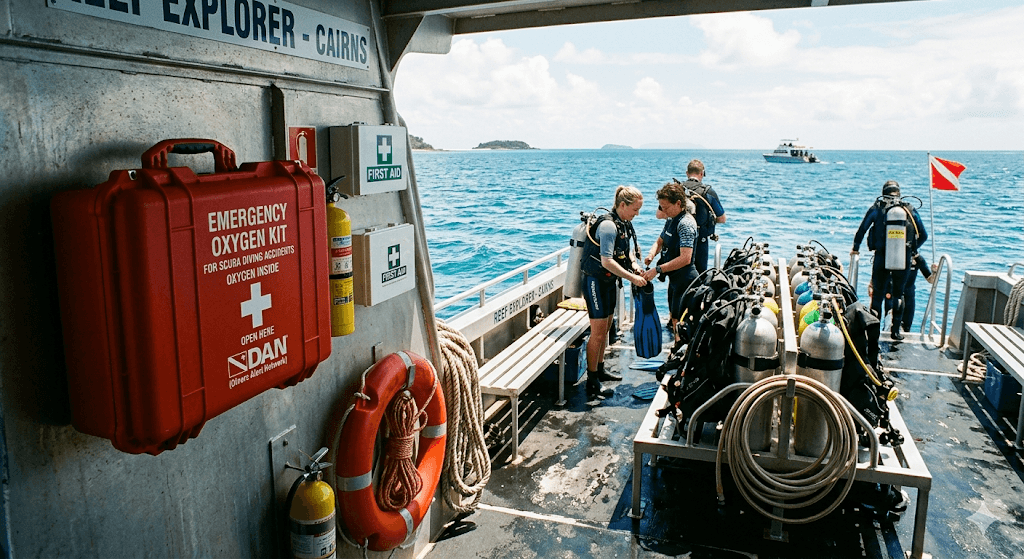
The dive boat carries an oxygen kit. The crew knows where it is. That means you're safe — right?
Not necessarily. In a decompression illness emergency, the type of oxygen delivery system on that boat, the pressure left in the cylinder, and whether anyone aboard has actually trained on it can be the difference between a diver who walks off the pier and one who is airlifted to a hyperbaric chamber with permanent neurological deficit. Many recreational operations carry a kit that delivers far less than the medical standard — and virtually none of them mention it in the briefing.
This is the briefing they skipped.
1. The Anatomy of DCI: Why 100% Oxygen in the First Minutes Matters
Two distinct injuries hide under the umbrella term decompression illness (DCI), and emergency oxygen is the front-line treatment for both:
- Decompression sickness (DCS) — dissolved inert gas (nitrogen on air, or nitrogen on most nitrox blends) comes out of solution faster than the circulation can transport and exhale it, forming bubbles in blood and tissue. This is a dissolved-gas problem governed by Henry's Law: the amount of gas dissolved in a liquid is proportional to its partial pressure. Ascend too fast and the surrounding pressure drops faster than the tissue can offgas — the gas that loaded in under pressure has nowhere to go but out of solution.
- Arterial gas embolism (AGE) — a mechanical lung injury. Hold your breath or have gas trapping on ascent and Boyle's Law (gas volume rises as pressure falls) over-expands the alveoli, forcing gas bubbles directly into the arterial circulation. AGE can reach the brain within seconds of surfacing and is a true time-critical emergency. It is barotrauma, not a dissolved-gas illness — a distinction that matters clinically, even though the surface first aid is identical: lay the diver flat, give 100% oxygen, call for evacuation.
Confusing the two, or calling DCS "the bends" and stopping there, is an amateur tell. Confusing either with ear or sinus barotrauma — a pressure injury that does not call for emergency oxygen protocols — is worse.
The first-aid response is built on a single physiological lever: the oxygen window (the inherent unsaturation of venous blood).
When a diver breathes near-100% oxygen at the surface, the partial pressure of inert gas in the lungs drops to near zero. By Dalton's Law the breathing mix is now almost entirely oxygen, so the alveolar nitrogen pressure collapses. That creates a steep diffusion gradient — dissolved nitrogen rushes from the tissues into the blood and out through the lungs. This accelerated washout does not cure DCI; resolving the bubbles still requires recompression in a hyperbaric chamber. But it shrinks existing bubbles, slows new bubble growth, oxygenates tissue downstream of any vascular blockage, reduces the inflammatory cascade, and — critically — buys time for evacuation.
DAN Research: Effect of Oxygen First Aid on DCI Outcome
Source: Divers Alert Network annual diving / fatality reports. Time-to-oxygen and oxygen fraction are the two most actionable variables available to bystander first responders.
The standard of care endorsed by DAN, the Undersea and Hyperbaric Medical Society (UHMS), the Diving Medical Advisory Committee (DMAC) and every major training agency is: the highest possible oxygen fraction, delivered continuously, started as soon as possible, and maintained until hyperbaric care takes over. The target is an inspired oxygen fraction approaching 1.0 — not 0.6, not 0.55. As close to 100% as the equipment allows.
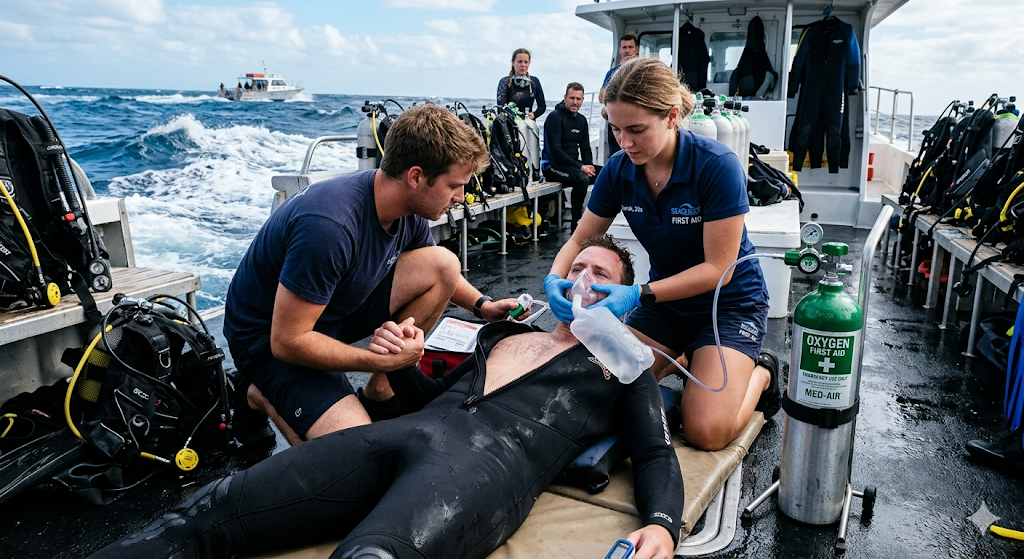
2. The Great Misconception: Why Constant-Flow Masks Under-Deliver at Sea
Walk onto a typical dive boat and you'll find a kit that looks the part — a green or white aluminium cylinder, a pressure gauge, a non-rebreather mask (NRM) sealed in a bag. The crew will tell you, in good faith, that they have emergency oxygen on board.
What they often have is a constant-flow system that, in real field conditions, delivers well below 100% oxygen. Here's the physics of why.
A non-rebreather mask feeds oxygen continuously into a reservoir bag at a fixed rate — typically 10–15 litres per minute — and the patient draws from that bag. A one-way valve between bag and mask, plus one-way flaps on the exhalation ports, are supposed to keep room air out. In a tightly sealed, well-managed NRM at 15 L/min, inspired oxygen can reach roughly 60–80%. But three things conspire against that on a pitching boat:
- Peak inspiratory flow outpaces the bag. A frightened, hyperventilating DCI casualty can demand 30–60 L/min at the peak of a breath. When the reservoir empties faster than 15 L/min refills it, the mask draws ambient air through its safety ports — exactly when you need oxygen fraction highest.
- Field seals leak. Beards, vomit, an unconscious slack jaw, the wrong mask size, a panicking patient pulling the mask off — every leak entrains 21%-oxygen air. A loose NRM in practice often delivers closer to 40–55%.
- The supply drains whether or not the diver inhales. That's the killer on a finite cylinder.
The non-rebreather mask has a legitimate role: in a hospital with piped, unlimited oxygen, or as the backup mode on a dive boat when no demand valve is available, or for a patient who cannot generate enough inspiratory effort to trigger a demand valve (weak, semi-conscious, or in respiratory arrest). Recent DAN bench work even shows a well-sealed NRM at 15 L/min can rival a demand valve for tissue oxygenation — when the seal is perfect. On a finite cylinder, with an imperfect seal, on a moving boat, constant flow alone is the wrong primary tool.

3. The Gold Standard: The Demand Valve System
A demand valve (also called a positive-pressure demand valve, PPDV, or demand inhalator valve) delivers oxygen only when the patient creates a slight negative pressure by starting to inhale. The valve opens, delivers a breath of near-100% oxygen, then closes completely. No flow occurs between breaths. With a well-sealed oronasal mask it delivers roughly 95–100% inspired oxygen — and wastes essentially nothing.
That efficiency does two jobs at once: it maximises the oxygen fraction (steepening the washout gradient from Dalton's and Henry's laws) and it stretches a small cylinder across the long evacuation window.
Oxygen Concentration Delivered to Patient
Constant-Flow NRM (15 L/min)
40–80%
Upper end only with a perfect seal; field reality on a moving boat is often 40–55%, diluted by air entrainment at peak inhalation
Demand Valve (sealed mask)
95–100%
Opens only on inhalation; zero entrainment between breaths; zero exhalation waste
Approx. Duration from a ~425 L (size D) Cylinder
Constant Flow @ 15 L/min
~28 min
Fixed drain; may be exhausted before many evacuation routes are completed
Demand Valve (calm casualty)
~60–90 min
Tracks the patient's real minute volume; carry spare cylinders for long evacuations regardless
Quick Reference — Three Delivery Devices, One Goal (FiO₂ → 1.0)
A complete kit carries all three: a demand valve for the conscious diver, an NRM for backup, and a bag-valve or pocket mask with an oxygen inlet for the diver who has stopped breathing.
Demand-valve kits are available from DAN, Cramer Decker, OxyCheq and similar suppliers at price points within reach of any operation. Provider training is short and standardised:
- DAN — Emergency Oxygen for Scuba Diving Injuries (EO2): a half-day course covering demand valve, constant flow, NRM and oronasal resuscitation mask.
- PADI — Emergency Oxygen Provider and SSI — Diver Stress & Rescue / React Right cover the same skill set.
- For working professionals offshore, DMAC and IMCA guidance and most TDI technical standards require oxygen capability matched to dive profile and evacuation time.
There is no technical barrier to deploying demand-valve delivery universally — only cost-cutting and institutional inertia.
DAN position (paraphrased): a demand valve is the preferred method of administering emergency oxygen to a conscious, spontaneously breathing diver. Constant-flow delivery should be considered a backup, or used when the patient cannot generate adequate inspiratory effort to trigger the valve.
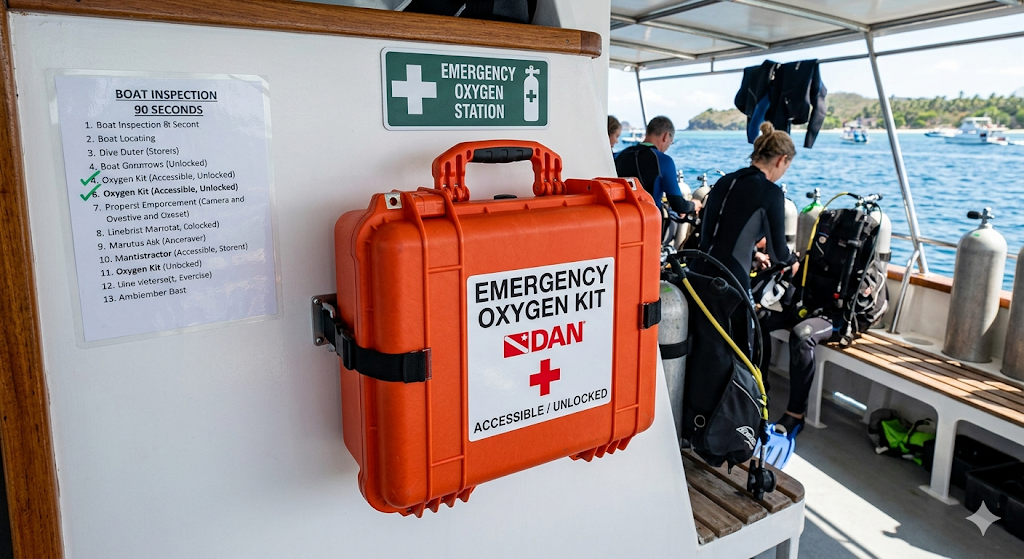
4. Boat Inspection: Assessing Oxygen-Kit Readiness in 90 Seconds
Before you board, you have every right to ask to see the emergency oxygen kit. A prepared operation produces it without hesitation and without defensiveness. Here's the checklist.
Cylinder Pressure
✓ Acceptable
Gauge reads near full — roughly 2000 psi / 140 bar. Ask the date of the last fill and last hydrostatic test stamped on the cylinder neck
✗ Reject — insufficient supply
Below ~1000 psi / 70 bar leaves little margin for a long evacuation. A gauge reading near zero means the kit is decorative. No spare cylinder = single point of failure
Demand Valve Function
✓ Acceptable
A demand valve is present, not just an NRM. With the cylinder cracked open, a gentle test inhalation triggers a clean, free flow that stops the instant you stop drawing. Silicone membrane is supple
✗ Reject — valve failure risk
Cracked, stiff or perished membrane: the valve may not trigger from a casualty's weak inspiratory effort. Free-flowing without inhalation wastes gas. A membrane is a cheap part — a perished one signals skipped servicing
Masks: Type, Sizes, Seal
✓ Acceptable
Tight oronasal mask for the demand valve, an NRM as backup, and a pocket/BVM mask with O₂ inlet for a non-breathing diver. Silicone seals supple and unwarped; more than one size on board
⚠ Backup only
NRM with no demand valve: workable in absolute emergency, but lower oxygen fraction and faster gas drain. Flag the gap to the operator before you dive
Storage, Service Log & Trained Crew
✓ Acceptable
Kit in a labelled, sealed case out of direct sun and away from oil/grease (an O₂ fire hazard). Dated inspection log with initials. At least one current oxygen-provider-certified crew member aboard
✗ Red Flag
Kit baking in a hot engine compartment or open sun — heat perishes silicone. No log, no provider on board, or a crew that hunts for the case while you watch. Unknown readiness = no readiness
5. If It Happens: The On-Boat Protocol
Recognition first. Suspect DCI if a diver shows any of these within ~24 hours of surfacing: unusual fatigue, joint pain, skin mottling, numbness or tingling, weakness, dizziness, difficulty walking, breathing trouble, or altered consciousness. When in doubt, treat for DCI. Oxygen first aid carries minimal risk; under-treating does not.
- Ensure scene safety, then check responsiveness, Airway, Breathing, Circulation.
- Start 100% oxygen immediately — demand valve for a conscious, breathing diver; NRM at 15 L/min only if no DV; BVM/pocket mask with O₂ inlet if not breathing.
- Lay the diver flat (supine). Do not use head-down or Trendelenburg positions — they raise intracranial pressure without benefit.
- Keep the diver still and warm; treat for shock. Give clear, non-alcoholic fluids only if fully conscious and able to swallow.
- Call DAN emergency hotline and local EMS/coastguard. Start evacuation toward the nearest hyperbaric chamber.
- Maintain oxygen continuously — do not stop on the boat just because symptoms ease. Improvement on oxygen is expected and is not a cure. Switch to a fresh cylinder rather than letting flow lapse.
- Note dive profiles, gas mix, max depth, ascent rate, and symptom timeline for the receiving physician.
- • Do not attempt in-water recompression — sending a symptomatic diver back down is dangerous without specialist protocols, gear and gas.
- • Do not stop oxygen because the diver "feels better." Symptom relief on O₂ is expected, not resolution.
- • Do not let the diver fly or ascend to altitude before clearance — lower pressure re-grows bubbles.
- • Do not bring oil, grease or open flame near the kit — concentrated oxygen makes hydrocarbons violently flammable.
- • Do not give aspirin or alcohol, and do not assume "it's just dehydration." Treat and evacuate.
6. The "Oxygen Readiness" Metric on ScubaProof
ScubaProof treats oxygen readiness as a binary critical safety variable — not a number that averages into a center's overall rating. It sits outside the 1–5 Gear score because the consequence of failure is categorically different from a leaky BCD or a stiff regulator. Where the four core ScubaProof signals — Safety, Gear, Staff Conduct and Oxygen Readiness — feed the composite Trust Score, oxygen readiness can also stand alone as a hard gate.
Our data engine scans verified reviews for a specific cluster of oxygen-related signals:
- • Any mention of no oxygen on the boat, or crew unable to locate the kit
- • A described DCI incident where oxygen was not administered
- • Cylinder reported empty or near-empty during an actual emergency
- • Crew described as untrained in oxygen administration during an incident
- • Oxygen kit present but crew hesitant or unsure how to use it
- • Kit described as constant-flow-only, with no demand valve
- • Cylinder pressure not verified at the start of the dive day (crew "assuming it's fine")
A center can post a 5.0 Gear score, a perfect Safety rating, and still carry a Red Flag for oxygen readiness. These signals do not cancel out. They appear side by side because they answer different questions: how well-maintained is the routine equipment versus will you survive the emergency.
When you search ScubaProof before your next trip, check the Oxygen Readiness indicator first. Everything else is secondary.
Safe bubbles.