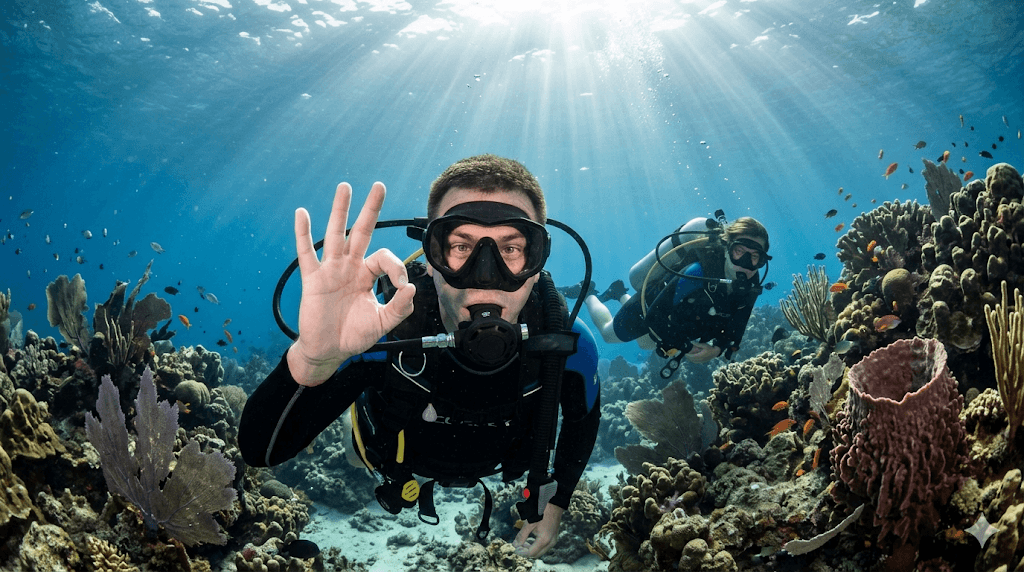
You are at 14 metres on a reef wall. Your buddy points at something behind you, then flashes a flat palm — the universal "stop." You turn, see a current picking up, and she taps her SPG and holds up three fingers: 30 bar remaining. You nod OK, signal "up," and start a controlled ascent. No words were spoken. No radio. The entire exchange took four seconds.
Underwater hand signals are not etiquette — they are a life-support communication system. Sound does not travel through water the way it does in air. Your regulator is in your mouth. Your mask hides half your face. When visibility drops to three metres on a drift dive, hand signals are the only channel between you and your buddy, your guide, and the boat crew watching from the surface.
This guide covers the core signal set every certified diver should know, regional variations that cause dangerous misunderstandings, and the signals most Open Water courses gloss over — low air, panic, and abort.
Why Signals Fail: Visibility, Culture, and Assumptions
Communication underwater fails for predictable reasons — not because divers are careless, but because the medium is hostile to information transfer.
- Light and visibility. At 20 metres in green water, colour shifts and contrast drop. A subtle finger gesture that works in a pool vanishes on a wreck at 15 metres visibility.
- Regional training standards. PADI-dominated resorts in Southeast Asia teach one signal set. European CMAS/FFESSM schools teach another for "OK" and "problem." A European diver's "OK" (thumb and forefinger circle) can be read as "zero" or "something's wrong" by an American-trained guide.
- Assumption of universality. Instructors teach signals in confined water, then groups disperse across the world assuming everyone learned the same chart. They did not.
Signal failure cascade — what happens when communication breaks
The fix is not memorising more gestures — it is agreeing on a signal set before the dive, in the surface briefing, and using large, deliberate movements underwater.
Core Signals: OK, Problem, Air, Direction
These four categories cover roughly 90% of recreational dive communication. Make each signal big, slow, and held until acknowledged.
OK — "I am fine / Do you understand?"
OK (question): thumb and forefinger forming a circle, other fingers extended. OK (answer): same gesture returned.
Both arms raised overhead and held — visible to boat crew from a distance. Do not confuse with the underwater circle OK.
Flat hand, palm down, rocking side to side — "something is wrong." Respond immediately; do not continue the dive.
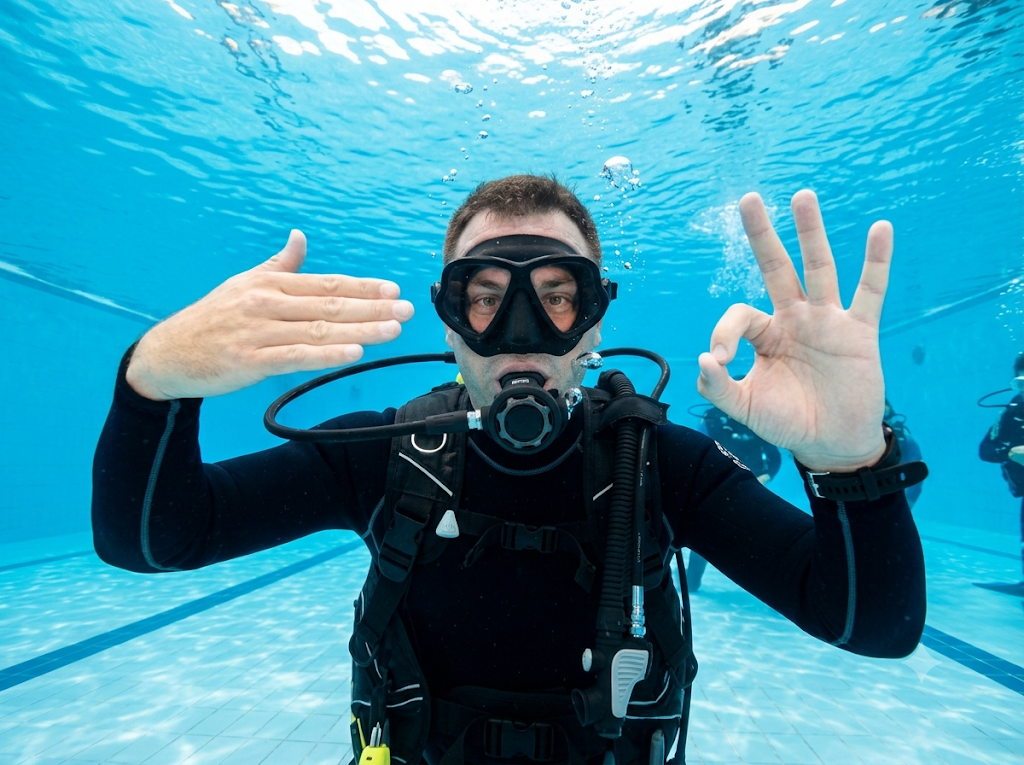
Problem / Something Wrong
Wave an open palm side to side (like a "slow down" gesture on the road). This is the signal that demands immediate attention — not a casual "look at this fish." Your buddy should close distance, make eye contact, and wait for a follow-up signal (air, ear, cold, etc.).
Air Pressure
The standard recreational signal: tap your SPG or chest, then hold up fingers for remaining pressure in tens of bar (or hundreds of psi).
Air pressure signals — bar system (metric)
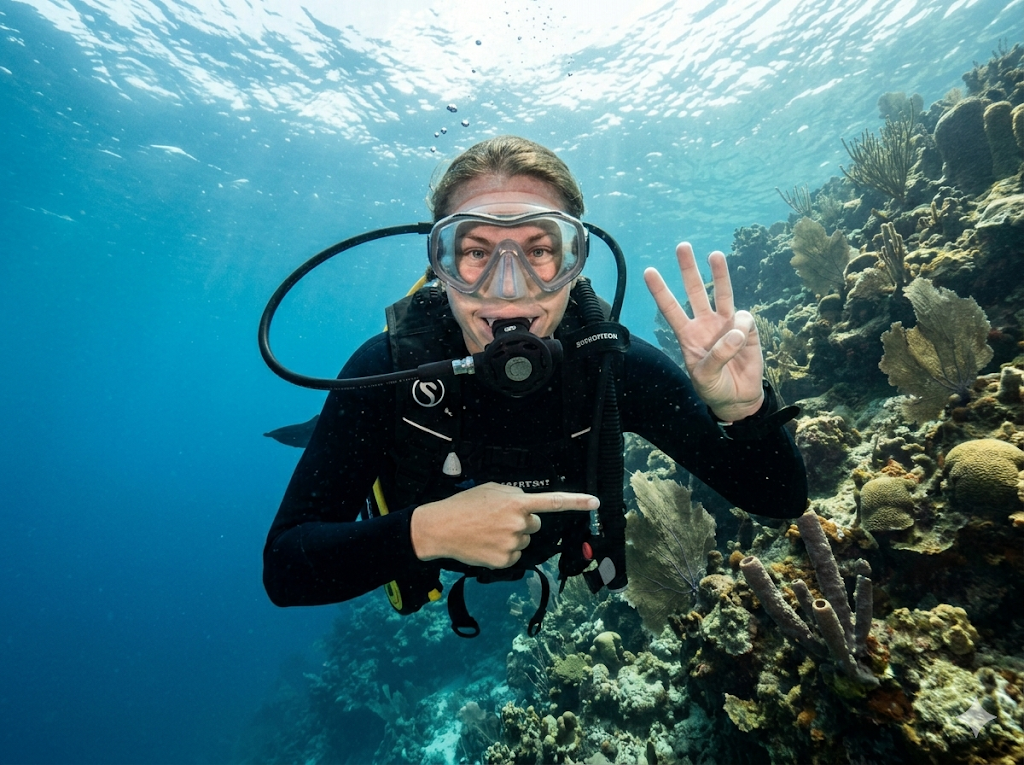
Low air vs out of air: low air is fingers on the SPG — you still have time to ascend. Out of air is a flat hand drawn across the throat (cutting motion) or a fist at the throat. This is an alternate-air-source emergency, not a conversation. Respond within two seconds.
Direction and Level
| Signal | Meaning | |--------|---------| | Thumb up | Ascend | | Thumb down | Descend | | Flat palm, push forward | Go that way / this direction | | Flat palm, push down | Level off / stay at this depth | | Finger pointing + circling | Look at this (fish, object, hazard) | | Two fingers pointing at eyes, then at buddy | Watch me / follow me |
Always confirm directional signals with eye contact. A thumb up in a downcurrent can mean "I want to go up" or a guide's "surface is that way" — context matters.
Marine Life and Hazard Signals
Guides use a shorthand vocabulary for common reef life. These vary more by region than core safety signals, but the high-risk ones are worth knowing globally.
- Shark — hand on forehead like a fin, or flat hand on top of head moving forward.
- Turtle — two hands mimicking flippers, or one flat hand rocking side to side.
- Moray eel — finger wiggling like a swimming snake near the reef.
- Current / drift — flat hand pushing in the direction of flow.
- Danger / don't go there — fist or flat palm blocking the path, sometimes with a head shake.
Regional Differences: US vs Europe vs Asia
The most dangerous mismatch is the OK sign.
Thumb–forefinger circle = OK
✓ Standard
Taught in most OW courses worldwide; dominant in Thailand, Philippines, Caribbean
✗ Confusion risk
In some cultures the same gesture is offensive on land — underwater it is still the dive standard, but be aware
Thumb up = OK (underwater)
✓ Standard
Common in France, Germany, Mediterranean clubs — thumb up means "all good" below the surface
✗ Critical clash
In PADI training, thumb up means ascend — not OK. A European diver giving "OK" can trigger an unplanned ascent
Pre-dive fix: during the briefing, ask "Which OK signal do we use — circle or thumb up?" and "How do we signal bar — fingers or gauge point?" Thirty seconds on the boat prevents a dangerous misunderstanding at 18 metres.
Signals Your OW Course Skipped
Open Water certification covers basics. These signals matter on real dives and are rarely drilled:
Wide eyes + rapid hand waving + failure to respond to OK. Do not signal back and wait — close distance, offer your octopus, control ascent rate. See our panic guide for the full protocol.
Clenched fist at chest level (some agencies) or repeated SPG tap with urgent eye contact. Distinct from routine air checks.
Thumbs up + slash across throat or both hands crossed in an X. Means end the dive now — not "kill the fish."
Point at ear + problem gesture. Buddy should signal level or slight up — do not continue descending.
Mime inflating a tube or point up with a reel gesture. Deploy before surfacing in boat traffic areas.
Briefing Protocol: Agree Before You Splash
Every dive briefing should include a 60-second signal check, especially with an unfamiliar buddy or international group.
- OK signal — circle or thumb up?
- Air units — bar or psi? How many fingers = how much?
- Turn pressure — "We turn at 100 bar / 1000 psi" spoken aloud.
- Problem response — "If I signal problem, close to arm's length and wait for my next signal."
- Separation plan — search 1 minute, then surface with SMB.
• Briefing skips buddy checks and signal review entirely
• Guide swims ahead and never looks back — signals are irrelevant if nobody sees them
• Reviews mention "lost my buddy for 10 minutes" or "didn't know the hand signals"
• Group of 8+ with one guide and no assistant — visual communication cannot scale
How ScubaProof Scores Staff Conduct
The Staff Conduct metric on ScubaProof captures how guides communicate underwater — not just friendliness on the boat, but whether divers felt seen, checked on, and understood.
Review phrases that improve Staff scores: "guide checked air constantly," "clear briefing on signals," "stayed with the slowest diver." Phrases that trigger Yellow Flags: "guide disappeared," "couldn't get their attention," "no briefing." These correlate with the Safety metric and feed the center's overall Trust Score.
Before booking, read Staff Conduct and Safety scores alongside Gear and Oxygen Readiness. A shop with excellent equipment but guides who swim off is a shop where your hand signals never reach anyone.
Safe bubbles.