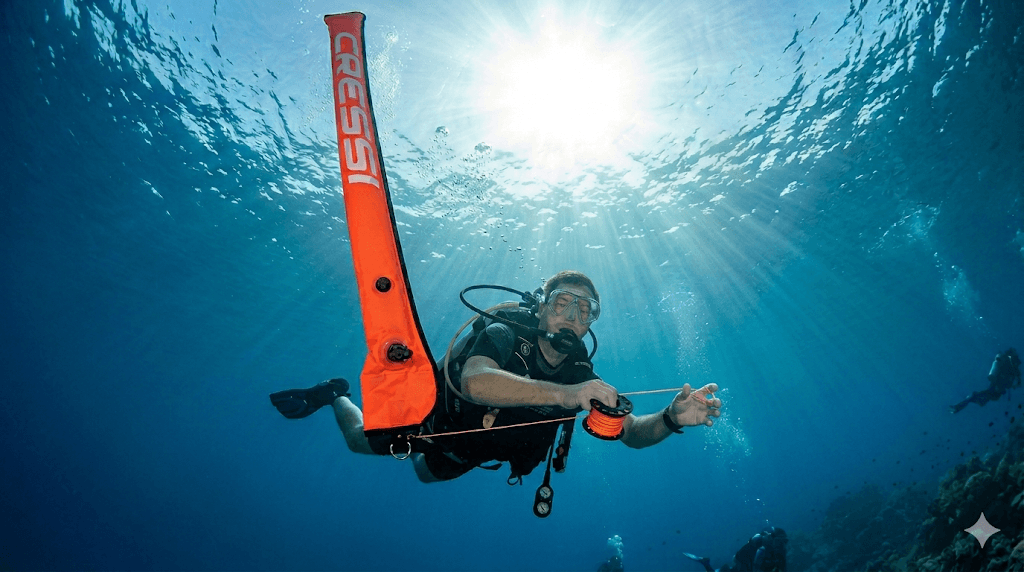
The dive boat is 200 metres downcurrent. You finish your safety stop at 5 metres, look up, and see two hulls crossing your ascent line. Without a surface marker, you are a head in the water that skippers cannot see until they are uncomfortably close. Deploy an SMB (surface marker buoy, often called a safety sausage) and you become a 1.5-metre orange flag announcing "diver below — stay clear."
SMB deployment is a standalone skill — not a footnote in Advanced Open Water. Drift dives, boat channels, and any site with surface traffic make it mandatory. Yet many certified divers have never inflated one from depth, never managed a reel under tension, and do not know the difference between a closed-cell SMB that traps gas and an open-cell tube that deflates the moment they stop blowing.
This guide covers equipment choice, step-by-step deployment from 5–10 metres, reel technique, and the boat-traffic protocol that keeps you visible without becoming a snag hazard.
SMB Physics: Why a Tube of Plastic Saves Lives
An SMB is a brightly coloured inflatable tube — typically orange or yellow — attached to a line you hold from depth. Once inflated, it stands upright on the surface, visible from hundreds of metres in calm conditions.
The physics is simple buoyancy: the SMB displaces enough water to become positively buoyant. A standard 1.2-metre recreational SMB generates roughly 4–6 kg of lift when fully inflated — enough to pull upward if you clip it to your BCD without holding the reel.
Closed-cell vs open-cell SMB
Reel vs spool: a reel has a winding handle and a locking mechanism; a spool is a bare axle of line. Reels are easier for beginners but can jam ("reel lock") if line stacks badly. Spools are simpler, lighter, and preferred by technical divers — but require more finger dexterity. For recreational boat diving, a 30–50 metre finger reel or ratchet reel is the standard.
When to Deploy: Depth, Timing, and Traffic
| Scenario | Deploy at | Why | |----------|-----------|-----| | Drift dive end | 5–10 m, before ascending | Boat follows the SMB, not your bubbles | | Boat channel crossing | 5 m minimum | Skippers need lead time to alter course | | Lost from group | Immediately at safe depth | Marks your position for search | | After safety stop | Before final ascent | Surface traffic cannot see you at 3 m |
Step-by-Step: Oral Inflation Deployment
Oral inflation is the most reliable method — no reliance on a low-pressure inflator that may not fit the SMB valve.
Unclip SMB + reel from D-ring
✓ Pass
Reel locked; line not tangled; SMB rolled, not creased
✗ Fail
Line wrapped around SPG hose or stage bottle — untangle on the surface, not at 8 m
Hold reel in left hand, SMB in right
✓ Pass
Reel brake engaged; thumb ready to release line in controlled bursts
✗ Fail
SMB clipped to BCD during inflation — lift pulls you up uncontrolled
Remove reg, oral inflate SMB 2/3 full
✓ Pass
Quick breaths into SMB valve; reg back in mouth within 3 seconds; eyes on reel
✗ Fail
Holding breath while reg is out — exhale small bubbles continuously
Release reel, let SMB ascend
✓ Pass
Line pays out smoothly; slight brake to prevent reel overrun; SMB reaches surface upright
✗ Fail — reel lock
Line jams, SMB pulls you upward — dump BCD air immediately, do not fight the lift
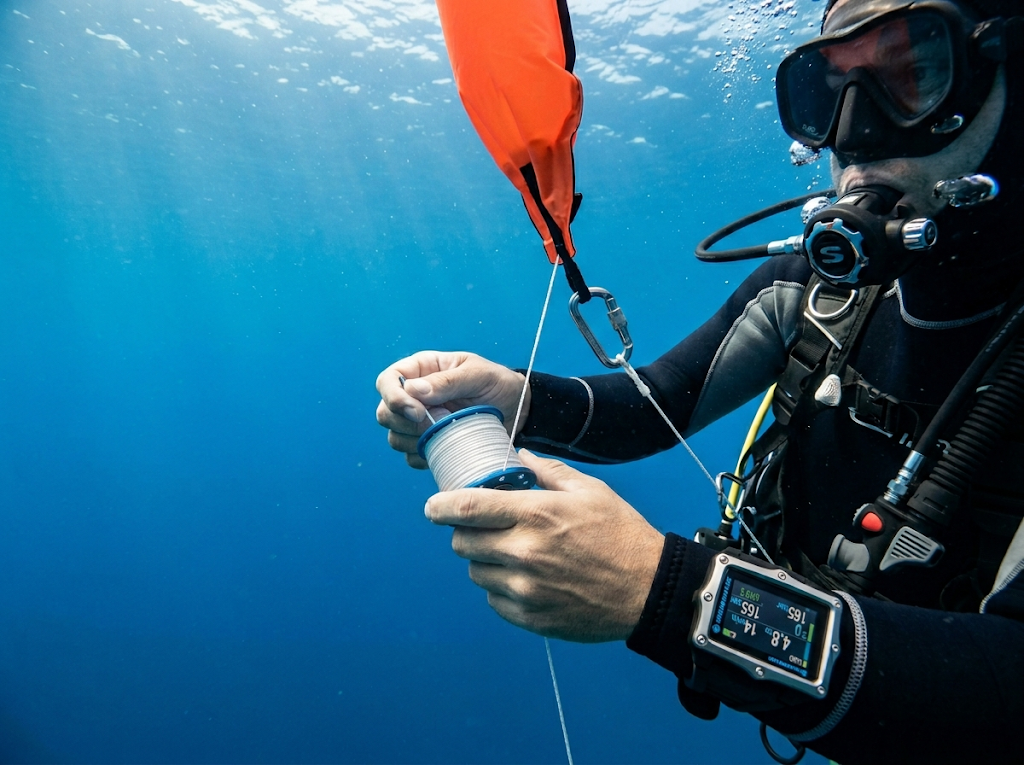
LP inflator method (alternative): some SMBs accept a low-pressure inflator hose via a quick-connect. Faster but requires matching fittings and risks free-flow if the connection leaks. Practice in a pool first.
Surface Protocol: Boat Traffic and Line Management
Once the SMB is on the surface, you hold the reel and ascend along the line. This keeps you directly below the marker — the position boats are trained to avoid.
Surface checklist — boat traffic areas
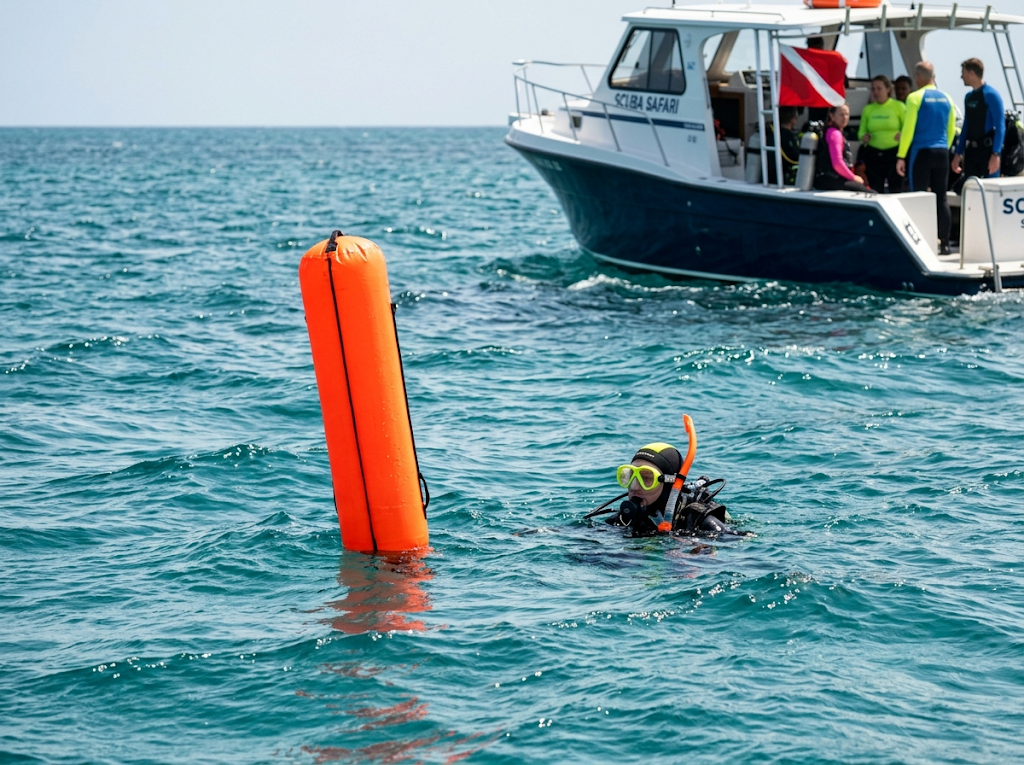
Wind and chop can collapse an under-inflated SMB. Top it up orally at the surface if needed. In strong current, hold the line taut — a slack line wraps around coral, your fins, or another diver's tank.
Common Mistakes and Reel Lock Recovery
• Surfacing in a channel because "the boat knows where we are"
• Assuming bubbles are enough — bubbles disperse and are invisible from a cockpit
• Deploying SMB after surfacing — too late for boats already on course
How ScubaProof Scores Safety and Gear
SMB competence sits at the intersection of Safety and Gear on ScubaProof. Reviewers who write "no SMB on drift dive," "boat almost hit us," "guide never deployed a marker" generate negative Safety events. Centers that include SMB practice in courses and brief drift protocols score higher on Staff Conduct.
The Trust Score weights Safety at 50% — the highest pillar. A center with excellent rental Gear but no SMB culture on drift sites is a center where surface traffic becomes your problem.
Before a drift dive holiday, filter centers by Safety score and read reviews for boat pickup and SMB mentions. Then buy your own closed-cell SMB and practise deployment in a pool until reel management is muscle memory.
Safe bubbles.