
A diver surfaces on a liveaboard in the Similan Islands with tingling in both legs — classic Type II DCS neurology. The nearest hyperbaric chamber is in Phuket, 90 nautical miles away. A helicopter medevac costs $15,000–$40,000. A single recompression treatment runs $5,000–$20,000 depending on the country and table used. Standard travel insurance excludes diving accidents or caps coverage at amounts that do not cover the first hour in chamber.
This is not a hypothetical. It happens dozens of times per year across Southeast Asia, the Red Sea, and the Caribbean. Dive-specific insurance — DAN (Divers Alert Network), Dive Assure, or equivalent — exists precisely because regular travel policies fail divers at the moment of need.
This guide covers what dive insurance actually pays for, real cost ranges, pre-existing condition traps, and five questions to ask your dive center before you splash.
What Standard Travel Insurance Misses
Most travel policies either exclude scuba entirely or cover it only to shallow depth limits (often 30 m) with no hyperbaric treatment provision. The gaps:
Coverage gap — travel vs dive-specific
DAN (Divers Alert Network) is the best-known dive insurer — a non-profit that also funds dive medicine research. Alternatives include Dive Assure, Divemaster Insurance, and some national federation policies (BSAC, VDST). Compare coverage limits, not just annual premium.
Real Costs: Chamber, Medevac, Hospital
Cost ranges — 2025–2026 indicative (USD)
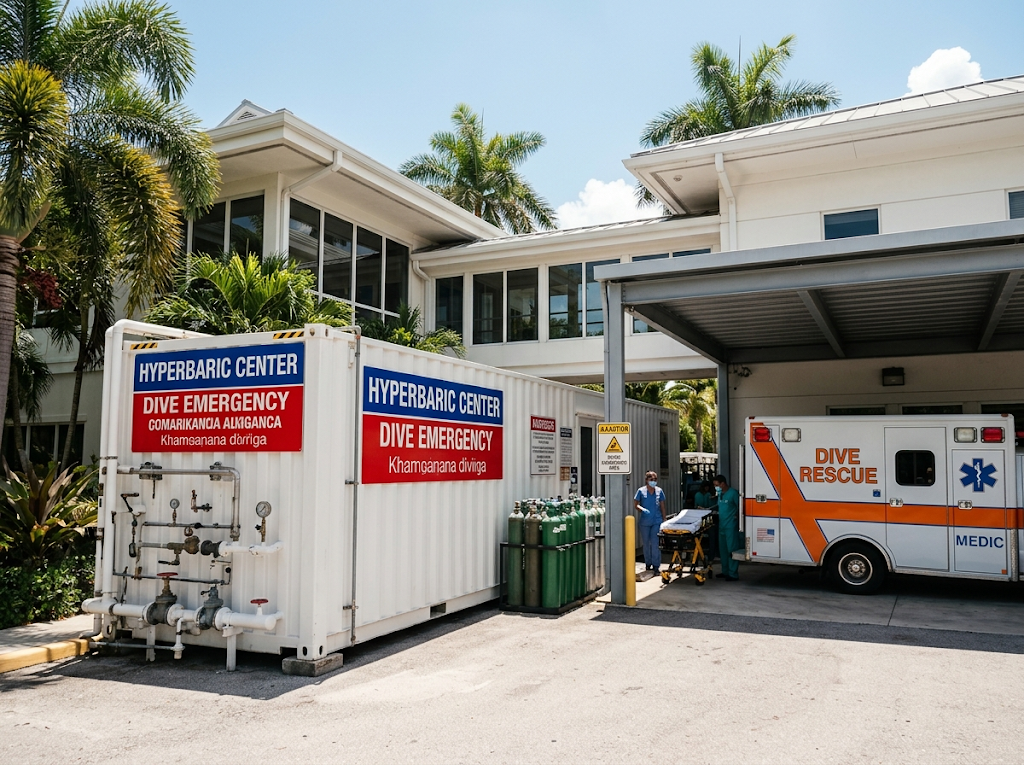
A $50–$150 annual dive insurance premium is not optional travel luxury — it is arithmetic. One untreated DCS event without coverage can exceed $100,000 total when medevac, chamber, and hospital are combined.
Medevac: Remote Island Reality

Key medevac facts:
- Pre-authorisation is usually required — call the hotline before arranging private transport
- Flying after diving restrictions apply to the patient AND sometimes to the flight crew altitude
- Nearest chamber may be in a different country — passport and visa access matters
- Oxygen on the boat during transfer is critical — see our oxygen readiness guide
Fine Print: Pre-Existing Conditions and Exclusions
Read the policy document, not just the marketing page. Common exclusions:
✓ Covered
Condition declared at enrolment; physician clearance obtained; policy issued with acceptance
✗ Denied claim
Asthma, heart condition, or PFO not declared — insurer voids coverage retroactively
✓ Covered
Diving within certification depth; technical diving only with tech-rider add-on
✗ Denied claim
OW diver at 38 m; solo diving without solo certification; cave penetration without training
✓ Covered
Incident with no intoxication evidence; standard post-dive beer hours later
✗ Denied claim
Elevated blood alcohol at time of dive; recreational drugs — universal exclusion
PFO (patent foramen ovale): if you have been diagnosed or suspect shunt-related DCS, declare it. Some insurers require a physician letter. Diving with an undiagnosed PFO after a DCS event is a coverage and medical double risk.
5 Questions for Your Dive Center Emergency Plan
Before your first dive at any new center, ask these in the briefing or by email:
Where is the nearest hyperbaric chamber, and how do we reach it from this site? They should answer with a city name, travel time, and phone number — not "we never had a problem."
Do you carry emergency oxygen on the boat, and is it pressurised and accessible? See our oxygen guide — "we have a tank" is not enough.
What is your DCS protocol — who calls DAN/local equivalent, and who accompanies the diver?
Do you have satellite or radio comms if mobile signal fails offshore?
Are your staff DAN/EFR trained in oxygen administration and first aid? Certificate dates should be current.
Centers that hesitate on any of these score poorly on ScubaProof Oxygen Readiness and Safety — both feed the Trust Score.
How ScubaProof Scores Oxygen Readiness
Oxygen Readiness is a dedicated ScubaProof metric — not generic "safety." It tracks whether centers carry pressurised O₂ on boats, whether staff are trained to administer it, and whether reviewers report oxygen availability accurately.
Combined with Safety (incident history) and Staff Conduct (emergency response quality), it gives you a picture that no insurance card can: whether the center is prepared before the accident happens.
Buy dive insurance before you travel. Then use ScubaProof to choose a center where the emergency plan is real — not a paragraph in the liability waiver.
Safe bubbles.