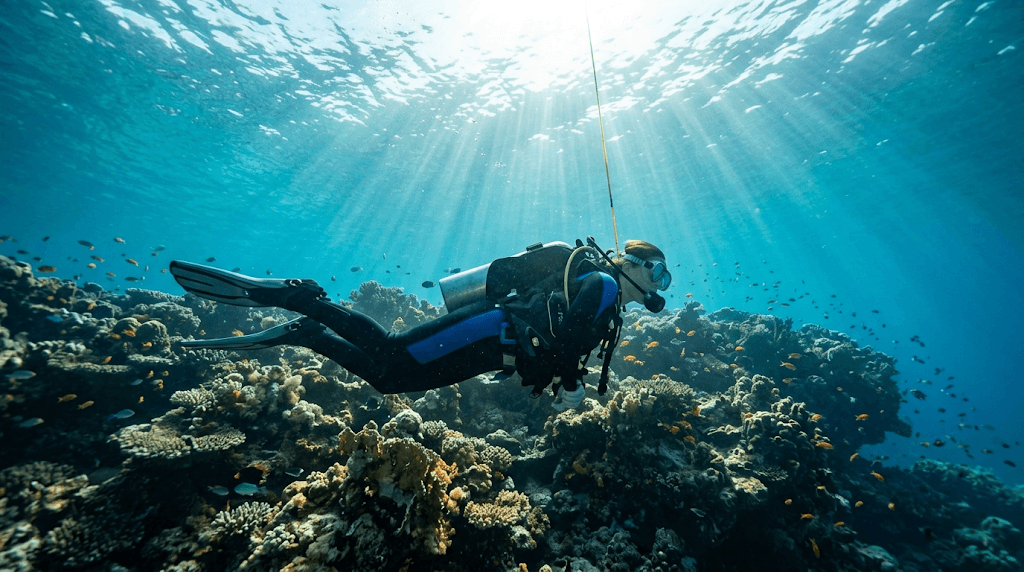
A diver in Ko Tao completed a textbook dive: 24 minutes at 22 metres, NDL never breached, slow ascent, no symptoms. He skipped the safety stop because the surface looked rough and he was low on air. Six hours later his shoulder ached. By morning the pain had spread to both elbows. He had stayed within his computer's no-decompression limit on every dive that week — yet tissue nitrogen had not offgassed fast enough. The safety stop he treated as optional was the last chance to shed load before the surface.
The 3-minute pause at 5 metres is the most misunderstood ritual in recreational diving. Some divers treat it as folklore. Others confuse it with mandatory decompression. This guide explains the gas physics, when agencies require it, how computers handle it differently from tables, and why skipping it raises DCS risk even on "normal" profiles.
The Physics: Henry's Law and the 5-Metre Zone
Henry's Law states that the amount of gas dissolved in a liquid is proportional to the partial pressure of that gas above that liquid. Your blood and tissues are the liquid; the nitrogen in your breathing mix is the gas. At depth, high ambient pressure drives nitrogen into your tissues. On ascent, pressure drops and nitrogen must leave — but it cannot leave instantly.
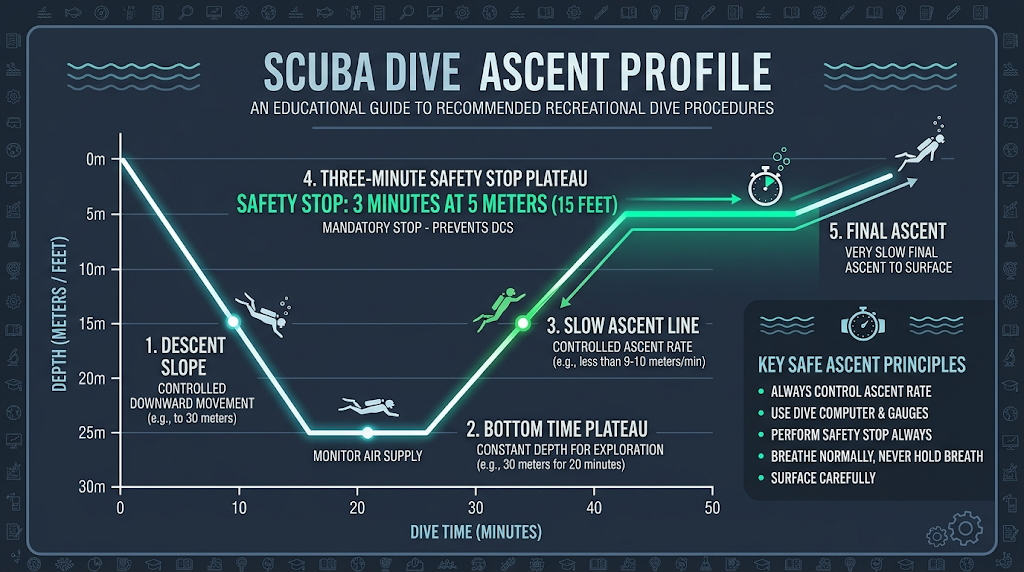
The 5-metre zone (approximately 1.5 bar absolute) is a sweet spot for recreational offgassing:
- Ambient pressure is still elevated enough to keep dissolved nitrogen in solution while you pause
- Depth is shallow enough that nitrogen partial pressure in your lungs is significantly lower than at your bottom depth, creating a gradient that drives nitrogen out of tissues and into your lungs, where you exhale it
- The stop is within easy reach of most divers' buoyancy control and does not require decompression gas
Three minutes is not arbitrary. DAN and agency research show that a brief pause at 5 m measurably reduces bubble grades detected by Doppler ultrasound after recreational dives — especially after profiles in the 15–30 m range or on repetitive multi-dive days.
Safety stop vs mandatory deco — do not confuse them
When Is a Safety Stop Mandatory vs Optional?
Agency language varies, but the practical framework is:
Strongly recommended (effectively standard practice) after:
- Any dive deeper than 10 m
- Any dive longer than 25–30 minutes (threshold varies by agency)
- Any dive where you approached NDL
- Every dive on a repetitive multi-dive day
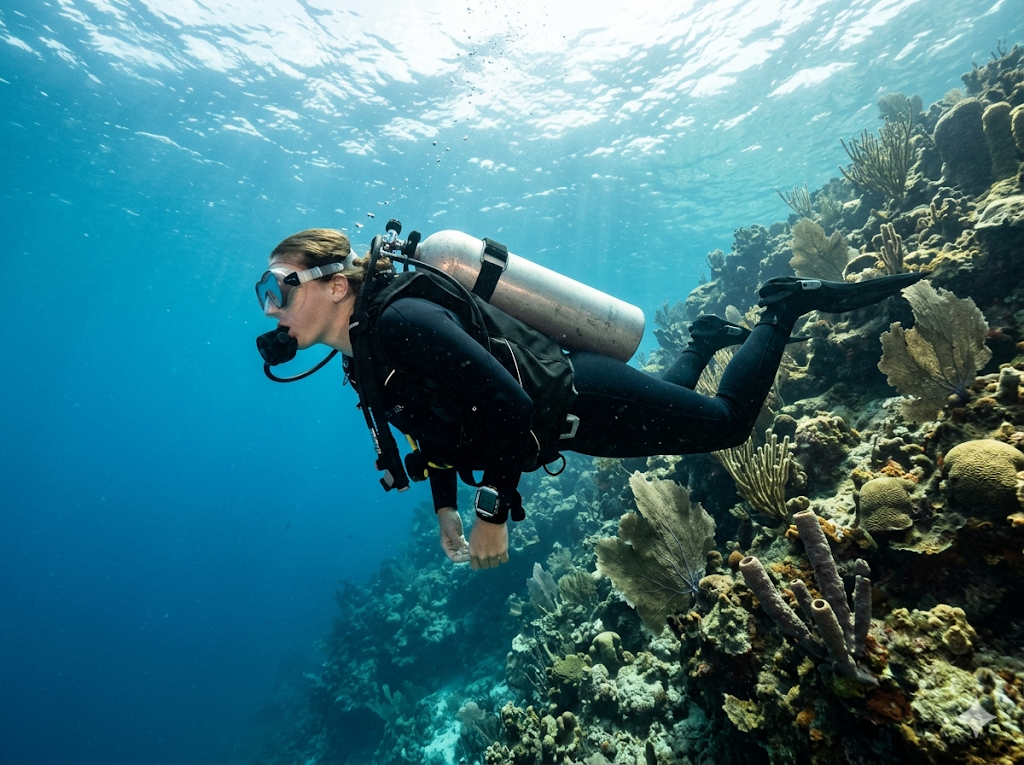
PADI and SSI training teach the 3-minute safety stop at 5 m as a standard end-of-dive procedure for all no-decompression dives. It is labelled "recommended" rather than "required" in no-stop profiles — but instructors and DAN treat it as non-negotiable for anything beyond a shallow checkout dive.
When it becomes truly mandatory:
- Your computer displays a decompression ceiling — you must stop at or above that depth until the ceiling clears. Surfacing through a ceiling is a serious DCS risk.
- You exceeded NDL (even briefly) — the computer may convert your safety stop into a mandatory deco obligation.
- Agency tables with a required stop symbol (rare in modern recreational diving with computers).
When skipping may be justified (rare):
- Genuine low-air emergency with insufficient gas to hold 5 m for 3 minutes — ascend slowly, signal the boat, breathe surface air
- Surface hazard (boat traffic directly overhead, dangerous surge at 5 m) — hold the shallowest safe depth possible, ascend slowly
Skipping for convenience — rough surface, cold, impatience — is not an emergency.
Computer vs Tables: Who Decides the Stop?
Dive computers track tissue loading continuously and typically auto-prompt a safety stop when the profile warrants it. The display shows depth band (often 3–6 m) and a countdown timer. Some models add time to the stop if you ascend too fast earlier in the dive or if you are in a more conservative algorithm mode.
Paper tables (US Navy, PADI RDP, SSI tables) use discrete depth/time boxes. A safety stop may be listed as a recommendation in the table instructions rather than embedded in every cell. With tables you must remember to execute the stop manually — one reason computers reduced DCS incidence in recreational diving after widespread adoption in the 1990s.
Pro tip — extend when warranted
After deep (30 m+) or long repetitive days, many instructors hold 5 minutes at 5 m instead of 3. DAN data supports longer stops after aggressive profiles. If your computer shows elevated desaturation time on the surface, an extra 2 minutes costs little.
Executing the Stop: Buoyancy, Air, and Ascent After
Depth control. Hang at 5 m using breath control, not constant BCD inflation. A small amount of gas in the wing is fine; over-inflation makes you bob through 5 m into 3 m, which shortens effective offgassing time at the target depth.
Air supply. Plan your dive so you surface with enough gas to hold the stop comfortably — typically 50 bar minimum in the cylinder, more on deep dives. Running out of air at 5 m forces an abbreviated stop or a rushed final ascent — both bad outcomes.
Final ascent to surface. After the timer completes, ascend the last 5 m at no more than 9–10 m per minute. The shallowest metres are where lung overexpansion risk peaks (Boyle's Law) and where many divers unconsciously speed up. Watch your computer's ascent-rate indicator.
Hang on a line when available — a shot line or SMB line stabilises depth in surge and prevents drifting shallow or deep.
DCS Risk: What the Safety Stop Actually Reduces
DCS (decompression sickness) occurs when nitrogen comes out of solution too quickly, forming bubbles in tissues and blood. Staying within NDL means the model predicts you can ascend directly without mandatory deco — but the model is conservative, not perfect. Individual factors — age, hydration, patent foramen ovale (PFO), cold, exertion, repetitive loading — can push real risk above what the table or computer assumes.
The safety stop adds a buffer at the most effective offgassing depth before the largest pressure drop (5 m to surface = halving of ambient pressure). DAN case data shows symptoms appearing after dives that were "within limits" but skipped stops, especially on day three or four of intensive diving.
This does not mean skipping one stop guarantees DCS. It means the stop is cheap insurance against a low-probability, high-consequence outcome.
Pre-Dive and Post-Dive Protocol
Safety stop checklist
How ScubaProof Rates Safety Stop Culture
Centres that skip or rush safety stops in training and fun dives signal weak Safety and Staff Conduct — both feed the Trust Score. Oxygen Readiness matters if a diver develops symptoms after a rushed profile.
ScubaProof red flags — critical
- 🚩DM routinely leads the group to the surface without pausing at 5 m
- 🚩Briefing states safety stops are "optional — we only do them if we have time"
- 🚩Divers surfacing with zero bar — no gas planning for end-of-dive procedures
- 🚩Confusion between safety stop and deco stop taught in checkout dives
ScubaProof yellow flags — caution
- ⚠Stops held at 3 m instead of 5 m — less effective offgassing zone
- ⚠Group ascends together fast after DM surfaces — no line or stop discipline
- ⚠No mention of DCS symptom watch in post-dive briefing
- ⚠Four-dive days with no discussion of cumulative nitrogen and extended stops
Three minutes at five metres is not a ritual for instructors to look professional. It is the last controlled offgassing step before the biggest pressure change of your dive. Treat it as part of the dive, not an afterthought.