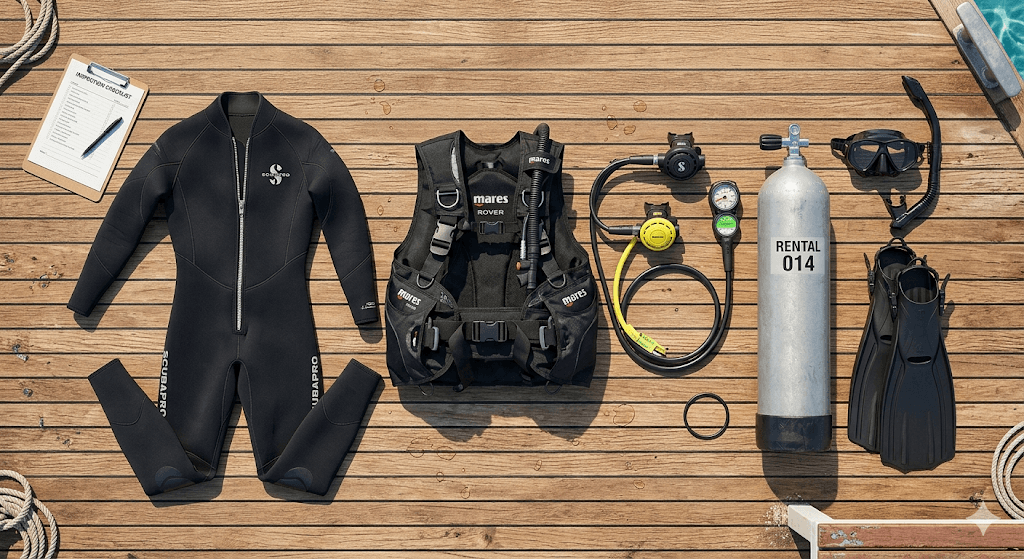
The BCD rack is stacked floor-to-ceiling, regulators hang in neat rows, and there's a price for every budget. None of that tells you when the second stage was last serviced. Rental gear is shared — sometimes by three groups a day — in warm tropical water that accelerates corrosion and salt creep. A brand-name sticker on the second stage means nothing if the O-ring inside was last replaced two seasons ago.
You are the last line of inspection before you commit to a life-support system underwater. On a busy boat nobody else will do this for you. Here is the full sequence: what to check, what it means physically, and exactly when to refuse a piece of kit and ask for another.
Why This Matters: Gear Doesn't Fail Politely
Two of the deadliest dive accidents — a rapid uncontrolled ascent and breathing-gas interruption — are usually traced back to equipment that was inspectable on the surface. The physics is unforgiving:
- Boyle's Law — at a constant temperature, gas volume is inversely proportional to absolute pressure. Air trapped in a BCD bladder by a stuck inflator doubles in volume between 10 m (2 ATA) and the surface (1 ATA). That expansion is what powers a runaway ascent — the diver accelerates upward, and the faster they rise the faster the gas expands. It is a positive-feedback loop, not a gentle drift.
- Henry's Law — the amount of gas dissolved in your tissues is proportional to its partial pressure. Ascend faster than your tissues can offgas and dissolved nitrogen comes out of solution as bubbles: decompression sickness. A jammed dump valve or runaway inflator is a direct DCS mechanism, not just a scare.
- Hypercapnia — a high-resistance, worn second stage forces you to work to breathe. Skip-breathing or shallow breathing lets CO₂ accumulate; rising CO₂ partial pressure drives air hunger, headache, and narcosis-like disorientation well before your gauge reads empty.
None of this requires deep technical diving to bite you. It happens in 12 m of warm water on a fun dive. Two minutes of inspection is cheap insurance.
1. The "Shiny Brand" Illusion
A well-marketed dive center buys your trust before it earns it. Fresh paint, a bilingual website, and certified instructors all suggest quality — but none of them tell you when that regulator was last serviced. The widely taught maintenance interval is a full overhaul roughly every year or every 100 dives, whichever comes first, though several manufacturers now publish 2-year inspection intervals with annual visual checks. In peak season on a busy boat, a popular reg can hit any of those limits fast.
Ask the counter staff directly: "When was this specific regulator last serviced — is there a service tag on the first stage?" A legitimate shop keeps a tag on the first stage with the date and technician's initials. If they shrug, that's your first red flag and it costs you nothing to ask for a different set.
2. Regulator: The Dry-Breathe Test
Run these three checks before the first stage is pressurised. The whole sequence takes under sixty seconds.
Mouthpiece Integrity
✓ Pass
Silicone is supple, uniformly thick, no bite-through holes, tab attachments intact, zip-tie present and tight
✗ Fail — swap immediately
Cracks at the tab attachment points, chalky rigid feel, or any hole larger than a pinprick — a bite-through can let the mouthpiece tear off mid-dive and force a regulator recovery
Purge Cover Snap-Back
✓ Pass
Button snaps back instantly with a firm click; absolute silence when released (test it pressurised, see Section 3)
✗ Fail — free-flow risk
Slow or incomplete return, any residual hiss once pressurised — a free-flowing second stage can empty a 12-litre cylinder in a few minutes and is a genuine gas-loss emergency
Breathing Resistance (Dry Breathe)
✓ Pass
Pressurised, air draws in with almost no effort and exhalation is smooth — like breathing through an open window
✗ Fail — hypercapnia risk
Noticeable suction effort, crackling or squeaking on inhalation: worn demand valve seat or misadjusted cracking pressure — drives CO₂ buildup, fatigue and disorientation at depth
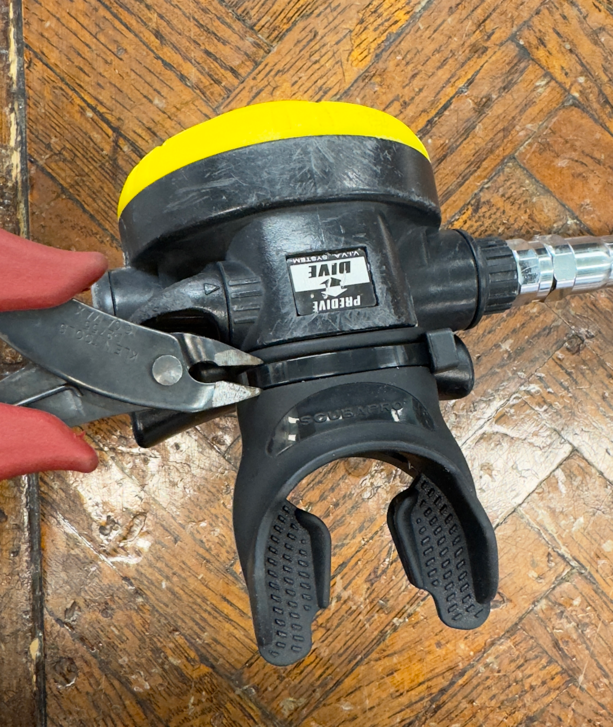
Pro-tip — the octopus is not optional. Run the exact same A/B/C checks on the alternate-air second stage (the octo/yellow reg). It is the most-neglected piece on any rental rig because nobody breathes it in normal use — which is precisely why a stranger's out-of-air emergency is the worst time to discover it free-flows. A reg you wouldn't trust for yourself is a reg you cannot offer to a panicking buddy.
3. The Real Leak Test: Pressurise and Watch the Needle
The dry checks above catch the obvious faults. The definitive test happens the moment the first stage is mated to the cylinder and the valve is opened. Most divers miss the single most diagnostic five seconds of the whole setup.
Pressurise sequence — do it in this order
A check minimum of around 180–200 bar on a standard 200-bar fill (or ~3000 psi imperial). A "full" cylinder reading 150 bar is a short-fill — you're paying for air you didn't get, and your gas planning is wrong from minute one. Then trace any audible leak:
- Hiss at the first stage / DIN or yoke connection — usually the tank-valve O-ring (see Section 5). Shut down, depressurise, reseat or replace the O-ring.
- Steady bubbling from the second stage when stationary — internal seat leak; swap the reg.
- Hiss from the inflator or LP hose connection — quick-disconnect O-ring or hose fault.
Do not dive a leaking system "because it's only small." A seep at 200 bar on the surface is a stream at depth, and a connection that weeps on the boat is the one that lets go when you're finning against current.
4. BCD: The Two-Valve Protocol
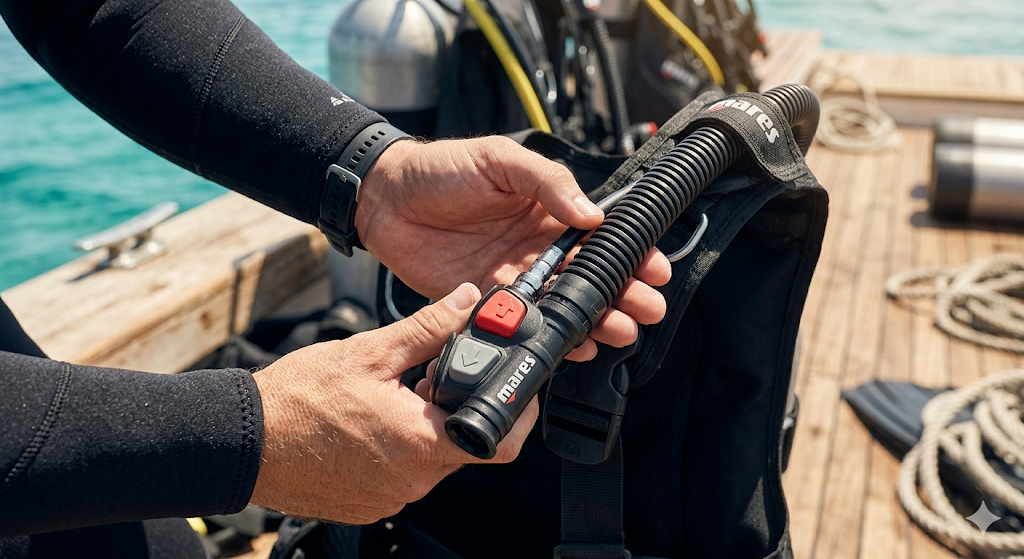
The BCD (buoyancy control device, called a Tarierweste / wing or jacket depending on style) is responsible for your buoyancy — and becomes a liability in a runaway ascent if either the inflator or a dump valve fails. Run both checks before the boat leaves the dock, with the BCD pressurised.
Also check, quickly: that the BCD actually holds air for a minute or two (a slow bladder leak shows up as the jacket going soft); that the cam band / tank strap is the right size and locks down hard with no slip (a cylinder sliding out of the band underwater is a real and frightening failure); and that every buckle, the sternum strap and the waist band clip and adjust. A buckle that won't lock is a doffing hazard on the surface in chop.
5. Hoses, O-rings and the Cylinder Stamp
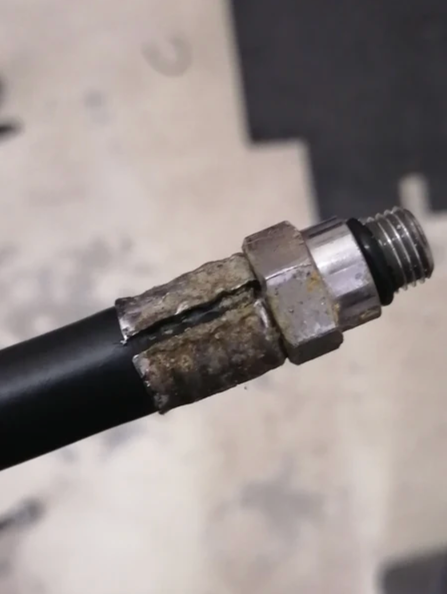
The LP inflator hose, the HP SPG hose, and the octopus LP hose are the three arteries of your rig. Each has a rubber protective sleeve — and that sleeve hides what's developing underneath.
The 10-Second Flex Test
Grip each hose near the regulator connection end and gently flex it through 90 degrees. Run your finger along the sleeve toward the crimp/banjo fitting — the metal collar where hose meets hardware. Microcracks concentrate at these stress points and stay invisible until 200+ bar of internal pressure forces them open.
Critical: Before the first stage is mated to the cylinder, look into the tank valve seat. The O-ring must be visible, seated flush, and unbroken — yoke fittings seal on an O-ring set into the valve face; DIN fittings carry the O-ring on the regulator threads, so check that one instead. A missing or chewed O-ring under 200 bar causes a high-pressure blow-off that can knock the rig over and leaves you with no gas. Refuse the cylinder — no exceptions, no embarrassment. Carry two spare O-rings in your save-a-dive kit and this never ends your day.
Read the Cylinder Stamp
Rental cylinders carry stamped or stickered dates on the shoulder that prove they are still legal to fill. This is the check almost no recreational diver makes — and it's the one that proves a shop's whole maintenance culture in five seconds.
Visual Inspection sticker, dated within the last 12 months — the internal annual check shops are expected to perform.
Hydrostatic (pressure) test stamp — every 5 years in the US, every 2.5 years for steel under EU rules. Stamped into the metal shoulder.
No legible date, or a date outside those windows → an out-of-test cylinder. A reputable fill station won't fill it. Decline and note it.
6. The Rest of the Kit: Mask, Fins, Wetsuit, Weights
Life-support gear gets the headlines, but a leaking mask or the wrong weight ruins a dive just as effectively — and a weight-belt that won't ditch is a genuine safety item.
- Mask — fit-test it dry: hold it to your face with no strap and inhale gently through the nose. It should suction and stay put. Check the skirt for cracks and the strap buckles for play. A rental mask with a perished skirt floods constantly and burns your gas on clearing.
- Fins — both buckles or spring straps intact and the right size over your boots. A blade that's far too stiff for your legs causes cramp and overexertion — itself a CO₂-retention pathway.
- Wetsuit / exposure protection — right thickness for the water temperature (a 3 mm suit in 24 °C water leaves most people cold by the second dive; thermal stress raises both DCS risk and air consumption). Check zips and seams.
- Weight system — confirm you can find and operate the quick-release: ditchable pouches must pull free in one motion, a weight belt's buckle must be set up for a right-hand release with no other strap crossing over it. Do this on the surface, every dive. Being unable to drop weight is a classic factor in surface drownings.
7. The 60-Second Final Check: BWRAF
Manufacturer checks are yours; the buddy check is the system the agencies build on top. Every major agency teaches the same pre-dive buddy check under a different mnemonic — PADI's BWRAF ("Begin With Review And Friend"), SSI's BARS, BSAC's checks, the GUE pre-dive flow. Run it with your buddy, out loud, every single dive. It catches the one thing you forgot.
BCD — inflates and holds, all dumps vent and reseat, cam band locked.
Weights — present, correct amount, quick-release located and clear.
Releases — every buckle on you and your buddy known and reachable.
Air — valve fully open, gauge reads near-full and holds, breathe both primary and octo while watching the needle (it must not drop), check the gas (air or the correct nitrox mix you analysed).
Final OK — mask, fins, computer on and set to the right mix, knife/light/SMB. Good to go.
Nitrox note: if your cylinder is labelled enriched air, you analyse it yourself and log the oxygen percentage and your maximum operating depth — never take a fill station's word for the mix. Breathing a nitrox blend below its intended depth raises oxygen partial pressure toward the 1.4 ATA working / 1.6 ATA contingency limits, and exceeding them risks oxygen toxicity convulsions underwater. A shop that hands you "32%" with no analyser on the bench has told you something about its safety culture.
8. How ScubaProof Scores the "Gear" Metric
The Gear rating on ScubaProof is not a manufacturer satisfaction survey. It is extracted algorithmically from verified diver reviews and weighted toward failure signals, not praise — and it sits alongside the Safety, Staff Conduct, and Oxygen Readiness metrics that together feed a center's overall Trust Score.
Every time a reviewer writes "regulator free-flowed," "BCD kept inflating on its own," "hose looked cracked," "expired cylinder," or "had to swap gear mid-dive," our data engine logs a negative Gear event. A cluster of negative Gear events within a 12-month window automatically triggers a Yellow Flag for that center on the platform; failure reports that describe injury or a near-miss escalate the Safety metric toward a Red Flag.
Consistent positive gear mentions — shop maintains and rotates its rental fleet
Mixed signals — run your physical checks carefully; consider bringing your own regulator and computer
Statistically equivalent to a maintenance log that hasn't been touched in two years — find another center
Before your next dive, search the center on ScubaProof. Two minutes reviewing the Gear and Safety scores on the pier could be the most valuable part of your dive day — and the inspection above is what turns a number into a decision you can defend.
Safe bubbles.