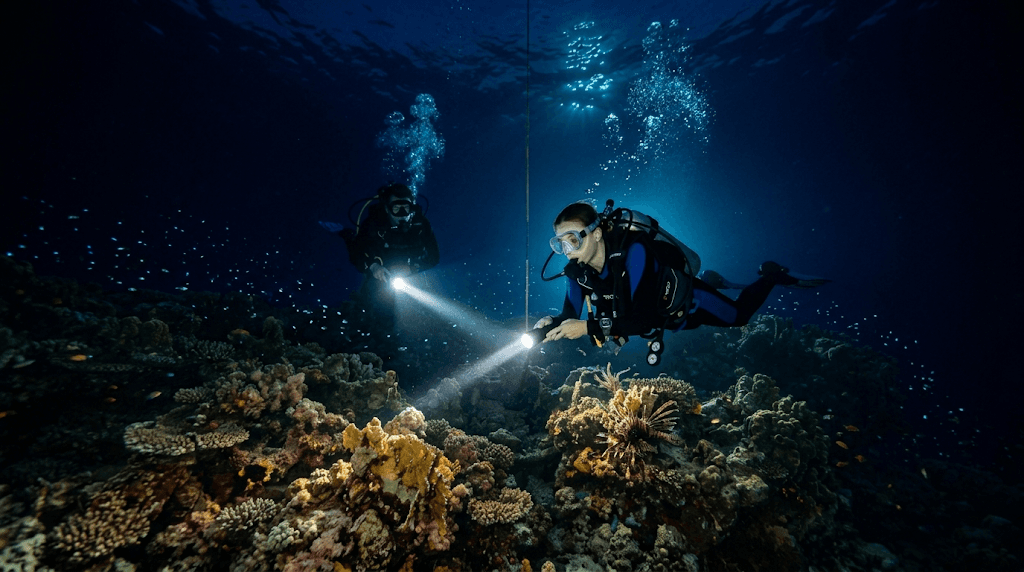
A diver on a night boat dive in Amed turned off her torch to watch bioluminescence. When she switched it back on, the group was gone. She surfaced alone, inflated her BCD, and spent eleven minutes in a moderate swell before the boat found her. Her primary light had been fully charged. Her backup was in the boat bag. She had no chemical light on her SMB. The dive had been within her certification limits. Everything that failed was protocol — not skill.
Night diving transforms familiar sites into alien terrain. Landmarks disappear. Predators hunt. Your world shrinks to the cone of your primary light. The skills are manageable; the consequences of cutting corners are not. This guide covers the light hierarchy every night diver must carry, navigation when you cannot see the reef, buddy protocols that prevent separation, and what to demand from a dive centre briefing before you roll in after dark.
The Light Hierarchy: Primary, Backup, Chemical
Primary light — your main torch. Minimum 800–1000 lumens for tropical night diving; colder or murkier water may need more. Burn time must exceed planned dive time by at least 30 minutes. Test on the boat, not at depth.
Backup light — a smaller torch stored on your person (BCD pocket or wrist mount), not in a gear bag on the boat. If your primary floods, cracks, or runs dead at 15 m, the backup is your only way to read gauges, signal your buddy, and execute a controlled ascent. Two failed lights at depth is a genuine emergency.
Chemical light (cyalume stick) — attached to your tank valve or SMB for surface identification. Boats spot a glowing stick far more reliably than a torch pointed at the sky. Some agencies require one per diver on night boat dives.
Minimum light kit — night boat dive
Navigation Without Sun, Colour, or Distance Cues
Daytime navigation uses the sun, reef contours, sand channels, and depth. At night you lose most of these. Effective night navigation relies on:
Pre-dive briefing map. Know the site layout before you descend: entry point, intended route, maximum depth, turn-around time, and exit point relative to the boat or shore. Draw it on a slate if the DM provides one.
Depth as anchor. Stay at the agreed depth band. Drifting 5 m deeper than the group is enough to lose visual contact in darkness.
Reef-on-one-shoulder rule. Pick a side (reef on your right, sand on your left, for example) and maintain it. U-turn when the terrain ends or at the agreed time — not when you feel like it.
Compass. A simple wrist or console compass works when sand patches and walls look identical in torchlight. Set reciprocal headings for out-and-back routes.
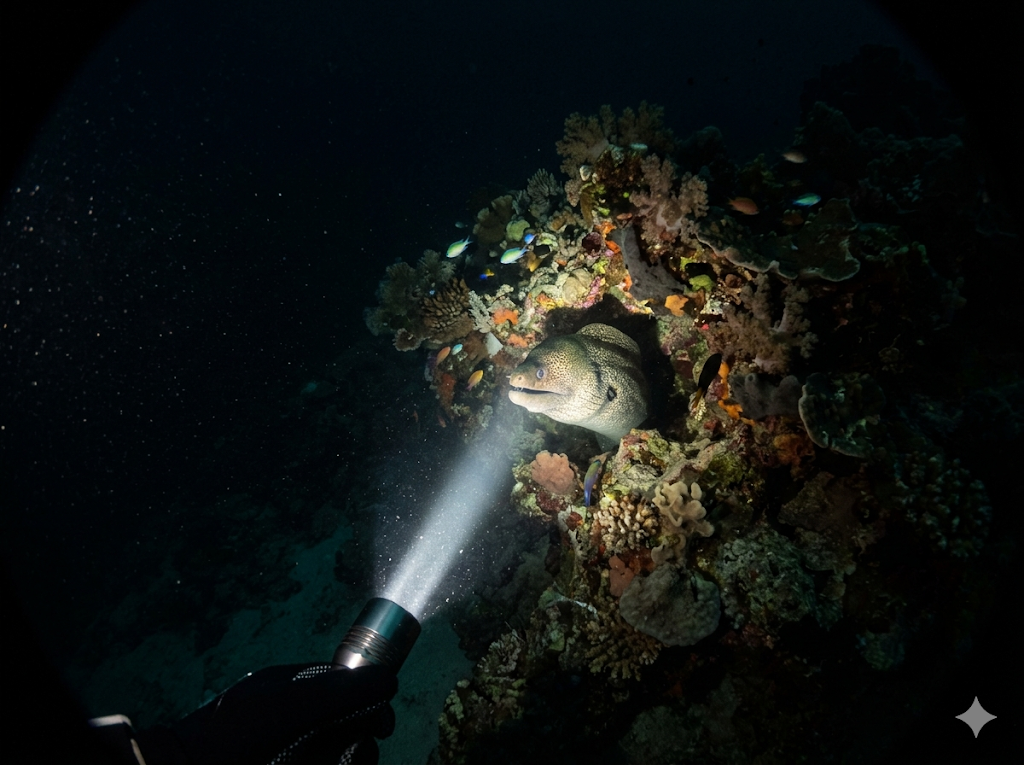
Guide line / shot line. On night dives with current or open sand, a fixed line from boat to reef is the highest-reliability navigation aid. Stay within arm's reach of the line in low visibility.
Never do this at night
- ⚡Turn off your only light to "experience darkness" without team agreement and a backup plan
- ⚡Chase marine life away from the group — separation happens in seconds
- ⚡Surface without a surface marker if the boat does not have a fixed line to the site
Buddy Protocols: Distance, Signals, Separation
Night diving demands tighter buddy distance than day dives — arm's length to 2 m is standard. You should always see your buddy's torch beam and chemical light.
Light signals (agree pre-dive):
- Circle beam on buddy = "OK?"
- Side-to-side wave = "Attention / look at me"
- Up-and-down wave = "Go up" or "Problem — ascend"
- Rapid flash = "Emergency"
Separation procedure (1 minute search rule):
- Signal with torch and tank banger for 1 minute at depth
- If no reunion, ascend slowly to the agreed safety-stop depth, deploying SMB if you have one
- Surface, inflate BCD, signal boat with torch + chemical light
- Do not re-descend alone to search
Marine Life and Behaviour Changes at Night
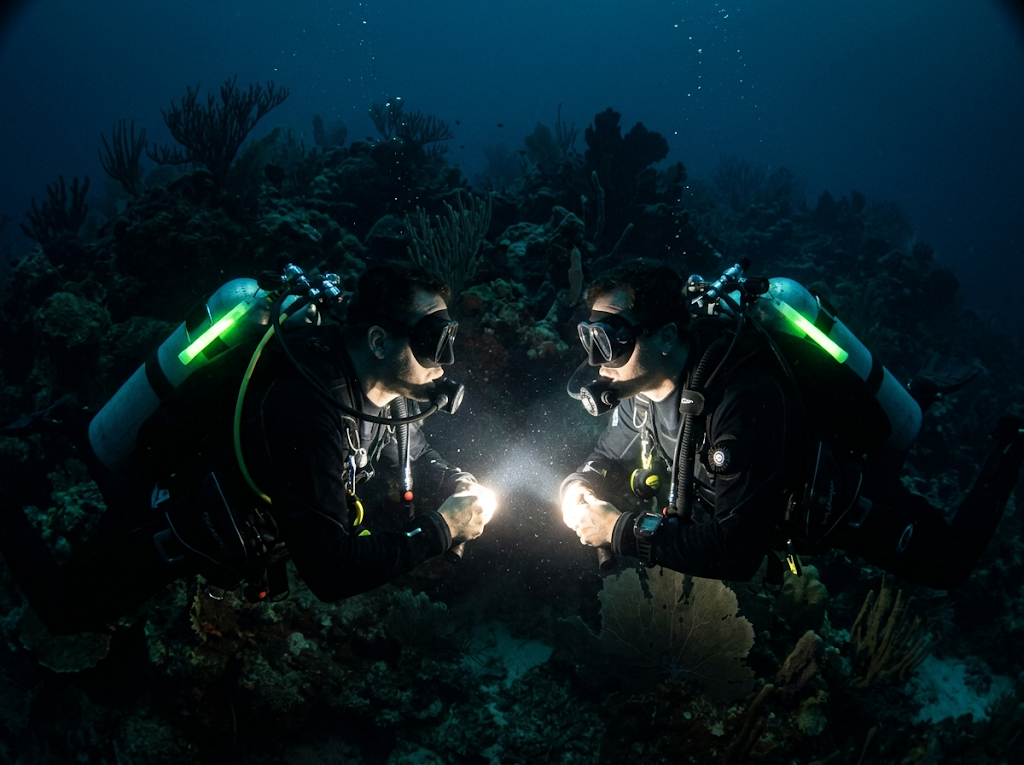
Nocturnal predators — moray eels, octopus, lionfish, hunting reef fish — are more active and may approach lights. This is normal. Do not chase, touch, or corner animals. Lionfish spines and moray bites are more common on night dives when divers thrust hands into crevices they cannot see clearly.
Stinging plankton (jellyfish larvae, etc.) can be invisible in torchlight. A full wetsuit or skin coverage reduces exposure. Avoid surfacing through visible jellyfish aggregations lit by boat deck lights.
Auditing the Centre Night-Dive Briefing
Before you commit to a night dive with an operator, the briefing should cover:
Briefing must include
✓ Pass
Site map and max depth · guide-to-diver ratio ≤ 1:4 night · separation protocol · boat pickup point · emergency oxygen location · light check before entry
✗ Fail
"Follow the group" with no ratio stated · no backup-light requirement · no surface marker plan · DM does not verify lights on deck · night dive combined with unfamiliar site and strong current
How ScubaProof Rates Night-Dive Operations
Night diving stress-tests Staff Conduct (briefing quality, guide ratios), Safety (separation protocols, emergency plans), and Oxygen Readiness (symptoms after a rushed ascent or lost diver). These feed the centre's Trust Score.
ScubaProof red flags — critical
- 🚩Night dive with guide-to-diver ratio worse than 1:6 — separation inevitable
- 🚩No requirement for backup light on person — primary-only policy
- 🚩Boat leaves site before head count after night dive
- 🚩First night dive for checkout divers at a high-current site
ScubaProof yellow flags — caution
- ⚠Chemical lights sold at dock but not checked — expired or dim sticks
- ⚠DM leads far ahead — torch beams of rear divers not visible to guide
- ⚠No SMB or surface marker required despite open-water pickup
- ⚠Briefing skips separation procedure — "stay close" is not a protocol
Night diving is among the most rewarding experiences in scuba — bioluminescence, hunting octopus, reefs that look nothing like day. It is also unforgiving of sloppy preparation. Two lights on your body, one on your tank, a buddy within arm's reach, and a briefing that names the separation plan. That is the minimum.