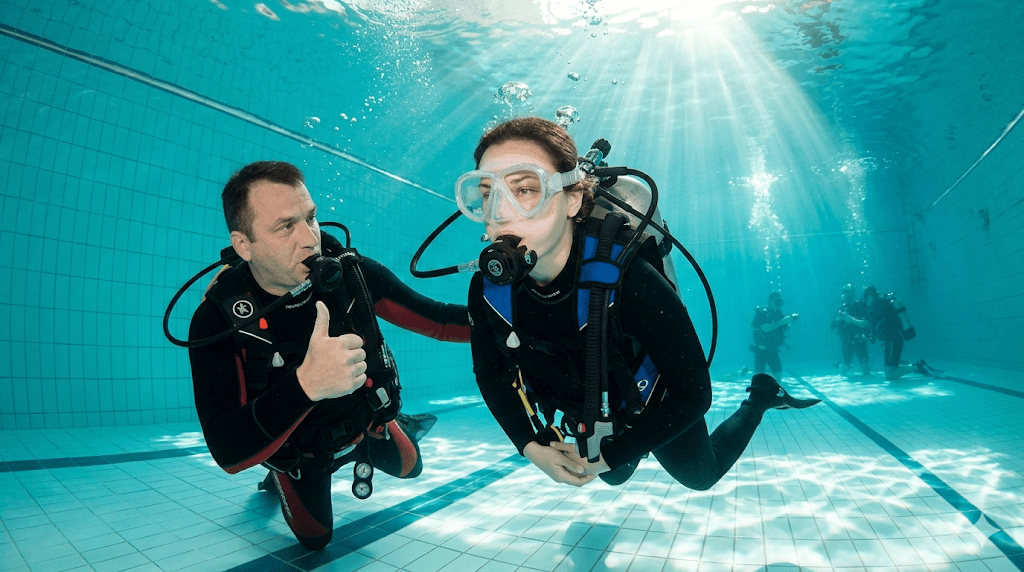
Water floods your mask at 8 metres. For a new diver, that moment triggers an ancient reflex: breathe through your nose, lift your head, reach for the surface. All three are wrong underwater. The correct response — exhale through your nose while pressing the mask top, eyes open, head neutral — takes about four seconds once trained. Without training, it takes a panic ascent and a trip to the boat ladder.
Mask clearing and regulator recovery are the two skills most often rushed in Open Water courses. Instructors demonstrate once in kneeling position; students pass by barely flooding the mask. Then on the first ocean dive, a wave fills the mask completely, the student inhale through their nose, and the buddy system becomes a rescue.
This guide gives you the step-by-step mechanics, the mistakes that cause failures, and a pool-to-open-water progression that makes both skills automatic before you need them.
The Physics: Why Water in Your Mask Is Not an Emergency
A flooded mask does not cut off your air supply. Your regulator delivers gas to your mouth independently of what happens on your face. The panic comes from sensation — water on the eyes and nose triggers mammalian dive reflex and nasal inhalation instinct.
Boyle's Law applies to the mask air space: as you descend, the air pocket in your mask compresses and sucks the mask tighter to your face. As you ascend, it expands and can break the seal — flooding the mask. This is why masks often leak on ascent, not descent.
Mask flood severity — response scale
Mask Clearing: Step-by-Step
Partial Flood Clear (the standard skill)
Head position — neutral, eyes forward
✓ Pass
Chin slightly tucked; looking straight ahead or slightly down
✗ Fail — most common error
Head tilted back to "look up" — water runs into your nose; breaks trim; adds buoyancy shift
Press mask top against forehead
✓ Pass
Fingertips on the top frame; creates a seal at the forehead while bottom opens
✗ Fail
Pressing the nose pocket — distorts the skirt, makes leak worse
Exhale steadily through nose
✓ Pass
Continuous gentle exhale; air pushes water out the bottom opening; 3–5 seconds
✗ Fail
Sharp blast through mouth only — does not displace water; or inhaling through nose
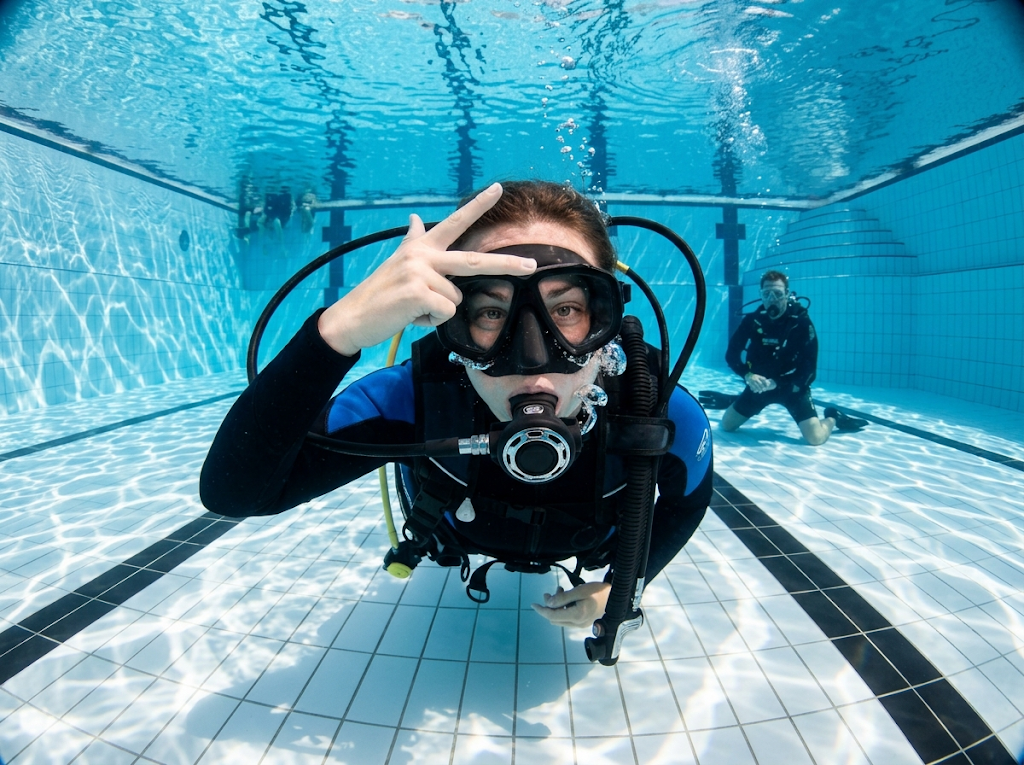
Full Flood and Mask Removal
For a completely flooded mask, the same technique works — it just takes a longer exhale. Mask removal and replacement is a separate skill: flood fully, remove mask, hold it in front of your face, replace, then clear. Practise with eyes open in a pool. In the ocean, silt and salt sting — that is normal and temporary.
Regulator Recovery: Step-by-Step
Regulator recovery trains the reflex for when your second stage is knocked out — by a buddy's fin, a camera, or your own hand during a mask clear.
Reach-back method
✓ Pass
Right arm reaches over right shoulder, sweeps hose from behind; find mouthpiece by feel; don left to right
✗ Fail
Head cranked backward searching visually — breaks trim, extends time without air
Sweep method (alternative)
✓ Pass
Arm sweeps outward from hip in a wide arc; catches hose; brings reg to mouth
✗ Fail
Small frantic arm movements — misses hose; increases panic and CO₂ retention
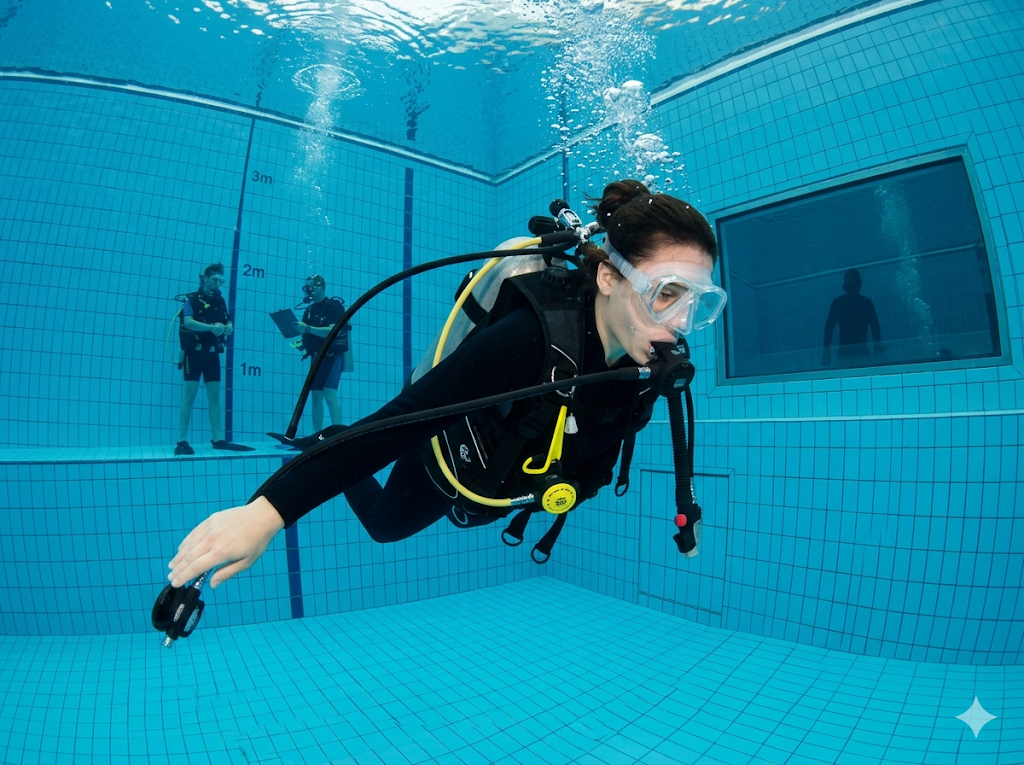
After recovery: exhale before inhaling if the reg was out for more than 2 seconds — there may be water in the chamber. A short purge blast clears it. Never hold your breath during recovery.
Pool to Open Water: Training Progression
| Stage | Location | Drill | Pass criteria | |-------|----------|-------|---------------| | 1 | Pool, kneeling | Partial mask flood | Clear in under 5 s, no head tilt | | 2 | Pool, neutrally buoyant | Full mask flood + clear | Eyes open, no nasal inhale | | 3 | Pool, neutrally buoyant | Mask remove/replace | Complete in under 15 s | | 4 | Pool, swimming | Reg recovery × 5 | Each recovery under 3 s, no ascent | | 5 | OW, shallow (5 m) | Repeat all skills | Calm conditions, instructor present | | 6 | OW, normal dive | Simulated flood during swim | Clear without stopping finning |
Connection to Underwater Panic
Mask flood and reg loss are the two most common triggers of the panic effect — the cognitive shutdown where trained skills disappear. The progression above exists specifically to build motor memory that runs under stress.
If you or your buddy loses composure during a skill: stop, breathe from the reg, hold something stable (line, buddy's arm, reef rock without touching living coral). Signal problem. Do not ascend uncontrolled. Our panic guide covers the full buddy-rescue protocol.
How ScubaProof Scores Staff Conduct
Instructors who rush confined-water skills show up in reviews: "never properly cleared my mask," "panic on first ocean dive," "had to be rescued." These map to Staff Conduct and Safety metrics on ScubaProof.
Centers with patient skill progression score higher on Staff Conduct. Centers where students surface in distress score toward Red Flags on Safety — which carries an 0.8 penalty to Trust Score.
Before choosing a school, read reviews for "confined water quality" and "instructor patience." The cheapest OW course is expensive if you panic on dive three.
Safe bubbles.