
Koh Tao certifies more entry-level divers than almost anywhere on Earth — well over 50,000 new Open Water students a year on an island you can walk across in an afternoon. That density is the island's gift and its trap. The shallow, warm, current-light training bays in the west are genuinely some of the best classrooms in the world. But "most dive centers per square kilometre on the planet" also means the widest spread in quality you will ever encounter — from PADI 5-Star Career Development Centres running tight ratios and serviced gear, to volume operations that treat your Open Water course as a conveyor belt.
This guide is the vetting process a working instructor uses before recommending a shop to a friend. It is built around the physics that actually hurt people here, the questions that separate a professional operation from a marketing front, and the specific dive sites worth your bottom time.
Why Koh Tao Is Easy to Learn In — and Easy to Get Hurt In
The hazard profile here is not sharks or "dangerous currents" — it is volume and complacency. Three things drive almost every incident on the island:
- Crowded sites. Chumphon Pinnacle or Sail Rock can have 80+ divers in the water at once. Boat traffic, dropped shotlines, and descending divers landing on ascending ones are real risks. A safety stop with a deployed SMB (surface marker buoy) is not optional here.
- Repetitive multi-dive days. Fun-diver packages stack 3–4 dives a day across consecutive days. Each repetitive dive loads more residual nitrogen into your tissues (Henry's Law — more on this below). Sloppy surface-interval discipline is the most common path to decompression sickness on Koh Tao, not deep diving.
- The "it's just Koh Tao" mindset. Because the bays are forgiving, standards slip. The instructor who skips a buddy check in 6 metres of water is the same instructor you do not want beside you at Chumphon in a current.
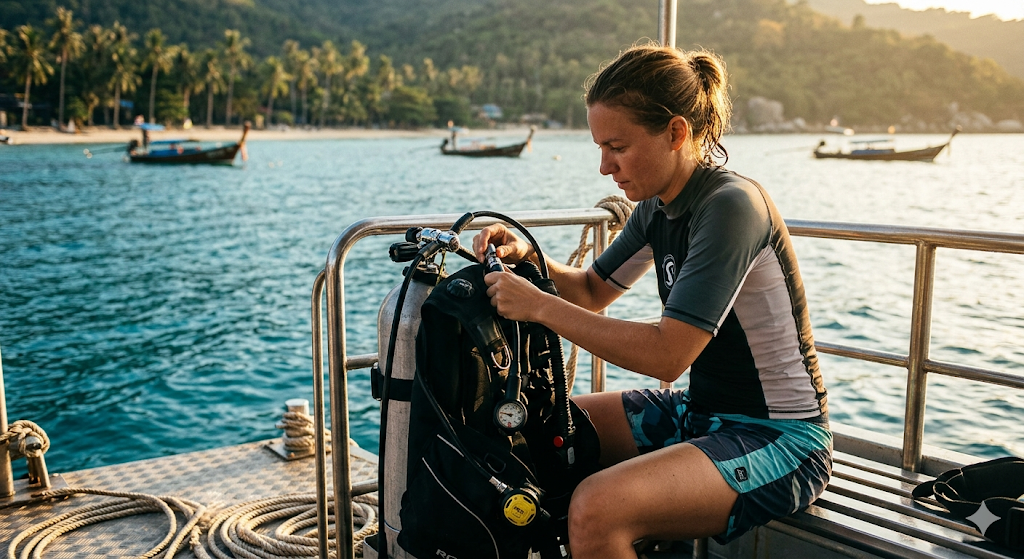
Before you book, ask to see the gear room and the compressor. A reputable center is proud to show you. A center that deflects, stalls, or "can't right now" is telling you something — believe it.
The 5-Minute Pier-Side Audit
You will not have time to read 600 reviews while standing on the pier with a gear bag. Ask these five questions at the desk. Judge the confidence and specificity of the answer, not the smile.
"What is the strict instructor-to-student ratio for my Open Water course?"
✓ Green Flag
A firm "maximum 1:4, often fewer" — and they cap it even if the standard allows more.
Why it matters
PADI allows up to 8 OW students per instructor in open water; the best shops self-limit to 4 so eyes are actually on you.
"Where is the emergency medical oxygen on the boat, and is it full?"
✓ Green Flag
They point to a rigged O₂ kit with a demand valve and a non-rebreather mask, and can tell you the cylinder pressure.
Why it matters
100% O₂ is the single most effective first aid for decompression illness. "Somewhere in the back" is a fail.
"Where is the nearest recompression chamber and what's your evac plan?"
✓ Green Flag
"Badalveda chamber on Koh Tao for first response; serious cases go to Bangkok Hospital Samui by speedboat plus the DAN hotline."
Why it matters
A staffer who cannot name the evacuation chain has never thought about the worst day on the job.
"When was the compressor air last tested, and how often are regs serviced?"
✓ Green Flag
A logbook or certificate, an annual air-quality test, and regs serviced on a documented cycle.
Why it matters
A compressor intake parked near a generator exhaust feeds you carbon monoxide that you cannot taste at depth.
"If I'm low on air or it gets crowded at depth, what's the protocol?"
✓ Green Flag
"We turn the dive on a set tank pressure, ascend as a group on the shotline, and deploy an SMB before surfacing."
Why it matters
"Just swim back to the boat on your own" is how solo divers go missing at busy pinnacle sites.
Instructor-to-Student Ratios: The Number That Matters Most
Ratio is the single biggest lever on your safety as a student or new diver. The training standards set a ceiling; good shops dive well under it.
A lower ratio buys you three things that genuinely change outcomes: more eyes on you during skills, faster response if a regulator free-flows or a mask floods at depth, and far better skill retention. Ask the exact question — "How many students will be in my group, and is there an assistant?" — and write the answer down. If the number on the boat is higher than the answer at the desk, that is a documented red flag.
The Physics That Actually Hurt Divers Here
You do not need to be a physiologist, but understanding three gas laws explains every safety rule you will be given.
Boyle's Law — why you never hold your breath
At a constant temperature, gas volume is inversely proportional to pressure. At 10 m the ambient pressure is 2 ATA (one atmosphere of air plus one of water); your lungs hold half the volume they would at the surface for the same amount of gas. Ascend without breathing out and that gas re-expands inside sealed lungs. The result is pulmonary barotrauma — potentially an arterial gas embolism, which can be fatal. This is barotrauma (mechanical pressure injury to a gas-filled space), and it is a completely different mechanism from decompression sickness. The same law explains ear and sinus squeezes: equalize early and often.
Henry's Law — why decompression sickness exists
The amount of a gas that dissolves into a liquid is proportional to its partial pressure. At depth the higher partial pressure of nitrogen drives nitrogen into your blood and tissues (ongassing). As you ascend, that pressure drops and the nitrogen comes back out (offgassing). Ascend too fast or skip your stops and dissolved nitrogen comes out of solution as bubbles in tissue and blood — decompression sickness (DCS). On Koh Tao the risk is not exotic deep diving; it is repetitive shallow dives with skimpy surface intervals. Follow your computer, ascend no faster than 9–10 m/min, and do a 3-minute safety stop at 5 m on every dive.
Dalton's Law — partial pressures and nitrox
Total pressure is the sum of the partial pressures of each gas in the mix. This matters the moment you breathe enriched air nitrox (EANx), common on Koh Tao for repetitive-dive days. Less nitrogen in the mix means less ongassing and longer no-decompression limits — a real advantage for stacked diving. The trade-off is oxygen: the partial pressure of oxygen (PpO₂) rises with depth, and above roughly 1.4 ATA PpO₂ the risk of CNS oxygen toxicity (which can trigger an underwater convulsion) climbs sharply. That sets a hard maximum operating depth (MOD) for each blend — about 30 m for EANx32, 22 m for EANx36. Always personally analyze your nitrox cylinder, log the percentage, and set your computer accordingly. A shop that hands you a "nitrox" tank with no analyzer in sight has failed a basic safety standard.
Gear and Air Checklist — Before Every Dive
Run this regardless of the center's reputation. Gear is a system; one weak link sinks the dive.
• BCD — inflator clicks crisply, dumps work, holds air with no slow leak.
• Regulator — both second stages breathe easily, no free-flow; the SPG needle is steady and reads full.
• Cylinder — in-date hydrostatic and visual-inspection stamps; O-ring intact; a quick sniff of the air is odourless (oil/exhaust smell = stop).
• Exposure suit — no blown seams at neck or wrists; correct thickness for 3–4 dives in 29 °C water.
• Buddy check — a full BWRAF check done out loud, every dive, no exceptions.
• BCDs patched with duct tape or zip-ties as a "fix" rather than retired.
• A regulator that free-flows on the surface or feels like sucking through a straw.
• A cylinder with an out-of-date or absent inspection stamp.
• Any air that tastes or smells oily — a classic carbon-monoxide warning you must never breathe at depth.
Pro tip: a well-run center inspects gear before and after every dive and services regulators on a documented schedule (typically annually or by use). Ask. The answer tells you whether maintenance is a system or an afterthought.
Koh Tao's Dive Sites, Matched to Your Level
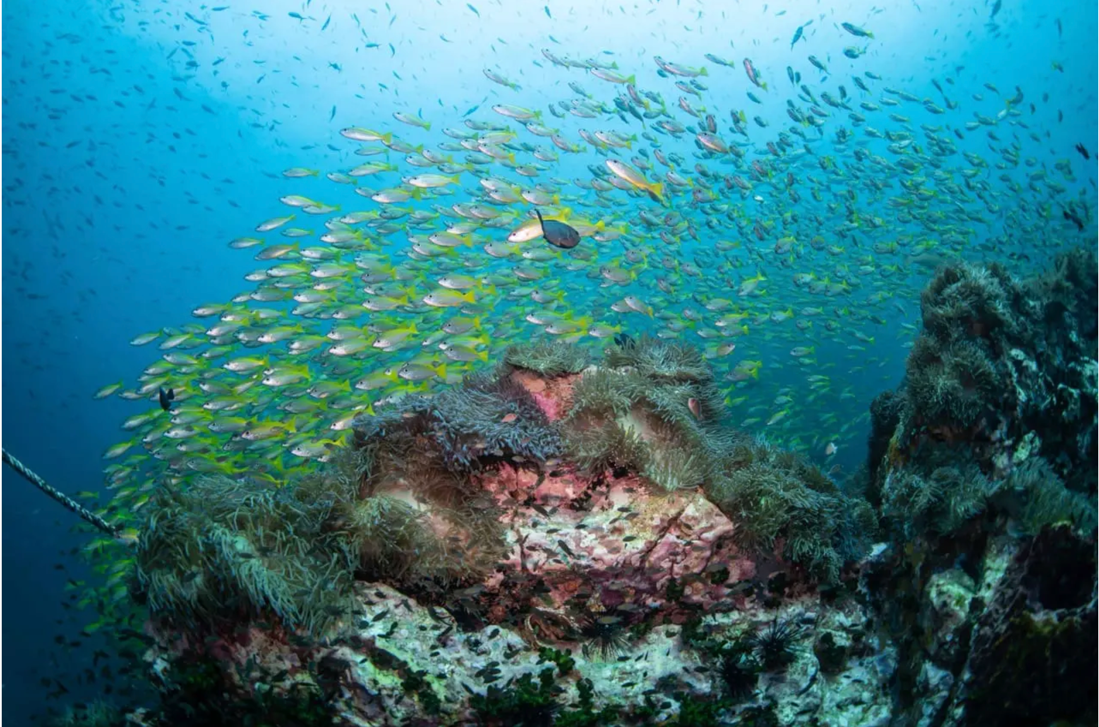
The island has a site for every certification level. The mistake beginners make is letting a shop talk them into a site beyond their training because "everyone goes there."
If you are mid-Open-Water course, your confined-water skills must happen in a sheltered bay before any open-water dive — that is a non-negotiable training-standard sequence, not a scheduling preference. Whale-shark season around the pinnacles is loosely March–May, but they are migratory and never guaranteed; any operator promising sightings is selling, not diving.
Certifying Agencies on Koh Tao
The island is dominated by PADI and SSI, with SDI/TDI technical specialists and the odd RAID or CMAS school. All are members of the WRSTC family of standards, so the floor for safety is broadly equivalent — the differences are in curriculum structure and materials, not in whether the certification is "real."
Choose the instructor and the operation, not the logo on the door. A motivated instructor running 1:4 at an SSI shop beats a checked-out instructor running 1:8 at a 5-Star PADI center every single time.
The Emergency Chain — Know It Before You Get Wet
Decompression illness is the emergency that defines Koh Tao diving. The response chain is short but every link must hold.
Two rules that save lives: administer oxygen early — do not wait to "see if it gets better," and never let a diver with suspected DCS fly or take the high-speed catamaran without medical clearance, because reducing ambient pressure makes bubbles grow. Every certified diver should carry DAN/DES insurance and have the emergency hotline saved before the first dive. Ask your center whether they are part of the island's DAN network and how they coordinate evacuations — a confident, specific answer is the mark of a serious operation.
What NOT to Do on Koh Tao
How ScubaProof Scores Koh Tao Centers
You cannot personally audit 60 shops in a week, and a glossy storefront tells you nothing about the air in the cylinder. ScubaProof runs an extractive review pipeline — it pulls factual signals from thousands of guest reviews and operational records, never invented accusations — and feeds them into five metrics that build the Trust Score.
A post-dive-headache cluster or an "oily air" mention triggers a Red Flag and an automatic penalty; a single uncorroborated complaint is a Yellow Flag that notifies the center and lightly reduces the score. A Koh Tao operator carrying active safety Red Flags with a Trust Score below 3.0 / 5.0 is labelled Under Review — treat that as a reason to choose another shop. You can change a dive center in five minutes; you cannot undo an incident at depth.
The centers listed below have been independently scored by this algorithm. Use the audit questions above as your in-person verification, and let the data narrow the field before you ever set foot on the pier.