
Every diver hears it during open-water training: "Don't fly right after diving." It sounds like an administrative box to tick before the airport run. It is not. Under that single sentence sits gas-law physics, cardiovascular physiology, and decades of hyperbaric chamber data.
The risk is brutally real and almost entirely preventable. Decompression sickness (DCS) provoked by premature altitude exposure is one of the most common — and most avoidable — emergencies in dive travel. The diver did everything right underwater, surfaced clean, then undid all of it by checking in at the gate too soon.
Here is exactly why your bloodstream can turn into a shaken soda bottle at 8,000 feet, what each international authority actually requires (not the watered-down version), and why the expensive computer on your wrist can be dangerously optimistic.
Why Nitrogen "Boils" in Your Blood
To see why altitude is dangerous after diving, you have to track one gas through two pressure changes: down, then up. The culprit is nitrogen — a biologically inert gas that makes up roughly 78% of the air in your cylinder. (Note the terminology: you breathe compressed air or nitrox from a cylinder, never "oxygen" from a "tank." Pure oxygen below ~6 m is toxic.)
Henry's Law: How Gas Loads Into Tissue
On the surface, the air you breathe sits at 1 ATA (atmosphere absolute) at sea level. Underwater, ambient pressure rises by 1 ATA for every 10 metres of seawater, and your regulator delivers gas at that ambient pressure so your lungs never collapse.
Henry's Law governs what happens next: the amount of a gas that dissolves into a liquid is directly proportional to the partial pressure of that gas above the liquid.
C = concentration of dissolved gas · k = Henry's law constant · Pgas = partial pressure of the gas
At 30 m you are at 4 ATA, so the partial pressure of nitrogen in your breathing gas is roughly four times higher than at the surface. Driven by that gradient, nitrogen is forced out of your lungs and dissolves into blood and tissues — fat, muscle, joints, spinal cord — far above its normal concentration. This loading process is called ongassing (or ingassing).
Crucially, Dalton's Law explains which gas matters: in a mixture, each gas exerts pressure independently, in proportion to its fraction. More depth means a higher partial pressure of nitrogen (PN₂), and Henry's Law converts that directly into more dissolved gas. This is also why nitrox helps — replacing some nitrogen with oxygen lowers PN₂ at any given depth, so you ongas less. (It does not shorten your no-fly time if your computer is set to air, and it does nothing for oxygen toxicity risk — different problem.)
The Soda Bottle: Saturation and Off-Gassing
Picture your body during a dive as a capped bottle of soda under pressure: the gas stays invisibly dissolved. When you ascend, ambient pressure drops and your body begins to off-gas — nitrogen diffuses out of tissues, back into blood, up to the lungs, and out with each exhalation.
Do this slowly and the gas leaves quietly in solution. Boyle's Law is the warning attached: pressure and volume are inversely related, so any gas that comes out of solution as a bubble expands as you go shallower. Ascend too fast — or strip away ambient pressure too soon by flying — and the pressure gradient reverses violently.
The Danger Zone: The Pressurized Cabin
A commercial airliner cabin is not pressurized to sea level. Regulations permit cabin altitude up to the equivalent of roughly 1,800–2,400 m (6,000–8,000 ft), around 0.74–0.81 ATA. You don't need to climb Everest to hurt yourself — a routine flight drops ambient pressure by 20–25%.
That sudden pressure drop pushes still-loaded tissues into supersaturation: the dissolved nitrogen can no longer stay in solution and comes out as physical gas bubbles in blood and tissue. The result is decompression sickness. Microbubbles obstruct capillaries, mechanically stress vessel walls, and trigger an inflammatory and clotting cascade. Clinically this ranges from joint pain ("the bends") and skin mottling, to neurological hits — numbness, weakness, vertigo, bladder dysfunction — and, in severe cases, spinal cord injury or pulmonary involvement ("the chokes").
Two different injuries — don't confuse them
Decompression sickness is dissolved inert gas coming out of solution as bubbles (the topic of this article). Barotrauma is mechanical injury from gas trapped in a rigid space — sinuses, ears, lungs — that cannot equalize with changing pressure. Flying with congested sinuses or a recent pulmonary issue is a barotrauma risk; flying with a residual nitrogen load is a DCS risk. The surface intervals here address DCS, not barotrauma.
The Golden Rules: What Each Authority Actually Says
Your body has no gauge for tissue nitrogen, so training agencies and hyperbaric medical bodies publish surface-interval windows derived from chamber trials and decades of incident data. The single most cited source is the 2002 DAN/UHMS Flying After Diving Workshop — the consensus most agencies adopted.
DAN / UHMS (the source document)
For recreational dives followed by flights at cabin altitudes of 2,000–2,400 m (6,500–8,000 ft):
- Single no-decompression dive: at least 12 hours surface interval
- Multiple dives per day, or multiple days of diving: at least 18 hours
- Dives requiring decompression stops: there is little published data, but substantially longer than 18 hours is prudent
These are minimums that still carry residual risk, not safe-with-certainty guarantees. Longer is always safer.
PADI
PADI teaches the DAN consensus, phrased for recreational students:
- Single dive: minimum 12 hours
- Repetitive dives or multi-day diving: minimum 18 hours
- Dives requiring decompression stops: >18 hours, commonly taught as a full day
GUE, CMAS, SSI, TDI
- SSI mirrors the DAN 12 h / 18 h framework.
- GUE and most technical (TDI) programs treat 18 hours as a bare floor and routinely require 24 hours or more after staged-decompression, mixed-gas, or trimix dives — the larger and slower the gas load, the longer the wait.
- CMAS national federations generally publish a conservative blanket recommendation of 24 hours after any repetitive or multi-day diving.
US Navy
The US Navy uses a compartment model with Repetitive Group Designators (letters tracking residual nitrogen across theoretical tissue compartments). Its tables yield a required surface interval before ascent to altitude based on your group and the target altitude. For routine recreational-equivalent profiles before commercial flight, that resolves to roughly a 24-hour wait for heavier profiles — the Navy's framework is built for repeatable operational safety, so it trends conservative.
Quick Reference: Flight Safety Intervals
Minimum surface interval before flying — by authority
Pro rule of thumb
Plan the last full day of any dive trip as a dry day. A clean 24-hour buffer before flying covers virtually every recreational profile, absorbs the uncertainty in any model, and costs you nothing but one day of postcards instead of bubbles.
It's Not Just Airplanes: Altitude by Any Means
The trigger is reduced ambient pressure, not the aircraft. The same surface-interval logic applies to:
- Driving over mountain passes to leave a dive destination — a road climbing to 1,500 m+ is altitude exposure.
- Returning to a town that already sits at altitude (e.g. high-plateau resorts, mountain lakes).
- Ziplines, cable cars, or scenic flights scheduled "as a last-day treat."
There is a separate discipline — altitude diving — for diving in mountain lakes, where you compute tables for the lower surface pressure you'll return to. That is the inverse problem. For flying-after-diving, just remember: if you are going up after diving, the clock applies regardless of the vehicle.
Why Your Dive Computer Might Be Wrong
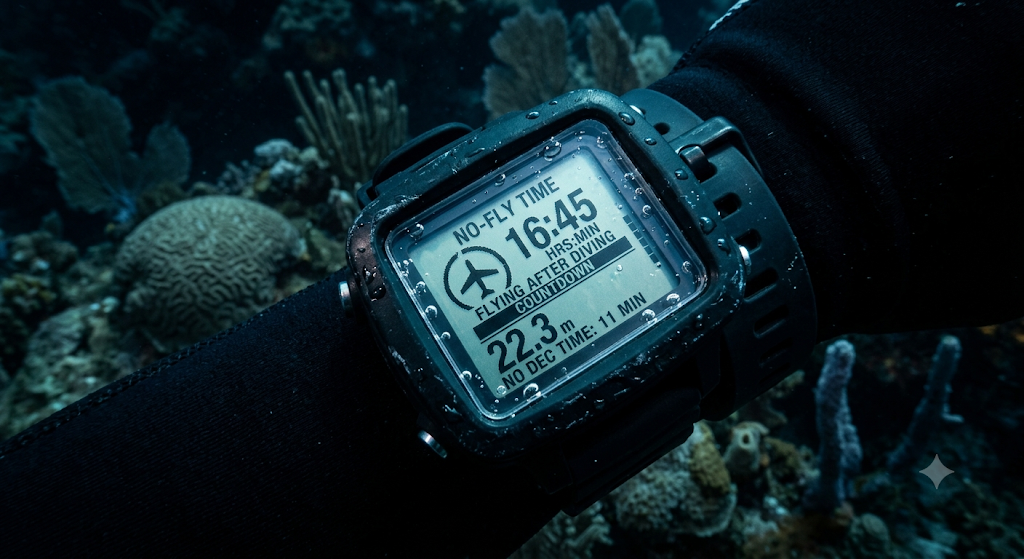
Modern computers run Bühlmann ZH-L16C (with gradient factors) or bubble models like RGBM/VPM, and they show a tidy "No-Fly" countdown. Treating that timer as a green light to board can be a serious mistake.
The fundamental flaw: Dive computers measure pressure and time. They do not measure you.
1. The Model Is an Average, You Are Not
Decompression algorithms assume tissues load and unload along fixed mathematical curves calibrated on a reference population. Your physiology deviates from that average in ways the device cannot see:
- Dehydration: breathing dry compressed gas plus immersion diuresis (cold and pressure make you urinate) leaves divers chronically under-hydrated. Thicker blood and lower volume slow peripheral circulation — and circulation is the highway nitrogen uses to leave.
- Body composition: nitrogen is lipophilic and dissolves roughly five times more readily in fat than in lean tissue. A higher body-fat fraction means "slow" tissue compartments stay loaded well after the algorithm calls you clear.
- Age, fitness, and core temperature: weaker perfusion and being cold at depth (when you ongas) but warm on the surface (when you should offgas) both distort real off-gassing versus the model's assumption.
2. Silent Bubbles
Most recreational computers use dissolved-gas models that assume nitrogen stays in solution until a threshold is crossed. They do not track silent bubbles — venous gas microbubbles that form even after textbook, within-limits ascents. Carry a heavy silent-bubble load to the end of a dive holiday, expose it to altitude, and Boyle's Law expands those bubbles immediately, sidestepping the clean desaturation curve on your wrist.
3. PFO — The Hidden Shunt
Roughly 1 in 4 people has a patent foramen ovale (PFO), a small flap-valve opening between the heart's atria that never fully closed after birth. Normally venous bubbles are filtered out by the lungs. A PFO can let them shunt directly into arterial circulation — and the brain — dramatically raising DCS risk for the same dive profile. Most carriers never know. If you have had unexplained DCS hits, get screened by a dive physician before you trust any computer's no-fly clock.
What NOT to Do
Avoid these at all costs
- Diving the morning of your flight. "One quick shallow dive before the airport" is the single most common pattern in flying-after-diving DCS cases. Don't.
- Treating the computer's no-fly countdown as permission. A 0:00 readout means "the model thinks you're clear," not "your body is clear."
- Drinking alcohol to celebrate the last dive day. Alcohol is a diuretic, deepens dehydration, and masks early DCS symptoms you need to feel.
- Booking a high-altitude transfer (mountain road, cable car) right after diving and assuming "it's not a plane, so it's fine."
- Hiding symptoms to avoid missing a flight. Tingling, unusual fatigue, or joint pain after diving is a medical event, not an inconvenience. Flying with symptoms turns mild DCS into severe DCS.
Pre-Flight Checklist for Divers
Before you head to the airport
If You Suspect DCS Before a Flight
Do not board. Treat it as an emergency.
- Stop and stay at ground level. Cancel the flight — altitude will make it worse.
- Breathe 100% oxygen. Surface oxygen first aid accelerates nitrogen off-gassing by maximising the pressure gradient, and is the single most effective field treatment for DCS.
- Hydrate with water or oral rehydration fluids if conscious and able to swallow.
- Call the emergency dive line (DAN operates 24/7 hotlines) and get to a recompression chamber. Definitive treatment is hyperbaric oxygen therapy.
- Hand over the dive computer / profile to the treating physician — depths, times, and surface intervals guide treatment.
This is exactly why a dive center's Oxygen Readiness matters before you ever splash. A reputable operation carries a serviced, full emergency oxygen unit and staff trained to deploy it — not a dusty cylinder no one has checked since last season.
How ScubaProof Surfaces Safe Operators
A center that runs tight, conservative profiles and has working emergency oxygen is your best insurance against ever needing this checklist. ScubaProof scores operators on the metrics that map directly to the risks above:
Safety
Conservative profiles, mandatory safety stops, ascent-rate discipline, and realistic last-day-before-flight planning.
Oxygen Readiness
A full, serviced emergency O₂ kit on the boat and staff trained to deploy it — the field treatment for DCS.
Staff Conduct
Briefings that cover no-fly windows, divemasters who refuse pressure to "squeeze in one more dive."
Gear & Trust Score
Maintained rental computers and a composite Trust Score so you can compare operators at a glance.
A red flag worth weighing heavily: an operator that schedules deep or repetitive dives on a guest's departure morning, or shrugs off the no-fly interval entirely.
Interactive Safety Calculator
Plan your itinerary against the combined, conservative PADI/DAN guidelines for your specific profile.
Flying After Diving Safety Assessment
Final Recommendations
- Build a buffer. Treat 18 hours as the floor and a full 24-hour surface interval as your personal standard before flying home from any multi-day trip.
- Hydrate systematically. Water and electrolytes throughout your diving days keep blood volume up — your best physiological defence against slow off-gassing.
- Own the last day. Dedicate the final 24 hours to dry, sea-level activities. Off-gassing on a beach beats off-gassing in a 0.75-ATA cabin.
- Don't let the computer overrule the consensus. Even at 0:00, apply the DAN 18-hour minimum after multi-day diving. Algorithms are averages, not promises.
- Choose your operator deliberately. Conservative profiles and real Oxygen Readiness are decided before you ever get in the water.