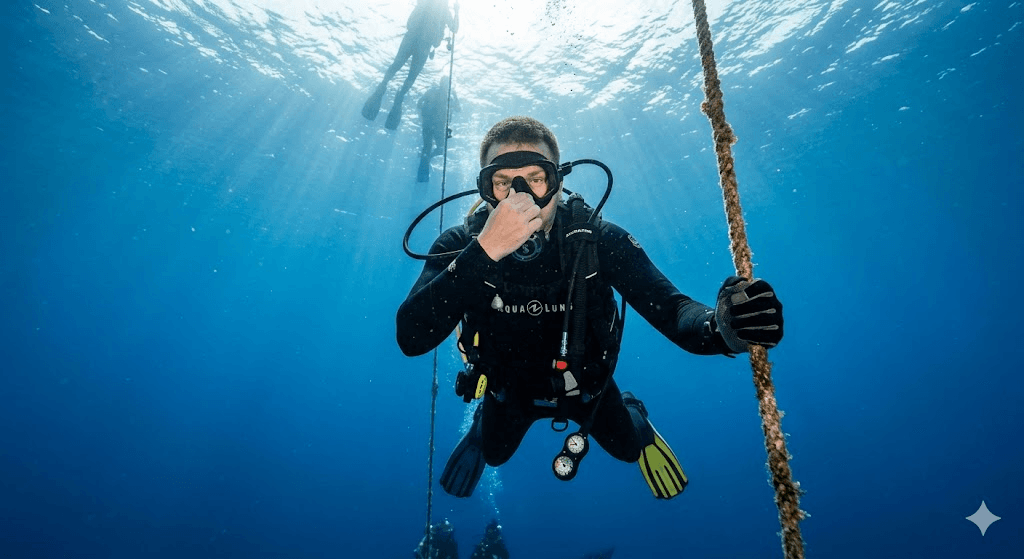
Ear pain is the number one reason divers abort a dive — and the leading cause of preventable barotrauma. At just 10 metres, the absolute pressure around you has already doubled. If you have ever felt a stabbing pain on descent and pushed through it anyway, you may have already injured your middle ear without realising it. The reassuring part: equalization is a learnable, trainable skill. The right technique, applied early, turns a dive-ending problem into a non-event.
This guide goes past the one-line "pinch and blow" most beginners are taught. You will get the physics behind the squeeze, six distinct equalization methods (including the ones freedivers and tech instructors actually use), a descent protocol, and a clear map of when ear pain stops being an inconvenience and becomes a medical emergency.
The Physics: Why Boyle's Law Makes Your Ears Hurt
Ear squeeze is not mysterious — it is Boyle's Law acting on a sealed pocket of gas. Boyle's Law states that for a fixed mass of gas at constant temperature, pressure and volume are inversely proportional: as ambient pressure rises, the gas volume shrinks.
The middle ear is exactly such a pocket: an air-filled cavity sealed on the outside by the eardrum (tympanic membrane) and connected to the back of the throat by the Eustachian tube. On descent, increasing water pressure compresses that trapped air, so its volume drops. Something has to fill the deficit, or the eardrum bows inward to take up the missing volume — and a stretched eardrum is what you feel as pain. Equalizing means actively pushing fresh air up the Eustachian tube to top the pocket back up to ambient pressure.
The cruel detail is where the volume change is steepest. Pressure rises linearly with depth (about 1 atmosphere per 10 metres of seawater), but the fractional volume change is largest near the surface, because you are dividing by a small starting pressure.
Boyle's Law — gas volume vs. depth (sealed pocket)
Read that table again: the pressure differential between the surface and 10 metres is the same 1 ATA as between 10 and 20 metres — but the volume halves in the first 10 metres alone, while in that next 10 metres it only drops from 50% to 33%. That is why most ear injuries happen in the first few metres, and why a diver who descends fast off the boat is the diver who ends up in an ENT clinic. The shallows are where you must be slowest and most attentive.
Why the Eustachian Tube Won't Always Open
The middle ear can only refill through the Eustachian tube — a narrow channel that is normally collapsed shut and opens only when muscles around it (the tensor veli palatini and levator veli palatini) contract during swallowing, yawning, or a deliberate equalizing maneuver.
Several things conspire against you:
- Anatomy. Some people simply have narrow or more horizontal tubes. This is trainable to a degree but not entirely.
- Congestion. Allergies, a cold, sinusitis, or smoking inflame the mucous membranes lining the tube and swell it shut.
- Pressure lock. Here is the non-obvious one. If you let a pressure differential build before equalizing, the higher outside pressure can physically clamp the tube's soft walls closed — like a wet drinking straw collapsing when you suck on it. Past roughly 1.5 metres of "debt," no amount of Valsalva will reopen it. The fix is to ascend slightly to relieve the differential, then equalize. Prevention beats rescue every time.
6 Equalization Techniques
There is no single "correct" method. Different anatomy responds to different techniques, and skilled divers blend several. Techniques 3 and 4 are the ones worth investing real practice in — they are the gentlest and the most controllable.
Valsalva Maneuver — Pinch and Blow
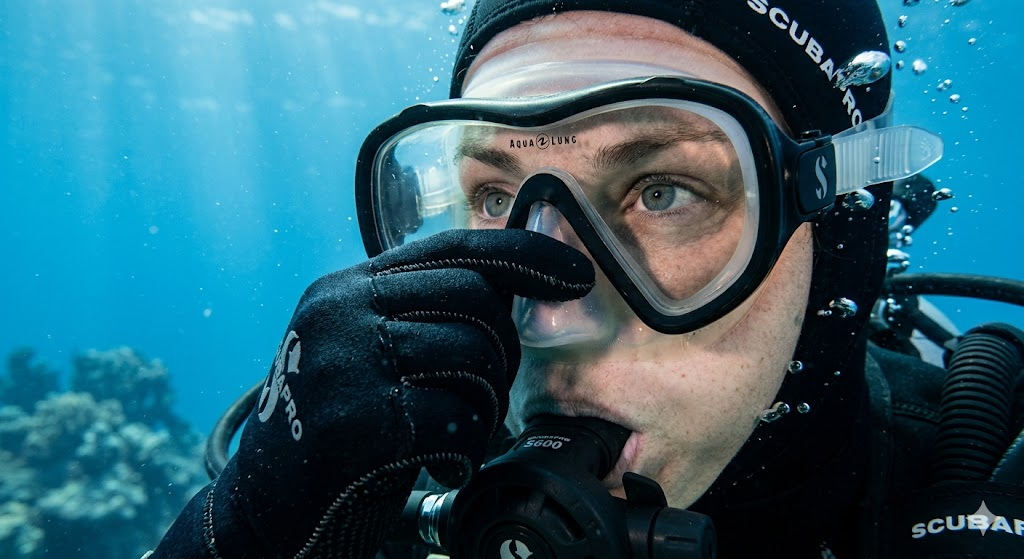
Pinch your nose through the mask skirt and blow gently against closed nostrils. Air is forced up the Eustachian tube; a soft "click" is normal. This is the method taught in nearly every open-water course (PADI, SSI, CMAS) and the one most beginners default to. The critical word is gently. Forced Valsalva spikes intrathoracic and cerebrospinal-fluid pressure, which transmits to the round window of the inner ear — over-pressurise it and you can rupture that membrane. Valsalva also closes the throat end of the tube as it works, so it is poor for reopening a tube that is already locked. If light pressure fails after one or two tries, switch methods — do not crank harder.
Toynbee Maneuver — Pinch and Swallow
Pinch your nose and swallow. Swallowing fires the muscles that actively pull the Eustachian tube open, while the pinch lets the moving air pressurise the middle ear instead of escaping out the nose. It works well when Valsalva produces nothing, and it is gentle by design — you cannot easily over-pressurise the inner ear with a swallow. Especially useful on ascent and for "stubborn" ears. The catch: you need saliva to swallow, so it gets harder on long dives with a dry mouth.
Frenzel Maneuver — Tongue Piston
Pinch the nose, close the vocal cords (glottis) as if about to lift something heavy, then drive the back of the tongue up and back toward the soft palate while making a "K" or "ng" sound. This uses the tongue as a piston to compress a small slug of air in the back of the throat and aim it at the Eustachian tube — the lungs and chest are not involved at all. Because no chest pressure is generated, it cannot blow out the round window the way a hard Valsalva can. It is the standard for freedivers and most technical instructors, it is fast, repeatable, and works hands-busy. It takes practice to isolate the tongue movement, but once learned it is the gentlest and most reliable method available.
BTV — Voluntary Tubal Opening (Hands-Free)
BTV (béance tubaire volontaire, popularised in French CMAS/FFESSM training) is the holy grail: opening the Eustachian tubes with the throat muscles alone — no nose pinch, no blowing. You contract the soft-palate and throat muscles used at the start of a yawn to hold both tubes open. Done well it is continuous and effortless, letting you descend with both hands free. Not everyone can learn it, and it usually requires weeks of practice, but for divers who master it, ear squeeze essentially disappears. Worth pursuing if you dive often.
Lowry / Edmonds — Combination Techniques
For ears that resist single methods, combine. The Lowry technique is Valsalva plus Toynbee at once: pinch the nose, then gently blow and swallow simultaneously. The Edmonds technique adds jaw position: push the jaw forward and down, then perform a gentle Valsalva or Frenzel. By recruiting the tube-opening muscles at the same time as you supply pressure, these often clear an ear that neither method alone would. Keep all pressure gentle.
Jaw Wiggle & Yawn — Passive Pre-Equalization
Move the jaw side to side, yawn, or swallow. These passive movements tug on the tissues around the Eustachian tube and can nudge it open with no pressure at all. Use this as a preventive habit at the surface and through the first metre or two of descent before any discomfort begins. It is rarely enough on its own below ~3 metres, but starting every descent already balanced is one of the highest-value habits you can build.
The Golden Rule: Equalize Early, Often, and Gently
The single biggest mistake is waiting until you feel pain. By the time pain arrives, the eardrum is already stressed and the Eustachian tube may already be pressure-locked shut — exactly when equalization becomes hardest. Run this protocol on every single descent.
Descent equalization protocol
A "click" is fine; a "pop with pain" is not. A soft click as air enters the ear is exactly what you want. A loud pop with sudden pain, spinning vertigo, or muffled hearing is a barotrauma warning — stop and reassess.
Pro tip — train it dry. You can learn Frenzel and BTV on the couch, no water needed. Practise in front of a mirror: pinch your nose, make the "K" sound, and watch for the tiny throat movement; you will hear and feel the click in your ears. Ten minutes a day for a couple of weeks builds the muscle control that makes equalizing on descent automatic.
What NOT To Do
Reverse Squeeze (Reverse Block) on Ascent
Most divers know about squeeze on descent, but Boyle's Law cuts both ways. On ascent, the air in your middle ear and sinuses expands. Normally it vents passively out the Eustachian tube. But if that tube is partially blocked — congestion, or rebound from a worn-off decongestant — the expanding air can't escape fast enough, building pressure and pain on the way up. This is a reverse block, and it is genuinely dangerous because the one thing that relieves it (going deeper) conflicts with your air supply and deco obligations.
If you hit a reverse block:
- Slow or stop the ascent. Do not bolt for the surface — uncontrolled ascent risks lung overexpansion injury and decompression sickness on top of the ear problem.
- Descend a metre if gas and your computer allow, let the pressure equalise, then try gentle jaw movements, swallowing, or a Toynbee. Trying to force air out is rarely effective.
- Ascend slowly as the block eases, giving the trapped gas time to vent.
A mild reverse block usually resolves on its own within about 30 minutes on the surface as the tissues relax. If it doesn't, or if it comes with vertigo or hearing loss, see a doctor the same day, and do not dive again until cleared.
Barotrauma vs. Decompression Sickness — Don't Confuse Them
Ear injuries here are barotrauma: mechanical damage from a pressure differential across a gas space, governed by Boyle's Law. That is a completely different mechanism from decompression sickness (DCS), which is caused by dissolved inert gas (nitrogen) coming out of solution as bubbles when you ascend too fast — Henry's Law territory. They are not the same injury, they are not treated the same way, and a "burst eardrum" is never decompression sickness.
The overlap that catches people out is inner-ear injury. Both inner-ear barotrauma (from a forced equalization) and inner-ear DCS can present with the same triad: vertigo, hearing loss, and tinnitus. Telling them apart matters because the treatments differ — inner-ear DCS needs recompression in a chamber, while inner-ear barotrauma generally must not be recompressed. If you surface with spinning vertigo and hearing changes after a dive, treat it as an emergency and get to a doctor or diving-medicine hotline who can sort out which it is. Do not self-diagnose underwater.
Barotrauma Severity Scale
Middle/inner-ear barotrauma — severity
If you experience bleeding from the ear canal, sudden significant hearing loss, or severe vertigo after a dive, treat it as a medical emergency. These signs point to a ruptured eardrum or inner-ear barotrauma — possibly a round-window rupture where inner-ear fluid is leaking. Do not dive again. See an ENT (ear, nose, and throat) specialist urgently; delayed treatment markedly worsens the chance of full recovery. A ruptured eardrum also exposes you to caloric vertigo — cold water hitting the inner ear triggers violent disorientation underwater, which is how an ear injury becomes a drowning risk.
What Good Dive Centers Do Differently
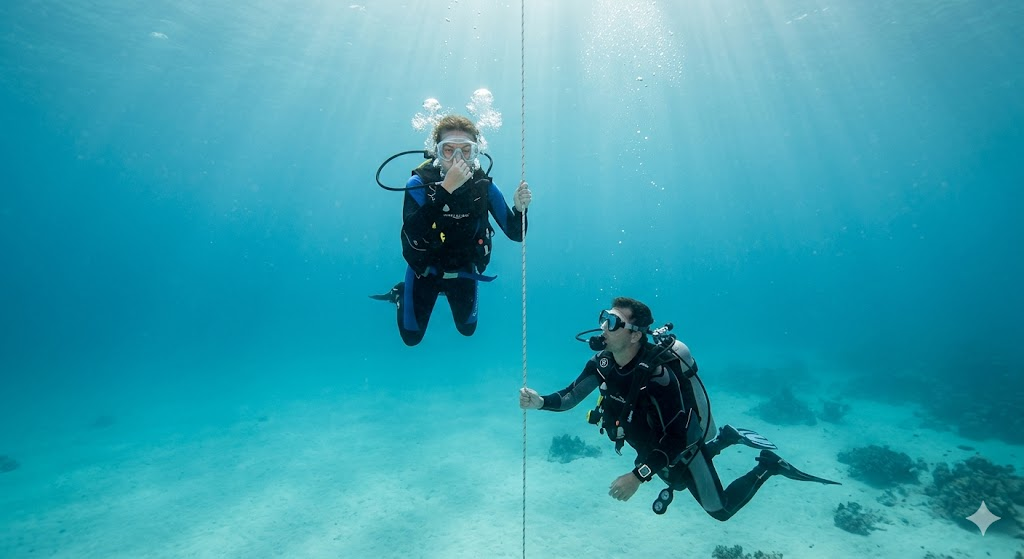
Equalization is as much an operational-culture issue as a personal-skill one. Quality dive centers brief beginners properly — demonstrating each technique, having students practise at the surface, and stopping the descent at 2–3 metres so every diver can confirm clear ears. They create an environment where "my ears won't clear" is met with patience, not pressure, and where the slowest equalizer sets the group's descent rate.
Low-quality operations rush descents to keep the schedule moving, brief equalization in a single throwaway sentence, and treat a struggling diver as a nuisance. Barotrauma incidents cluster at exactly these centers. Here is how that shows up in ScubaProof metrics:
Before booking your first dive — or your hundredth — check the center's Safety, Staff Conduct, and Oxygen Readiness scores on ScubaProof, and read what the Trust Score is built from. We aggregate real data on equalization briefings, descent culture, and incident handling so you can dive with operations that put your ears, and your hearing, first.