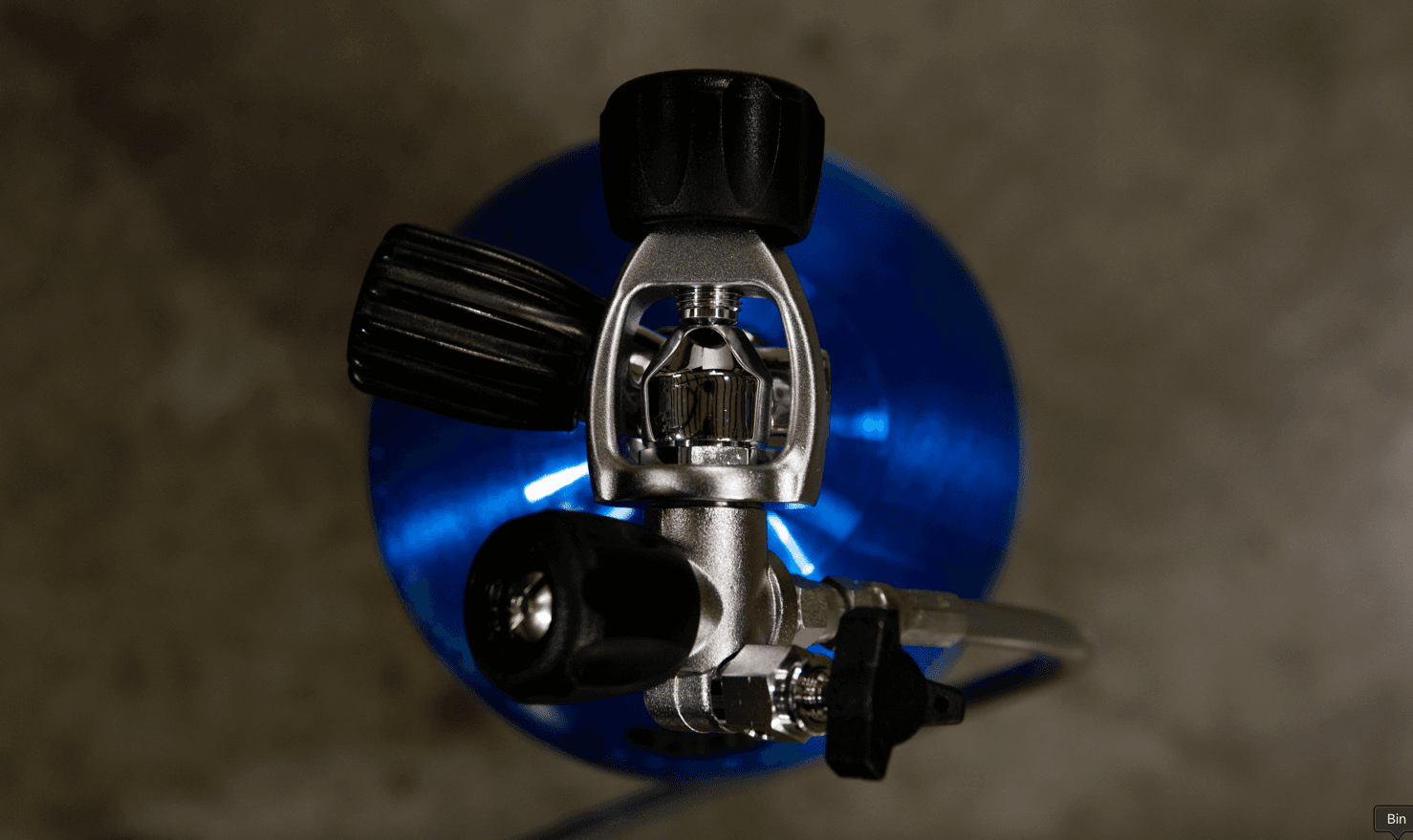
You cannot smell it, taste it, or see it. Carbon monoxide (CO) is colourless, odourless, and tasteless — and in a poorly maintained scuba compressor it accumulates in the cylinder at concentrations that are merely uncomfortable at the surface but incapacitating at depth.
This is not theoretical. CO poisoning appears in diving fatality investigations worldwide, and the recurring pattern is depressingly consistent: a combustion engine sited near the compressor intake, an activated-carbon filter saturated months past its service life, and symptoms dismissed as narcosis until the diver loses consciousness. The line between that outcome and an uneventful dive is a maintenance log, a filter-change schedule, and a 30-second test you can run yourself.
This guide covers the physiology, the physics, the compressor chain, and the field procedures — beginner through technical — so you never have to look anything else up on this topic.
1. What CO Actually Does to a Diver
Carbon monoxide kills by hijacking haemoglobin, the oxygen-carrying protein in red blood cells. CO binds haemoglobin 200–250 times more avidly than oxygen, forming carboxyhaemoglobin (COHb). Each haemoglobin site occupied by CO is a site that can no longer carry O₂.
But the damage runs deeper than simple seat-blocking. CO also:
- Shifts the oxyhaemoglobin dissociation curve leftward — the haemoglobin that is still loaded with oxygen clings to it more tightly and releases less to the tissues. So you suffer both reduced carrying capacity and reduced delivery.
- Binds intracellular myoglobin and cytochrome oxidase, poisoning the mitochondria directly. This is why CO has delayed neurological after-effects that can appear days to weeks later (delayed neuropsychiatric sequelae).
The brain consumes roughly 20% of the body's oxygen at rest and fails first: headache, impaired judgement, then loss of consciousness. The heart, the other high-demand organ, is the second casualty.
The half-life that matters. Breathing normal air at the surface, COHb has an elimination half-life of about 4–6 hours. Breathing 100% oxygen at 1 ATA drops that to roughly 60–90 minutes. In a hyperbaric chamber at 2.5–3 ATA it falls to 20–30 minutes. This is precisely why a dive operation's oxygen readiness — a full, accessible O₂ kit and trained staff — is not optional first aid theatre. It is the single intervention that reverses the poisoning.
2. The Physics: Why Depth Amplifies the Dose
Here is the nuance most articles get wrong, so let's be precise. The concentration of CO in your cylinder, measured in parts per million (ppm), does not change as you descend — 10 ppm is 10 ppm at any depth. What changes is partial pressure, governed by Dalton's Law: the partial pressure of a gas equals its fractional concentration multiplied by the total absolute pressure.
At depth, total pressure rises, so the partial pressure of CO (PpCO) you breathe rises proportionally, and your blood equilibrates against that higher partial pressure. Henry's Law then drives more CO into solution and onto haemoglobin. The practical shorthand divers use — "CO is 4× worse at 30 m" — is a partial-pressure statement, not a concentration one. The number of CO molecules crossing your alveolar membrane per breath scales with absolute pressure.
There is a second, crueller twist. On the surface, a victim's body fights hypoxia, but the inspired oxygen partial pressure is normal. At depth, the elevated PO₂ of your breathing gas can mask the hypoxia — your tissues are starved of O₂ delivery (CO blocks the haemoglobin) yet the high ambient PO₂ keeps just enough dissolved oxygen in plasma to suppress the warning signs. Then you ascend. Ambient pressure falls, PpCO and PO₂ both drop, the thin plasma-oxygen cushion vanishes, and a diver who felt "fine but headachy" at 30 m can lose consciousness on the safety stop or at the surface. CO incidents frequently strike during or just after ascent.
Same cylinder, same 50 ppm contamination — partial pressure of CO by depth
3. The Standards: What "Clean Air" Means on Paper
Breathing air is a manufactured product with legal limits. The two reference standards are EN 12021 (European / international, the one most dive operations and tech divers cite) and CGA G-7.1 Grade E (North American). They do not agree on CO: EN 12021:2014 caps it at the stricter ≤ 5 ppm, while CGA Grade E allows ≤ 10 ppm. EN 12021 also specifies the full envelope.
EN 12021 breathing-air limits (compressed air for diving)
*Water limit depends on max storage pressure; lower for high-pressure / cold use.
At 30 m (4 ATA) the EN 12021 ceiling of 5 ppm produces a PpCO equivalent to roughly 20 ppm at the surface — and even the looser CGA Grade E limit of 10 ppm only reaches a ~40 ppm equivalent, still inside the safety margin. The danger lives entirely in the gap between "certified clean" and "never tested." A compressor that drifts to 50–100 ppm gives no warning at the fill panel and no warning in your mouth.
Critical fact. Oil contamination has a tell — a petroleum or sweet-metallic taste. CO has none. A clean-tasting breath proves the air is oil-light; it proves nothing about CO. Never let the taste test stand in for a CO analysis.
4. How Contamination Gets Into Your Cylinder
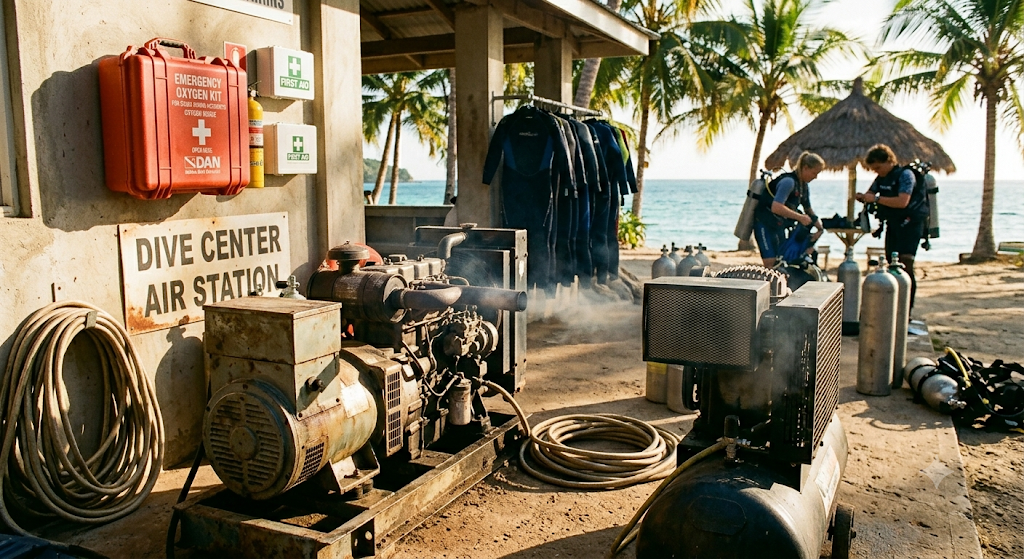
The dominant pathway is intake proximity to combustion. The compressor draws ambient air; if that air is downwind of a diesel generator, a parked vehicle, a boat's own exhaust, or even a smoker on the dock, the compressor faithfully pressurises those products of incomplete combustion into the cylinder at 200–300 bar. A long, high, upwind intake hose is the cheapest CO defence in existence — and its absence is a red flag.
The second pathway is the compressor eating itself. When piston rings wear or cooling fails, the unit overheats. Lubricating oil flashes into vapour, and — critically — an overheating compressor can manufacture CO internally by partially combusting its own oil film. This is why a hot, neglected compressor is dangerous even with a perfect intake location.
The filter stack is the last line of defence. Each stage fails differently.
Particulate / Coalescing Pre-Filter
What it removes
Dust, rust, large aerosols, bulk water droplets. Essential but does nothing to CO or hydrocarbon vapour.
Failure mode
Clogging raises compressor load and temperature — which accelerates downstream filter exhaustion and CO generation.
Activated Carbon + Hopcalite — The Critical Stage
What it removes
Activated carbon adsorbs hydrocarbons, oil vapour and odours. A dedicated hopcalite catalyst (where fitted) converts CO to CO₂. Capacity is huge when fresh — and invisible once spent.
Failure mode
Once saturated it passes CO and hydrocarbons through with zero warning — no colour change, no alarm, no smell. Hopcalite is also poisoned by moisture, so a failed desiccant stage kills the CO conversion. Replace per the manufacturer's hour-count or every 3–6 months, whichever comes first.
Moisture Separator / Molecular Sieve
What it removes
Water vapour. Protects against internal cylinder corrosion, valve damage, and — at altitude or in cold water — regulator freeze-up.
Failure mode
Saturated desiccant delivers humid air, rusting the cylinder from inside and feeding particles into the next fill. Wet gas also disables hopcalite upstream of it.
5. Recognising CO Poisoning Underwater
CO mimics the two states divers expect to feel: nitrogen narcosis (disorientation, false confidence) and exertional fatigue (breathlessness, headache). That overlap is what makes it lethal — the victim explains every symptom away.
The post-dive headache is the most underreported signal in diving. A headache that develops during a dive — and resolves on breathing fresh air or oxygen — is a textbook CO indicator. Cherry-red skin is taught in first-aid courses but is unreliable and usually a late or post-mortem sign; do not wait for it. The strongest epidemiological signal is clustering: when multiple divers off the same fill panel report headaches the same day, that compressor is guilty until proven innocent.
6. Emergency Response: What To Do
Suspected CO poisoning — immediate actions
1. End the dive. Controlled ascent with the affected diver, respecting safety-stop and any decompression obligation — a CO casualty is not exempt from DCS risk.
2. Get them off the bad gas and onto 100% oxygen at the highest available concentration, via a non-rebreather or demand valve. This is the priority intervention — it cuts the COHb half-life from hours to ~1 hour.
3. Keep them on oxygen continuously even if they "feel better." COHb rebounds and delayed neurological effects are real.
4. Activate EMS / call DAN. Severe cases need hyperbaric oxygen, which clears COHb fastest and reduces delayed sequelae.
5. Quarantine the cylinder and the compressor. Preserve the gas for analysis and stop further fills — others may already be diving the same air.
A standard fingertip pulse oximeter is useless here — it cannot distinguish oxyhaemoglobin from carboxyhaemoglobin and will read a falsely reassuring high SpO₂. Only a CO-oximeter (or arterial blood gas) measures COHb. Treat on clinical suspicion, not on the oximeter.
7. Protect Yourself Before You Get In
Carry a CO analyser — and use it correctly
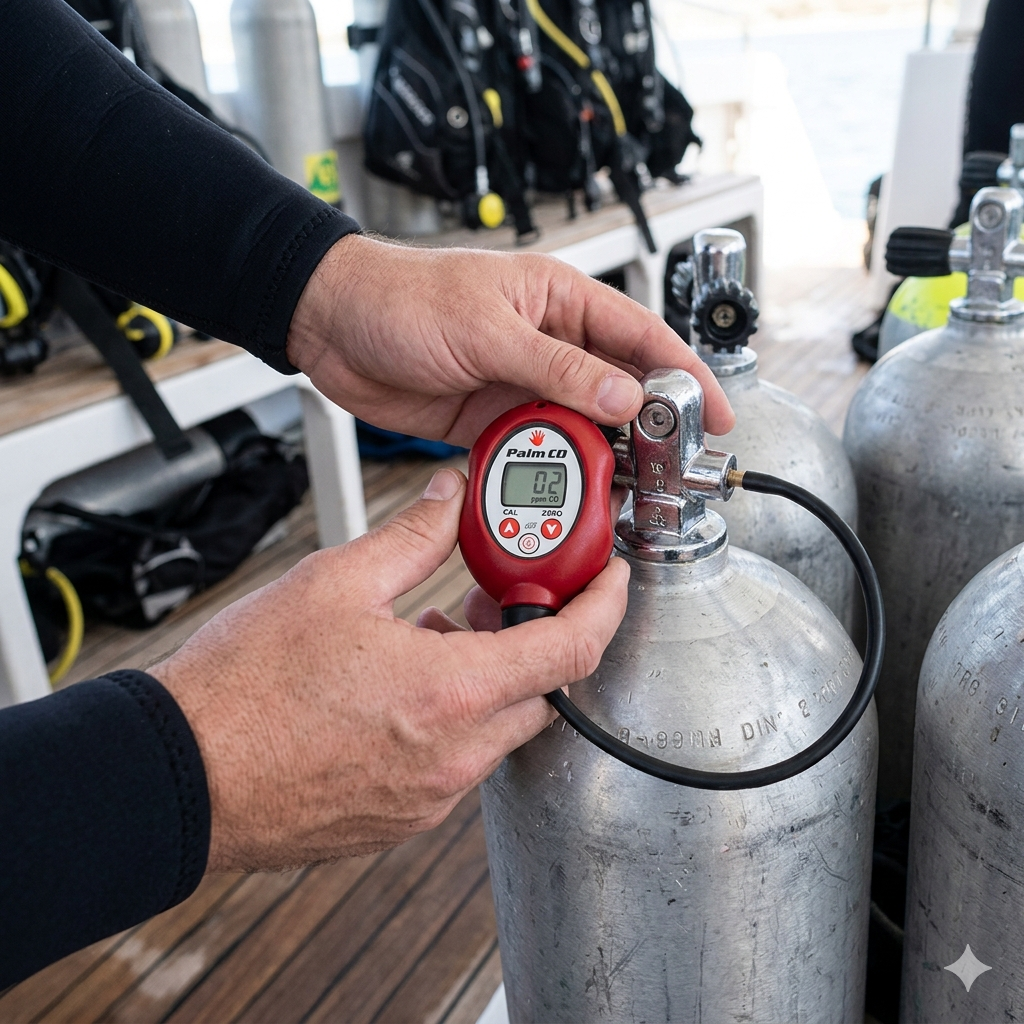
A dive-specific CO analyser (e.g. Analox, Forensics Detectors, Dräger pump units) costs less than a single guided dive day. How to use it: crack the cylinder valve and bleed a slow, steady, low flow across the sensor — flooding it at full blast gives a false low reading; too little gas under-reports. Read in ppm and let it stabilise. Any reading above EN 12021's 5 ppm limit = reject the fill (CGA Grade E allows up to 10 ppm, but treat anything over 5 ppm as a problem). Test on arrival at any unfamiliar operator and after any compressor or filter service. Calibrate per the manufacturer and respect the sensor's expiry date.
The taste test — first sensory filter, not a CO test
At the surface, take a slow breath from the second stage. Clean diving air is completely neutral — nothing beyond dryness. An oily or petroleum taste means oil carryover: abort and report. A sweet or chemical taste means contaminants: abort. CO has no taste — this test catches oil, never carbon monoxide. A clean breath is necessary, not sufficient.
Ask for the filter log and the air-quality certificate
Ask directly: "When was the carbon/hopcalite filter last changed — can I see the log? And the latest accredited air-quality test?" EN 12021 operations test at an accredited lab on a defined interval (commonly quarterly). A professional answers without hesitation and shows paper. Evasion or irritation is itself a red flag.
Inspect where the compressor breathes
Find the air intake. It must sit upwind and well clear of any combustion source — generator, vehicle, boat exhaust, kitchen vent. A compressor metres from a continuously running diesel genset contaminates every fill. A fixed inline CO monitor with audible alarm on the fill panel is the mark of a serious operation; a hot, oil-streaked, undated compressor is the opposite. If the intake is sited in exhaust, walk away regardless of price.
• Do not rely on taste, smell, or "the air looks fine" to clear a cylinder for CO.
• Do not trust a fingertip pulse oximeter to rule out CO poisoning — it cannot.
• Do not assume nitrox is safer; it comes off the same compressor and carries the same CO risk.
• Do not push through an unexplained in-water headache or sudden euphoria as "just narcosis." Signal your buddy and ascend.
• Do not stop oxygen early on a recovering casualty — rebound and delayed effects are documented.
8. Technical, Nitrox and Rebreather Notes
Higher partial pressures magnify everything. Trimix and deep nitrox push absolute pressures well past recreational limits, so the same ppm of CO produces a far higher PpCO — tech divers treat analysing every fill as non-negotiable, alongside their O₂ and helium checks. On a closed-circuit rebreather the threat is different but related: CO is not metabolised in the loop and the scrubber does not remove it, so a contaminated diluent or O₂ fill recirculates the poison breath after breath. Boosters and gas blending also concentrate whatever is in the supply. The discipline is identical across the board: test the gas, log the filters, site the intake away from combustion.
9. How ScubaProof Surfaces Air-Quality Problems Before You Book
Reading reviews by hand is too slow and inconsistent to catch compressor patterns across hundreds of operators. ScubaProof's extractive review pipeline targets the language signatures of air-quality incidents and feeds them into the Gear and Oxygen Readiness safety metrics and the overall Trust Score.
• "bad / oily taste in the regulator" · "tasted like oil"
• "got a headache after every dive" · "everyone in our group had a headache"
• "smelled exhaust / diesel" · "generator next to the compressor"
• "felt dizzy underwater" · "thought it was narcosis but it wasn't"
• Any mention of hospitalisation, hyperbaric treatment, or emergency ascent after a gas complaint
• "air tasted slightly off but the dive was fine" · "mild headache after diving"
• "old compressor, didn't look well maintained" · "couldn't say when filters were changed"
• "compressor was right next to the boat engine"
• Single uncorroborated post-dive headache reports
Air-quality signals carry extra weight in the algorithm because CO is invisible until it kills. A single credible "oily air + headache" report places a Trust Score hold on the operator until it provides a current filter-change record and an accredited air-quality certificate. Combined with the Staff Conduct and Oxygen Readiness metrics, this is how the platform flags the operations most likely to put a contaminated cylinder on your back.
A centre carrying active air-quality Red Flags with a Trust Score below 3.5 / 5.0 should be treated as an absolute contraindication. You can change a dive centre in five minutes. You cannot reverse CO poisoning at 30 metres.