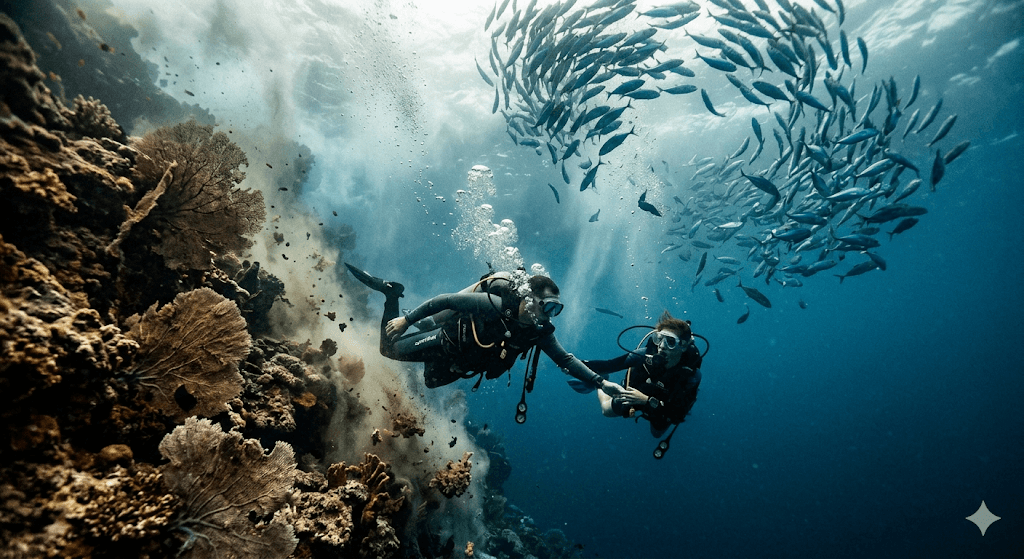
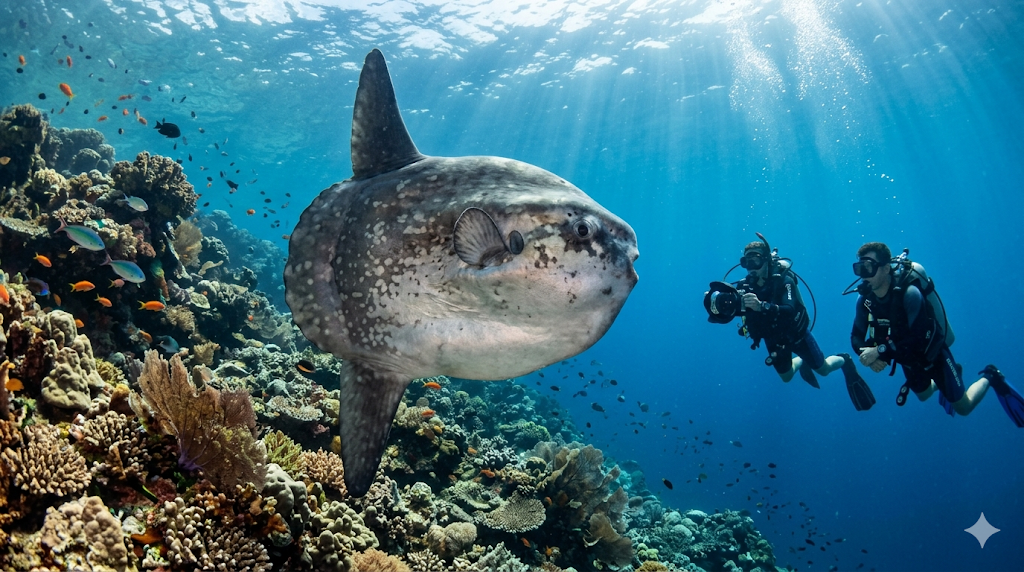
Crystal Bay, Nusa Penida, August. The water is a shade of blue that makes photographers weep — 30-metre visibility, 26°C at the surface, with the silhouette of a mola-mola the size of a wardrobe drifting past at 18 metres. This is exactly why tens of thousands of divers a year make the 45-minute speedboat crossing from Sanur.
It is also exactly why this channel has contributed to a disproportionate number of fatalities for a site that looks benign from a boat deck.
Here is the thing most briefings skip: the extraordinary clarity, the cold that lets the mola-mola rise, and the downcurrents that kill here are not three separate facts. They are the same physical event seen from three angles. Understand the water and you understand all of it. This guide gives you the physics, the survival protocol drilled to muscle memory, the gas and depth math, and a hard checklist for auditing the boat before you ever step on it.
1. Why Nusa Penida Is Both Spectacular and Dangerous
The Lombok Strait separates Bali from Lombok Island: roughly 35 kilometres of channel connecting the shallow Bali Sea to the deep Indian Ocean, which exceeds 1,300 m in the strait itself. The Wallace Line — the biogeographical boundary between Asian and Australasian fauna — runs straight through this passage. That is why Nusa Penida sees mola-mola (ocean sunfish), oceanic manta rays, and the occasional thresher shark almost never encountered around Bali proper.
The engine is cold Indian Ocean upwelling. During the southeast monsoon (roughly May–October), deep ocean water is funnelled north through the strait, creating a sharp thermocline: surface water at 26–28°C, dropping to 14–18°C at just 15–25 metres. That cold layer is nutrient-rich; it triggers a plankton bloom, the plankton brings jellyfish, and the jellyfish bring the mola-mola — the heaviest bony fish on earth — up to depths recreational divers can reach.
The same cold-water intrusion that feeds the mola-mola drives the violent density currents that have injured and killed divers at Crystal Bay for decades. You cannot have one without the other.
The number that matters: Tidal flow in the Lombok Strait during spring tides has been measured at up to 3.5 knots (about 6.5 km/h) — faster than any diver can swim in a straight line. At Crystal Bay's headland, topographic compression of that flow can locally exceed it.
2. The Physics: Tidal Hydraulics, Density Currents, and Why a BCD Lies to You
The Lombok Strait has a tidal range of roughly 2.5 metres. Twice a day, billions of litres of water must move through the strait in each direction. The bottom drops steeply and the channel narrows, so the flow accelerates — the same reason a river speeds up through a gorge. Where that moving water meets the headlands of Nusa Penida, it has nowhere to go but down, up, or sideways. The result is three named hazards.
Why inflating your BCD makes a downcurrent worse — Boyle's Law in one paragraph
Boyle's Law says gas volume is inversely proportional to pressure: descend and the air in your BCD and drysuit compresses, so your buoyancy drops exactly when you are being driven deeper. Add air to compensate and the current pushes you deeper still, compressing that new air, demanding more — a yo-yo that empties your cylinder at the worst possible depth. The wing also balloons your frontal profile into a sail for the current to grab. The lift you are adding never wins, because the column moving you is mechanical force, not buoyancy. This single piece of physics is why the correct first move in a downcurrent is sideways, not up.
Danger Window: Crystal Bay by Tidal Phase
Tidal predictions for Nusa Penida: use BMKG (Indonesian met service) or a tide app, cross-referenced with the lunar phase — spring tides fall near the full and new moon and run strongest. Any guide who does not check tides before Crystal Bay is guessing.
3. Downcurrent Survival: The Four-Step Protocol
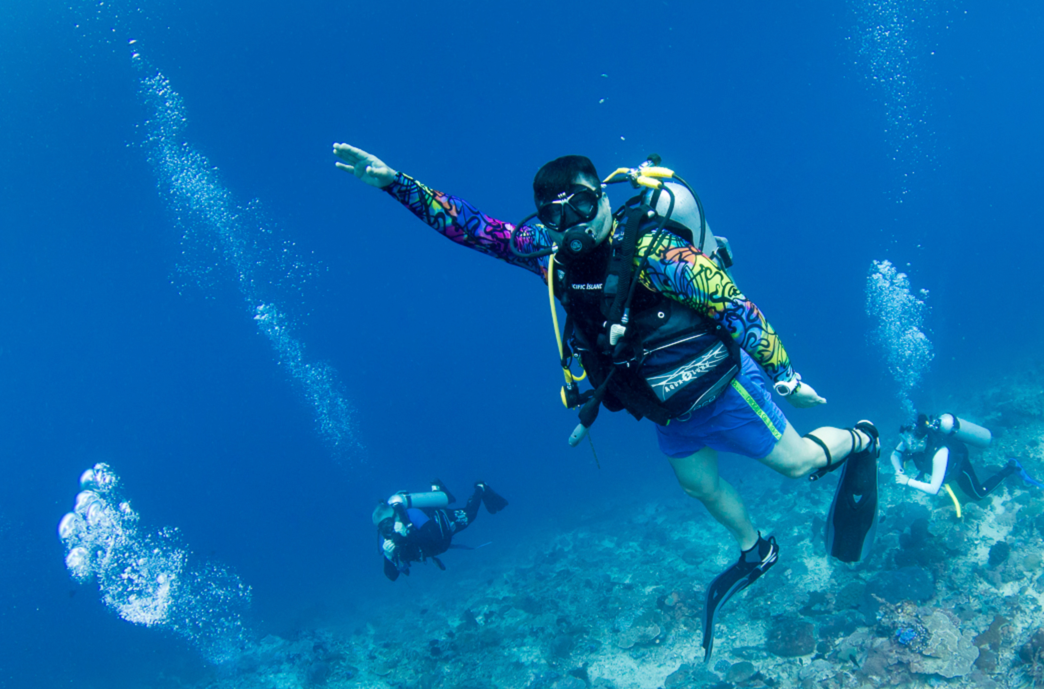
The instinct when you start sinking is to inflate the BCD. At Crystal Bay that instinct can kill you. Here is the correct sequence — rehearse it mentally on the boat before every dive, because in a real downcurrent you will not have time to reason it out.
NEVER: Dump Air Into the BCD While Still in the Column
Per Boyle's Law the air you add compresses as you go deeper, so buoyancy keeps falling and you keep adding more. You inflate into a sail, burn your gas at maximum depth and stress, and still lose. Inflate only after you have moved out of the column laterally.
NEVER: Fight the Current Straight Up
Swimming up against a 1 m/s downcurrent demands more thrust than human legs produce. You will exhaust yourself and spike your gas consumption at the deepest, most dangerous point of the dive. A tired diver at 40 metres with low gas is a fatality statistic.
STEP 1: Signal Your Buddy, Get Horizontal, Deploy Reef Hook if Within Reach
Keep your buddy in sight at all times at Crystal Bay — non-negotiable. The instant you feel unexpected negative buoyancy, lock eyes with your buddy and signal "down current" (thumb down, circling). Flatten into a horizontal trim attitude so your fins push you sideways, not into the floor. If a reef hook can reach solid structure, set it now to arrest the descent. This is exactly why reef hooks are mandatory kit here.
STEP 2: Escape Laterally — 90 Degrees to the Current, Toward the Wall
Downcurrents are columns, not sheets — they have an edge. Swim horizontally, perpendicular to the flow, toward the reef wall or rocky outcrop. Counter-intuitively, move toward the wall, not into open blue: the wall is the edge of the column and gives you a reference and a handhold. At Crystal Bay the column is typically 15–30 metres wide; crossing its boundary takes maybe 5–15 fin kicks and far less energy than fighting up.
STEP 3: Breathe Slowly, Re-Establish Buoyancy, Then Ascend on a Schedule
Out of the column, slow your breathing to vent CO₂ and break the panic loop. Check depth and remaining gas. Now add air to reach neutral buoyancy, then ascend no faster than 9–10 m/min (PADI/SSI/GUE agree on roughly this rate) with a 3-minute safety stop at 5 metres. Do not bolt for the surface — the boat crew must know your position before you reach 5 m.
LAST RESORT: Controlled Ascent If the Column Pushed You Into Deco
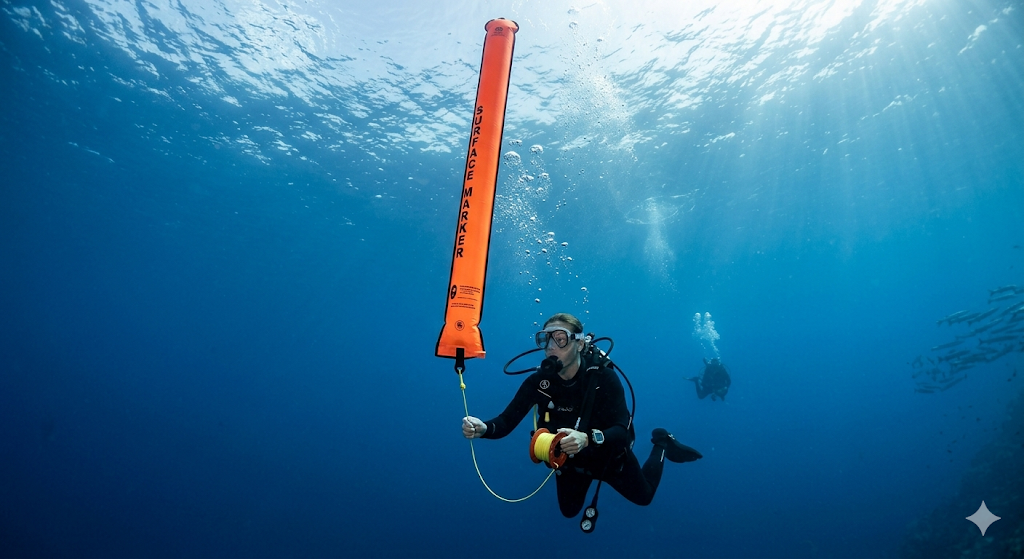
If the downcurrent dragged you past your no-decompression limit before you escaped, deploy your DSMB from depth on a reel, ascend slowly, and clear all required stops plus an extended safety stop on the gas you have. Surface as close to the DSMB line as possible. Never surface without marking your position — a Nusa Penida current can carry a diver 500 metres from the boat in 10 minutes.
4. The Math You Owe Yourself: Gas, Depth, Narcosis, and Trim
Survival protocol handles the emergency. Gas and depth planning is what keeps you out of one. These are the numbers a competent guide assumes you already understand before Crystal Bay.
Plan gas for the worst minute, not the average
Your surface air consumption (SAC) is calm-water arithmetic. A downcurrent or washing-machine workout can spike consumption two to four times baseline. Apply Boyle's and Dalton's Laws: at 30 m the ambient pressure is 4 ATA, so every breath uses four times the surface volume of gas. Hard work at 4 ATA drains an aluminium 11.1 L cylinder frighteningly fast. The discipline is the rule of thirds for the reserve at demanding sites: bank a real reserve rather than diving to the dive computer's no-stop limit and the tank's last bar.
Depth → Pressure → Gas Reality at Crystal Bay
A downcurrent's job is to push you out of the green row and into the red one before you notice. Plan the dive shallow enough that an unplanned 10 m drop is recoverable, not catastrophic.
Nitrox helps oxygen exposure, not narcosis or the current
Enriched air nitrox (e.g. EAN32) lengthens no-stop time and reduces inert-gas loading — useful when a current may force an unplanned deeper excursion. But two things people get wrong: nitrox does not reduce nitrogen narcosis meaningfully, and the higher oxygen fraction lowers your maximum operating depth (MOD). By Dalton's Law, oxygen partial pressure rises with depth; the recreational ceiling is a PO₂ of 1.4 ATA, which puts EAN32's MOD at about 33 metres. Push EAN32 to 40 m and your PO₂ hits 1.6 ATA — at the absolute oxygen-toxicity ceiling, the last thing you want when a downcurrent has just doubled your workload. Match the gas to the planned depth and dive the gas you planned.
Equalize early, and trim for the current
Crystal Bay descents are often fast and against texture, so equalize gently and continuously from the surface — never force a blocked ear, which risks middle-ear barotrauma (a pressure injury, entirely distinct from decompression sickness, which is dissolved-gas bubbles coming out of solution on ascent). A streamlined horizontal trim with a stable centre of gravity is not cosmetic here: it lets you generate horizontal thrust on demand for the lateral escape, keeps your profile small to the current, and stops you silting or crashing the reef when a surge hits.
5. What Your Bali Dive Boat Must Have
The quality of the surface operation decides whether a downcurrent becomes a frightening story or a fatality. Before you board any boat heading to Crystal Bay or Manta Point, verify the following.
Dedicated Surface Lookout (Captain plus Observer)
✓ What it looks like
One crew member whose only job during the dive is scanning the surface for bubbles and SMBs. The captain drives; the lookout watches. At a professional operation these are never the same person.
✗ Red flag
A single crew member doubling as captain and lookout, or — far too common — the whole crew below deck during the dive. Ask out loud: "Who is watching the water while we are down?"
Reef Hooks — One Per Diver
✓ What it looks like
A stainless or titanium hook on a short line clipped to the BCD, pre-rigged and reachable without fumbling. Every diver gets one — the guide's hook does not save you.
✗ Red flag
One or two hooks shared across a group of eight. An operator who takes divers to Crystal Bay without per-person reef hooks is not running a current dive — they are running a lottery.
Personal DSMB, Drift Line, and Emergency Oxygen on Deck
✓ What it looks like
Every diver carries a personal DSMB and spool. The boat trails a drift line during the dive. A working emergency O₂ kit with a demand valve and enough cylinder volume for the run back to Bali is on deck and reachable in under 30 seconds.
✗ Red flag
"DSMB? You don't need that here," or an O₂ cylinder that is empty, expired, or buried under gear. You always need a DSMB at Nusa Penida, and emergency oxygen is the single most useful first-aid tool for a suspected DCS hit on the long boat ride back.
Current Briefing Built on Tidal Data, Not Vibes
✓ What it looks like
The guide shows today's tidal chart, identifies the slack window, explains the entry point relative to the headland, assigns buddy pairs, rehearses the downcurrent protocol and lost-buddy procedure, and confirms minimum certification for the planned depth.
✗ Red flag
"Crystal Bay is fine today, I know this site." Familiarity is not data. If the guide has not checked the tide and cannot show you the slack window, walk away — there is another boat tomorrow.
Your 60-second pre-board checklist
Ask Before You Step On The Boat
□ "Who watches the surface while we dive?" — must be a named person
□ "Show me today's tide chart and the slack window."
□ "Is there a reef hook and a DSMB for me personally?"
□ "What's the planned max depth and the gas?" — confirm it suits your cert
□ "Where is the emergency oxygen and is it full?"
□ "What's the diver-to-guide ratio at Crystal Bay?" — 4:1 or better
□ "What's the lost-buddy and lost-group procedure?"
A professional guide welcomes every one of these questions. Irritation at being asked is itself a red flag.
6. Using ScubaProof to Filter Bali Dive Centers
Crystal Bay and Manta Point are not beginner sites. They demand a minimum of Advanced Open Water certification, 30+ logged dives, and prior current-diving experience. Any center willing to take a fresh Open Water diver to Crystal Bay chasing a mola-mola has already failed the safety audit before the boat leaves the dock.
ScubaProof's map view for Bali and Nusa Penida lets you filter centers not just on the overall Trust Score, but on the underlying metrics extracted from real diver reviews: Safety, Gear, Staff Conduct, and Oxygen Readiness. For current-diving sites, weight Staff Conduct (briefing discipline, ratios, surface watch), Gear (per-person reef hooks and DSMBs), and Oxygen Readiness (a working, full O₂ kit for the long ride home) above raw star averages.
• "took our Open Water group to Crystal Bay" — site is not OW-appropriate
• "no current briefing before Crystal Bay" / "guide didn't mention downcurrents"
• "no reef hooks provided" / "we weren't given DSMBs"
• "nobody was watching the boat surface during our dive"
• "no oxygen on board" / "the O₂ bottle was empty" — Oxygen Readiness failure
• Any mention of a diver being lost, separated, or requiring rescue at Nusa Penida
• "guide checked the tide briefly but didn't explain it to us"
• "we were 9 divers with one guide at Crystal Bay" — ratio too high for a current site
• "guide had one reef hook for the whole group"
• "boat crew was asleep when we surfaced"
A center's Trust Score below 3.8 / 5.0 for Nusa Penida operations should be treated as a hard no. The sites are too demanding and the consequences too severe, and there are enough quality operators in South Bali running Nusa Penida trips professionally that there is no reason to compromise.
Check the map, read the Staff Conduct and Oxygen Readiness signals, look at the Gear score. Then check the tides yourself.
Safe bubbles — and go find your mola-mola.